Son, brother, husband, friend, king, refuge — and truthful, compassionate, unshaken, master of his anger. For each quality: what it is, and exactly where in the story and in which verses Vālmīki shows it.
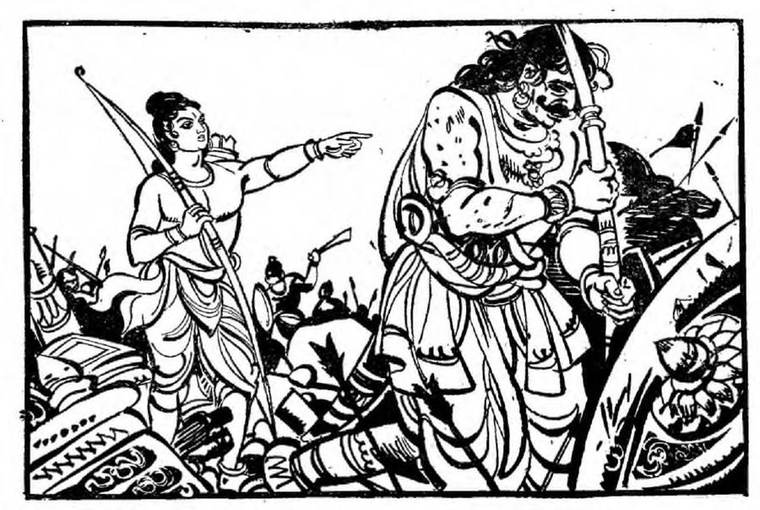
Rāma sends the disarmed Rāvaṇa home to rest
Maryādā Puruṣottama
Maryādā is the boundary — the shoreline that holds the ocean. Puruṣottama is the highest of persons. Rāma is the supreme person who, having every power
to break the rules, keeps every one of them at any cost to himself, so that the world has a standard to live by. The whole Rāmāyaṇa is the biography of this one idea.
The epic begins with sixteen questions (below). Here they are gathered into sixteen qualities, each with the exact places in the story and the verses where it is seen.
When roles conflict, he absorbs the cost himself rather than fail any duty — and where he cannot satisfy all (Vāli, the Uttara Kāṇḍa), the epic shows the conflict openly.
Bāla Kāṇḍa 1.1.2–3Vālmīki to Nārada
The question that begins the epic
को न्वस्मिन् साम्प्रतं लोके गुणवान् कश्च वीर्यवान् । धर्मज्ञश्च कृतज्ञश्च सत्यवाक्यो दृढव्रतः ॥ चारित्रेण च को युक्तः सर्वभूतेषु को हितः । विद्वान् कः कः समर्थश्च कश्चैकप्रियदर्शनः ॥
ko nv asmin sāmprataṃ loke guṇavān kaś ca vīryavān | dharmajñaś ca kṛtajñaś ca satya-vākyo dṛḍha-vrataḥ || cāritreṇa ca ko yuktaḥ sarva-bhūteṣu ko hitaḥ | vidvān kaḥ kaḥ samarthaś ca kaś caika-priya-darśanaḥ ||
Word by word
kaḥ nuwho indeed
asmin lokein this world
sāmpratamat present, now
guṇavānpossessed of virtues
kaḥ ca vīryavānand who is valorous
dharmajñaḥknower of dharma
ca kṛtajñaḥand grateful
satya-vākyaḥtruthful in speech
dṛḍha-vrataḥfirm in his vows
cāritreṇa ca yuktaḥendowed with good conduct
kaḥ sarva-bhūteṣu hitaḥwho is the well-wisher of all beings
vidvānlearned
kaḥ samarthaḥwho is capable
ca kaḥ eka-priya-darśanaḥand who is uniquely pleasing to behold
MeaningWho in this world today is virtuous and valiant, knows dharma, is grateful, truthful and firm in his vows? Who is of good conduct, the well-wisher of all beings, learned, capable, and uniquely delightful to see?
ContextThe next two verses complete the list — ātmavān (self-possessed), jita-krodhaḥ (master of anger), dyutimān (radiant), anasūyakaḥ (free of envy), and one whose anger even the gods fear in battle. These sixteen qualities are the table of contents of Rāma’s character; every kāṇḍa shows several of them under pressure.
Philosophical aspectThe epic opens with an ideal, not an event. Vedānta says we become what we contemplate; Vālmīki gives the reader a perfect human being to contemplate. Note the word sāmpratam — “now”: perfection is not a myth of the past but a possibility in every age.
The Maryādā framework — from the study companion
upodghātaḥ — the lens
Rāma as Maryādā Puruṣottama — The Framework
Read this before the kāṇḍas · the epic's own definition of its hero
Maryādā means a boundary, a limit, the line that must not be crossed — the shoreline that holds the ocean. Puruṣottama is the highest among persons. Maryādā Puruṣottama therefore names a very specific kind of greatness: not the greatness that transcends limits (that is Kṛṣṇa, the līlā-puruṣottama) but the greatness that submits to limits perfectly — the supreme person who, having every power to break the rules, keeps every one of them, at any personal cost, so that the world has a standard to live by. The whole Rāmāyaṇa is the biography of this single idea.
❖ Golden boxes moments that define Rāma as Maryādā Puruṣottama
Green boxes where Kamban’s Tamil Rāmāyaṇam tells it differently
Verse cards ślokas worth memorising
The Sixteen Guṇas — Nārada's PortraitBāla Kāṇḍa, sarga 1❖ MaryādāVerse
The epic opens with Vālmīki asking Nārada whether a man of sixteen specific qualities exists in the world now — not in myth, not in heaven. Nārada answers: yes, and his name is Rāma. These sixteen are the epic's table of contents for its hero; every kāṇḍa demonstrates several of them under pressure.
Bāla Kāṇḍa 1.2–3 — the founding question
को न्वस्मिन् साम्प्रतं लोके गुणवान् कश्च वीर्यवान् । धर्मज्ञश्च कृतज्ञश्च सत्यवाक्यो दृढव्रतः ॥ चारित्रेण च को युक्तः सर्वभूतेषु को हितः । विद्वान् कः कः समर्थश्च कश्चैकप्रियदर्शनः ॥
ko nv asmin sāmprataṁ loke guṇavān kaś ca vīryavān | dharmajñaś ca kṛtajñaś ca satyavākyo dṛḍhavrataḥ || cāritreṇa ca ko yuktaḥ sarva-bhūteṣu ko hitaḥ | vidvān kaḥ kaḥ samarthaś ca kaś caika-priya-darśanaḥ ||
kaḥ nu asmin sāmpratam loke — who, indeed, in this world right now
guṇavān — is possessed of virtue
vīryavān — possessed of valour
dharmajñaḥ — a knower of dharma
kṛtajñaḥ — grateful, mindful of what is done for him
satyavākyaḥ — true of speech
dṛḍhavrataḥ — firm in vows
cāritreṇa yuktaḥ — endowed with good conduct
sarva-bhūteṣu hitaḥ — a well-wisher of all beings
vidvān — learned
samarthaḥ — capable in all things
eka-priya-darśanaḥ — uniquely pleasing to behold
The verses that follow complete the sixteen: ātmavān (self-possessed), jita-krodhaḥ (having conquered anger), dyutimān (radiant), anasūyakaḥ (free of envy), and finally kasya bibhyati devāś ca jāta-roṣasya saṁyuge — one whose battle-wrath even the gods fear. Note the architecture: fourteen qualities of restraint and goodness, crowned by one of terrifying power. The maryādā ideal is not gentleness for lack of strength; it is infinite strength that has chosen the fence.
guṇavānvirtuous — the sum announced first
vīryavānvalorous — tested at Tāṭakā, Khara, Rāvaṇa
dharmajñaḥknower of dharma — the Jābāli & Vāli debates
kṛtajñaḥgrateful — Guha, Jaṭāyu, Śabarī, Hanumān
satyavākyaḥtrue of speech — the exile itself
dṛḍhavrataḥfirm in vows — fourteen years to the day
cāritravānof clean conduct — even enemies attest it
sarvabhūtahitaḥwell-wisher of all — spares spies, mourns foes
vidvānlearned — scripture, statecraft, astras
samarthaḥcapable — never fails a task undertaken
priyadarśanaḥbeautiful to all — citizens cannot look away
ātmavānself-possessed — the calm at the exile news
jitakrodhaḥanger conquered — wrath only ever on leash
bibhyati devāḥwhose roused wrath gods fear — the ocean learns this
His Identities — One Man, Every Relationship PerfectedThe whole epic as a table of roles❖ MaryādāPhilosophy
The tradition's claim is not that Rāma was a great king who happened to have a family, but that he is the perfection of every role a human being can occupy — and that when the roles conflicted, he absorbed the cost himself rather than shortchange any duty. Use this table as a running index while reading: each row is demonstrated in specific, findable scenes.
As son
Accepts fourteen years of exile to keep a promise his father cannot even bring himself to speak; refuses Bharata's plea because returning would falsify Daśaratha's word posthumously; performs Jaṭāyu's cremation with a son's hands when denied his own father's.
As brother
To Lakṣmaṇa: the grief-mad lament of Yuddha 101 — "wives may be found in every land, but not a womb-brother." To Bharata: hands over the kingdom's symbols without a flicker of suspicion, twice. To Śatrughna: entrusts what he cannot oversee. And extends brotherhood outward — Guha, Sugrīva, Vibhīṣaṇa each adopted as brother.
As husband
Eka-patnī-vrata — the vow of one wife, unusual for an ancient king and kept absolutely; wages the war of an age for her; and yet, as king, subordinates even this bond to public duty — the epic's deepest wound and its most debated maryādā.
As friend
Sugrīva's cause taken up before his own; the vow to Sugrīva discharged at the price of the Vāli controversy; Hanumān repaid with an embrace Rāma names as his entire wealth.
As enemy
Sends the defeated, disarmed Rāvaṇa home to rest and return; releases captured spies with courtesy; forbids rejoicing at Rāvaṇa's death — "hostility ends with death; he is now mine as much as yours."
As king
Rāma-rājya: the ruler as the standard others copy (yad yad ācarati śreṣṭhaḥ — the Gītā's principle lived a yuga earlier); accepts that a king's private life is public property; the paduka interregnum honoured to the day.
As disciple
Obeys Viśvāmitra against his own scruple at Tāṭakā; receives Agastya's weapons and Vasiṣṭha's counsel with the same bowed head after conquering the three worlds' conqueror.
As refuge
Śaraṇāgata-vatsala — the vow of Yuddha 18.33: refuge asked once is protection granted forever, "even if it is Rāvaṇa himself."
His Principles — the Vows That Never BreakThe code, with its charter verses❖ MaryādāVerseDharma
Tradition compresses Rāma's code into a set of famous "singles" — one word, one arrow, one wife — plus the master-principles of satya and abhaya. Watch for each of these operating in the kāṇḍas below; the golden ❖ markers point them out in place.
1 · Eka-vacana — the word given once is final
Announced by Rāma himself to Kaikeyī, before he even knows what she will ask — the promise precedes its content, which is the whole point.
tad brūhi vacanaṁ devi rājño yad abhikāṅkṣitam | kariṣye pratijāne ca rāmo dvir nābhibhāṣate ||
tat brūhi vacanam devi — so speak the word, O queen
rājñaḥ yat abhikāṅkṣitam — whatever the king desires
kariṣye — I shall do it
pratijāne ca — and I promise it now
rāmaḥ — Rāma
dviḥ na abhibhāṣate — does not speak twice
Spoken with the preceding verse still in the air — "at the king's word I would leap into fire, drink sharp poison, fall into the sea." Rāma signs a blank contract because the signature, not the terms, is what a son owes. Rāmo dvir nābhibhāṣate became proverbial for irrevocable speech; the parallel formula dviḥ śaraṁ nābhisandhatte — he never notches an arrow twice — extends it to action: no second attempts because the first is total.
2 · Eka-patnī-vrata — one wife, absolutely
No ancient Indian king-hero shares this vow. Its narrative proof: offered the widowed Mandodarī's Laṅkā, surrounded by decades of royal precedent for polygamy, Rāma's fidelity is never even tested as a temptation — Vālmīki treats it as constitutional. Its costliest proof: in the Uttara, rather than remarry for the aśvamedha (which ritually requires a wife), Rāma has a golden image of Sītā made to sit beside him. The vow outlasts the marriage.
3 · Satya above everything, including happiness
The charter is the Jābāli reply (2.109, verse card in Ayodhyā below): truth is the root of all things; there is no station above it. Rāma's operating rule follows: any conflict between satya and sukha is decided for satya before deliberation begins. This is why he can hear the exile calmly — the decision procedure has no variables left.
4 · Śaraṇāgata-rakṣā — the surrendered are protected, unconditionally
The vow of Yuddha 18.33 (verse card below): refuge sought once with "I am yours" binds Rāma totally — extended in the same breath to Rāvaṇa himself, hypothetically, and honoured toward spies, deserters and enemies throughout.
5 · Strength on a leash — jita-krodha, not a-krodha
Rāma is not anger-free; he is anger-mastered. Three times the leash shows: the cosmic rage after Sītā's abduction (calmed by Lakṣmaṇa), the three days of scorned prayer to the ocean (ended by the bow that terrifies creation — then instantly sheathed when the ocean submits), and the battle-wrath "even gods fear." The maryādā ideal needs the fury to be real; a fence around nothing protects nothing.
6 · The ruler is the copybook — conduct as public property
Rāma to Bharata and again in the Uttara: whatever the best man does, the people do after him. Hence his hardest principle — a king's private exoneration (he knows Sītā is pure; Agni has testified) does not discharge his public one (the people must never learn cynicism from the throne). Whether the Uttara's application of this was right is the tradition's longest argument; that it was his principle, consistently held from Ayodhyā onward, is not in doubt.
Reading key
Wherever a golden box like this appears in the kāṇḍas below, one of these six principles is operating on screen. Collect them as you read: by Yuddha Kāṇḍa you will find the "plot" is simply these vows colliding with circumstances engineered to make each one maximally expensive.
Truthfulness — the word given once satya-vāk · satya-sandha
He never says a thing twice and never takes it back.
Nārada’s third question is satya-vākyaḥ. Rāma’s whole exile rests on it: a father’s word must not become a lie through the son. He keeps promises to Kaikeyī, to the sages, to Sugrīva, to Vibhīṣaṇa — and, at the very end, to Time itself, at the cost of Lakṣmaṇa.
Dharma is not a rule he follows but the way he is.
His enemy Mārīca gives the definition: “Rāma is dharma with a body.” In every crisis he asks not what he wants, or even what is fair to him, but what is right for everyone concerned — and accepts the cost himself.
Where exactly it shows
BālaThe Birth of the Poem — Nārada’s answer names Rāma as the living answer to Vālmīki’s sixteen questions — the epic’s own thesis (1.1.2–19).
Yuddha 6.109.25 — Maraṇāntāni vairāṇi — enmity ends with death
The son pitṛ-vākya-paripālaka
Keeps his father’s word as if it were his own.
He accepts exile before he is told the details, will not let his father’s promise be broken even after his death, honours Kaikeyī, and performs for Jaṭāyu the rites he could not perform for Daśaratha.
AyodhyāThree Who Would Not Let Him Go — He consoles Kausalyā and asks her to care for his father — the son who comforts the parent who cannot accept his sacrifice.
One wife, absolutely — and a war of the worlds for her.
Unusual for a king of his time, he takes one wife and never another, even after sending her away. He thanks Sītā for her criticism, grieves for her like any lover, and yet — the epic’s deepest wound — subordinates even this bond to his duty as king.
Guha the hunter, Jaṭāyu the vulture, Sugrīva the monkey, Vibhīṣaṇa the rākṣasa: Rāma’s friends come from every margin, and each friendship is a vow he keeps — even when it costs him his reputation, as with Vāli.
Rule as service; the ruler’s conduct is the people’s example.
The citizens choose him for his gentleness; his first question to Bharata is about governance; Rāma-rājya is the reign of security and dharma — and for the people’s sake he gives up even Sītā. “As the king, so the people.”
YuddhaThe Fire and the Revelation — He subjects his own heart to the people’s scrutiny — the beginning of the tension that will break in the Uttara Kāṇḍa.
“To anyone who says ‘I am yours’ even once, I give fearlessness.”
The sages, Sugrīva, Vibhīṣaṇa, even the crow that wronged Sītā — whoever comes to him is protected. His vow of refuge (6.18.33) is the spiritual summit of the epic.
He spares Mārīca as a boy, sends the disarmed Rāvaṇa home to rest, releases enemy spies, honours Rāvaṇa’s funeral (“enmity ends with death”), and slips away from Ayodhyā’s citizens so that they will not suffer.
Yuddha 6.109.25 — Maraṇāntāni vairāṇi — enmity ends with death
Equanimity ātmavān · sthita-prajña
The same face on the morning of the crown and of the exile.
Nārada calls him ātmavān, self-possessed. The loss of the kingdom leaves “no change in his mind”; he teaches Bharata the impermanence of all things. His peace does not depend on circumstances.
Where exactly it shows
BālaThe Birth of the Poem — Among the sixteen: ātmavān, self-possessed, and jita-krodhaḥ, one who has conquered anger.
He does not answer harsh words, will not blame Kaikeyī, bears Paraśurāma’s insults. Yet when anger is needed — at the ocean, at Sītā’s loss — it is terrifying, and he lays it down the moment it has done its work. The ideal is not the absence of anger but its mastery.
Where exactly it shows
BālaParaśurāma Humbled — Provoked and insulted before his father, he remains courteous (1.76.1–5).
Humility — the man who would not be God vinaya · “ātmānaṃ mānuṣaṃ manye”
He bows to elders, sages and the fallen, and calls himself only a man.
He touches Ahalyā’s feet, sits before Śabarī as a student, waits for his guru’s word to lift the bow, and answers the gods: “I think of myself as a man, Rāma, son of Daśaratha.”
Where exactly it shows
BālaAyodhyā, the Sacrifice and the Birth of Rāma — Viṣṇu chooses the most limited form — a mortal, born of a womb, subject to grief — because only a human can kill Rāvaṇa and only a human can be an example.
BālaAhalyā Set Free — The prince bows to her as a younger person to an elder.
Strength without equal — always in the service of others.
Tāṭakā, Subāhu, the fourteen thousand of Janasthāna, the seven sāla trees, Vāli, Kumbhakarṇa, Rāvaṇa. “Kṣatriyas carry the bow so that no cry of the distressed is heard.”
He follows Viśvāmitra without question, listens to every story on the road, receives the weapons of Agastya and, in the middle of the final battle, the Āditya-hṛdaya.
Where exactly it shows
BālaViśvāmitra Comes for Rāma — Rāma goes without a word of protest, walking behind the sage — the first picture of him as śiṣya.
Vālmīki highlighted one facet of Rāma’s personality to absolute perfection and could not do equal justice to the others — which is why some critics see apparent inconsistencies in his character. The perfect son abandoned his old father; the perfect king sent Sītā away at one dissenting voice — the greatest sacrifice — though he had shown superhuman powers to win her back; the perfect friend shot Vāli from hiding, because one cannot face lust head-on. And the perfect human carried his weapons at all times: aggressive goodness — inequity will always be there in the world; have the strength and conviction to fight it at all times.
Verses follow the Gita Press (southern) numbering, checked against valmikiramayan.net; other editions may differ by a few verses,
and the critical edition omits some popular verses (marked). Stories are retold in brief from Vālmīki, with C. Rajagopalachari and Kamala Subramaniam
for further reading; later additions (Tulasīdāsa, Kamban, folk tradition) are marked as such. The symbolic readings are offered for reflection —
one way among several of hearing the story. Drawings: Vipin K. Das, from Children’s Illustrated Ramayanam, retold by Vishnu B (2011).
Online Classes
Know More About Classes
Fill in your details and we’ll reach out with class schedule, fees, and more.
✓
Thank you!
We’ve received your enquiry and will get back to you within 24 hours.