Research › Yoga Vāsiṣṭha
योगवासिष्ठम्
The Yoga Vāsiṣṭha
Vasiṣṭha’s teaching to Rāma — the “Mahā-Rāmāyaṇa”. Six books, from dispassion to liberation: each topic and story summarised, 121 key verses opened word by word with their philosophy, tagged by concept and quality, and linked to the Rāmāyaṇa.
What the Yoga Vāsiṣṭha is
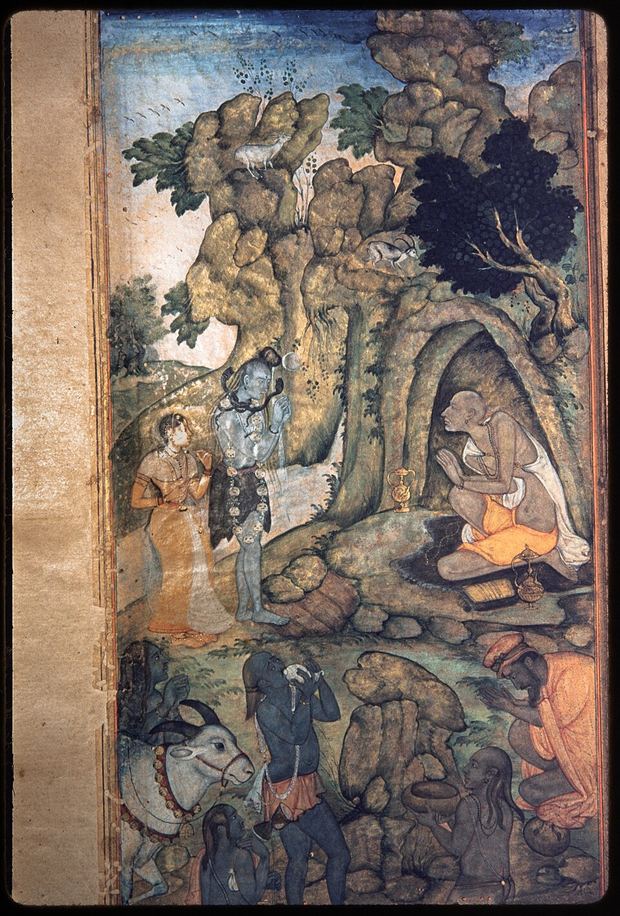
Thirty-two thousand verses in six books (prakaraṇas), traditionally ascribed to Vālmīki and also called the Mahā-Rāmāyaṇa, Ārṣa Rāmāyaṇa or Mokṣopāya — “the means to liberation”. Its frame: the young Rāma, back from a pilgrimage, has lost all interest in life. Viśvāmitra arrives to ask for him; Rāma explains his despair before the court; and the family guru Vasiṣṭha teaches him, over many days, until he is free — and then sends him back to his duty.
Its method is the story. Again and again a vivid tale — Līlā, Karkaṭī, the sons of Indu, Janaka, Cūḍālā, Bhuśuṇḍa, the world within a rock — shows that the world is an appearance in consciousness, made by the mind, and that the mind can be stilled by effort, enquiry and understanding.
How to study it
- Begin with the Saara Sangrah (below): 86 verses that carry the whole teaching, in order.
- Then read the parts in order. Open each topic: the story and teaching are summarised, and the verses of those sargas sit inside, word by word.
- Learn a verse a week on All verses with Practise on.
- Follow a thread — a concept or a quality — through the indexes below.
- Read it beside the Rāmāyaṇa. The epic shows how Rāma lived; this book shows the understanding he lived from.
The six books
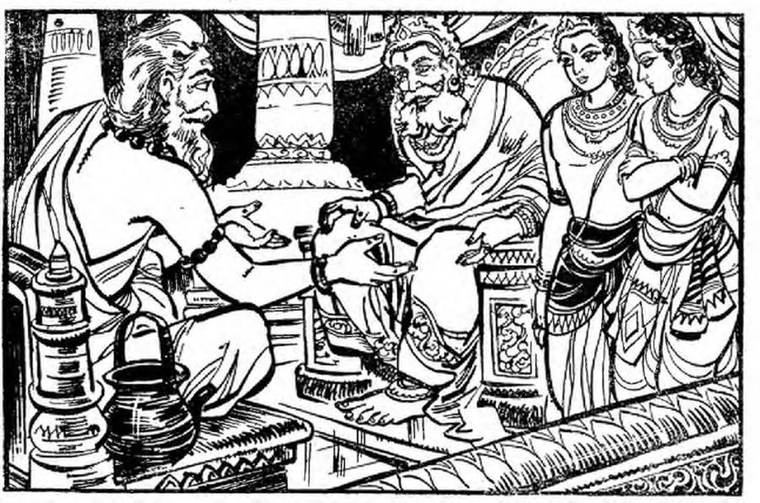 IPart I · VairāgyaOn Dispassion — वैराग्यप्रकरणम्Chapters I:1 – I:33 (1,500 of the scripture's 32,000 couplets). Vālmīki's frame narrative, and Rāma's discourse of dispassion before the assembled court of Ayodhyā — the opening gate of the entire scripture.11 topics · 15 verses with word meanings
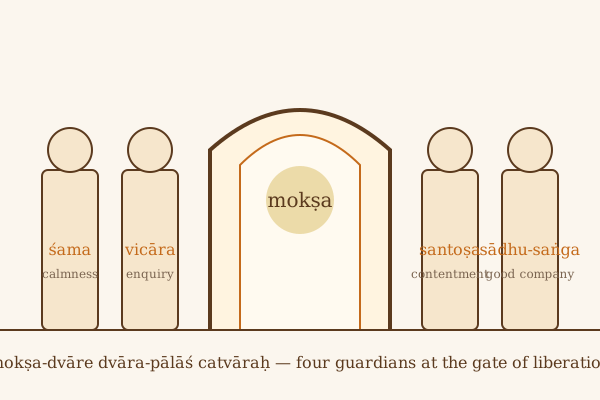 IIPart II · MumukṣuOn the Seeker — मुमुक्षुव्यवहारप्रकरणम्Chapters II:1 – II:20 (1,000 of the scripture's 32,000 couplets). Vasiṣṭha begins his reply to Rāma — first confirming, through the story of Śuka, why even self-acquired wisdom needs a teacher's seal; then laying the ground rules of the entire teaching: self-effort, the four gatekeepers of liberation, and the right use of the scripture itself.8 topics · 12 verses with word meanings
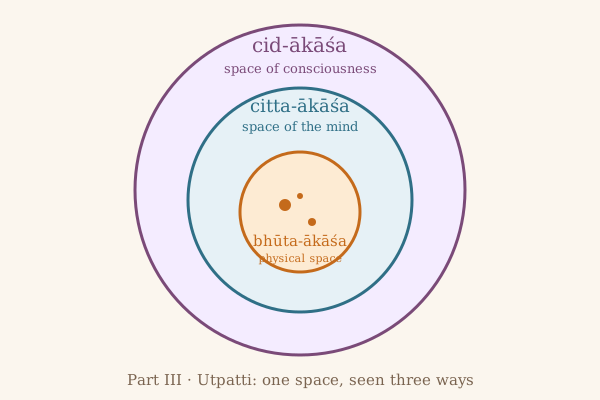 IIIPart III · UtpattiOn Creation — उत्पत्तिप्रकरणम्Chapters III:1 – III:122, the largest of the six sections (7,000 of the scripture's 32,000 couplets). Vasiṣṭha answers "how does the universe that was never truly created appear to be?" — almost entirely through story: Līlā, Karkaṭī, the ten sons of Indu, the Great Forest, the three non-existent princes, and King Lavaṇa.11 topics · 37 verses with word meanings
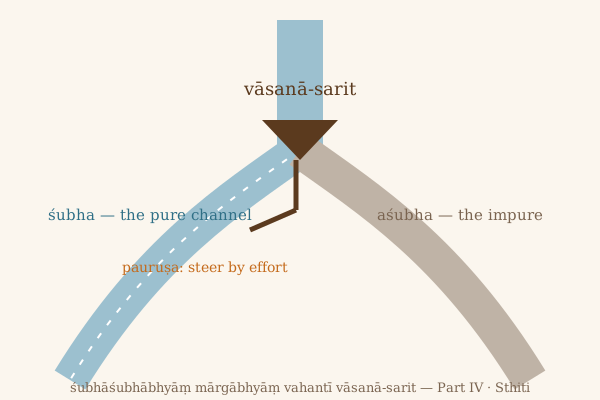 IVPart IV · SthitiOn Existence — स्थितिप्रकरणम्Chapters IV:1 – IV:62 (3,000 of the scripture's 32,000 couplets). Having argued in Part Three that the world was never truly created, Vasiṣṭha now turns to the companion question: given that it nonetheless appears to persist, what is it that actually sustains this appearance of existence?7 topics · 5 verses with word meanings
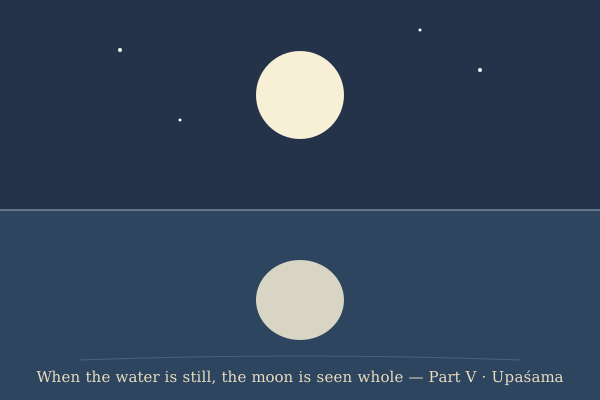 VPart V · UpaśamaOn Dissolution — उपशमप्रकरणम्Chapters V:1 – V:93 (5,000 of the scripture's 32,000 couplets). Utpatti dismantled creation's reality; Sthiti examined what sustains its appearance; now Upaśama turns to the winding-down itself — a long gallery of kings and sages (Janaka, Bali, Prahlāda, Suraghu) who each, differently, dissolve the mental conditioning that makes the world seem to press in on them, mostly without ever leaving their thrones.11 topics · 8 verses with word meanings
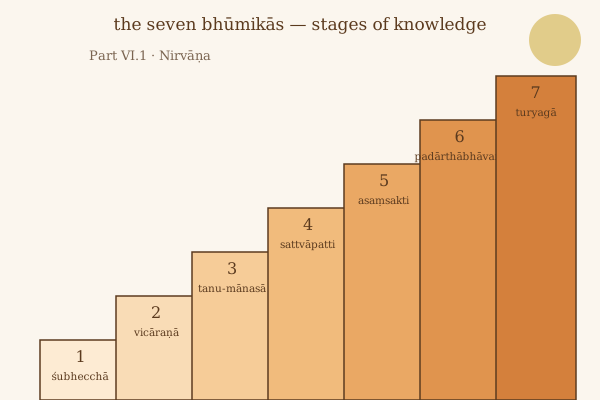 VI.1Part VI.1 · Nirvāṇa IOn Liberation — I — निर्वाणप्रकरणम् (पूर्वार्धम्)Chapters VI.1:1 – VI.1:127. Nirvāṇa is the largest of all six sections (14,500 of 32,000 couplets) and the text itself divides it into two halves — Pūrvārdha and Uttarārdha — exactly where this guide splits too. This first half opens with Vasiṣṭha's summary instruction to Rāma, then moves into some of the scripture's most celebrated individual episodes: Bhūśuṇḍa the deathless crow, a prophecy of the Bhagavad Gītā, and the tale of the Hundred Rudras.10 topics · 32 verses with word meanings
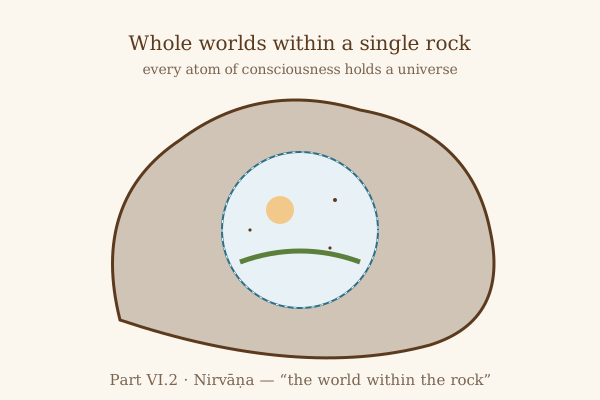 VI.2Part VI.2 · Nirvāṇa IIOn Liberation — II — निर्वाणप्रकरणम् (उत्तरार्धम्)Chapters VI.2:1 – VI.2:~215, closing the entire scripture. This second half of Nirvāṇa contains some of the Yogavāsiṣṭha's most cosmologically extravagant visions — the World Within the Rock, the Sage from Outer Space — before the narrative frame closes on itself entirely with Kundadanta, and the whole six-part teaching ends with Rāma's own declaration of realization.8 topics · 12 verses with word meanings
The Saara Sangrah — the teaching in its own order
Swami Tejomayananda’s selection, studied in the Chinmaya Vedānta course: Rāma’s yearning → preparatory teaching → knowledge of the Self → the jīvanmukta → the seven stages → obstacles → from disciple to avatāra. Each links to its card, with word meanings.
- 1.1 Salutation to the Truth that is the Self I · 1.1
- 1.2 Who is fit to study this scripture I · 2.3
- 1.3 How did Rāma live in the world? I · 2.20
- 1.4 Liberation while living — the promise of the book I · 3.16
- 1.5 Born to die, dying to be born I · 12.7
- 1.6 “Who am I? What is all this?” I · 12.15
- 1.7 Joylessness, like a traveller in the desert I · 12.16
- 1.9–10 Rāma’s fast of the spirit I · 31.20
- 1.9–10 Until I find that rest I · 31.21
- 2.1 “You already know — only confirm it” II · 1.2
- 2.2 Liberation and bondage defined II · 2.5
- 2.3 Everything is attained by effort II · 4.8
- 2.4–6 The river of vāsanās II · 9.30
- 2.7 Even good tendencies are finally let go II · 9.42
- 2.8 The four gatekeepers of liberation II · 11.59
- 3.1 First understand bondage III · 1.21
- 3.2 Bondage is the reality given to the seen III · 1.22
- 3.3 “World, you, I” — the false seen III · 1.23
- 3.4 The seen is like a dream in deep sleep III · 1.10
- 3.5 What remains — still and deep III · 9.47
- 3.6 Many names for the one Essence III · 1.12
- 3.7 How the Self seems to become a jīva III · 1.13
- 3.8 The world is a magic show of the mind III · 1.19
- 3.9 The many names of illusion III · 1.20
- 3.10 Gold and the bracelet III · 1.17
- 3.11 The seed and the sprout III · 3.39
- 3.14 The knots of the heart are cut III · 7.10
- 4.1 Liberation while living, and after the body III · 9.2
- 4.2 His face does not change in joy or sorrow III · 9.6
- 4.3 Awake as if in deep sleep III · 9.7
- 4.4 Acting with feelings, untouched like space III · 9.8
- 4.5 Busy outside, space-like within III · 9.4
- 4.6 No one fears him; he fears no one III · 9.11
- 4.7 As the wind becomes still III · 9.14
- 4.8 Fuller than the full III · 9.49
- 5.1 Stage 1 · Śubhecchā — the good wish III · 118.8
- 5.2 Stage 2 · Vicāraṇā — reflection III · 118.9
- 5.3 Stage 3 · Tanu-mānasā — the thinning of the mind III · 118.10
- 5.4 Stage 4 · Sattvāpatti — abiding in pure being III · 118.11
- 5.5 Stage 5 · Asaṃsakti — non-attachment III · 118.12
- 5.6–7 Stage 6 · Padārthābhāvanī — objects fade (i) III · 118.13
- 5.6–7 Stage 6 · Padārthābhāvanī — objects fade (ii) III · 118.14
- 5.8 Stage 7 · Turyagā — abiding in the fourth III · 118.15
- 5.9 Those who reached the seventh stage III · 118.17
- 5.10 The fourth and beyond the fourth III · 118.16
- 6.1 Rāma asks: what of those who never met a sage? VI.1 · 126.43
- 6.2 By chance, after many births VI.1 · 126.45
- 6.4 Each stage burns past karma VI.1 · 126.48
- 6.5 Reborn in a pure and prosperous home VI.1 · 126.50
- 6.6 The first three stages are “waking” VI.1 · 126.52
- 6.7 The wild she-elephant of desire (i) VI.1 · 126.74
- 6.7 The wild she-elephant of desire (ii) VI.1 · 126.75
- 6.10 What “imagination” means VI.1 · 126.91
- 6.11 “I cry with arms raised — no one listens” VI.1 · 126.94
- 6.12 In silence the supreme state is reached VI.2 · 1.14
- 6.13 Ideation is bondage; its absence, freedom VI.1 · 126.97
- 6.14 Established in yoga, act — or do not VI.1 · 126.99
- 6.15 True renunciation — dwelling on the One VI.1 · 126.11
- 7.1–2 Rāma awakens VI.1 · 127.4
- 7.5 Not before, not after, not now — a dream VI.1 · 127.19
- 7.6 From form to the formless VI.1 · 127.35
- 7.8 Why did the realised Rāma go back to work? VI.1 · 128.57
- 7.9 “This is not the time to rest — bring joy to the world” VI.1 · 128.96
- 7.10 Samādhi is pure only when the world is included VI.1 · 128.97
- 7.11 Rule, knowing all is passing — and be happy VI.1 · 128.98
- 7.12–14 Rāma accepts the guru’s word VI.1 · 128.102
- 7.16–17 Nothing higher than Self-knowledge — and its knower VI.1 · 128.105
- 7.18 “Follow this path, Bharadvāja, and be happy” VI.1 · 128.109
- 7.19 Even a child who hears this awakens VI.2 · 215.6
- 7.21 Salutation to Brahman — the closing verse VI.2 · 216.25
Verses by kind
Qualities it teaches
Index of concepts
Every concept the verses explain, A–Z. Open one to see its verses.
Action without doership 8 verses
VI.1 · 115.1 Be a great doer, a great enjoyer, a great renouncer
VI.1 · 126.11 True renunciation — dwelling on the One
VI.1 · 126.99 Established in yoga, act — or do not
VI.1 · 128.57 Why did the realised Rāma go back to work?
VI.1 · 128.96 “This is not the time to rest — bring joy to the world”
VI.1 · 128.98 Rule, knowing all is passing — and be happy
VI.2 · 213.50 Vasiṣṭha’s last word: rule with dharma, free of craving
Appearance of the world 7 verses
I · 12.11 Deer chasing a mirage
III · 1.10 The seen is like a dream in deep sleep
III · 1.17 Gold and the bracelet
IV · 45.14 In truth nothing is born or dies
VI.2 · 10.6 No cause, so no world was ever born
VI.2 · 216.25 Salutation to Brahman — the closing verse
Avidyā — ignorance 1 verse
Beyond good and bad 1 verse
Bondage and liberation 8 verses
I · 3.16 Liberation while living — the promise of the book
II · 2.5 Liberation and bondage defined
III · 1.21 First understand bondage
III · 1.22 Bondage is the reality given to the seen
III · 96.59 Bound mind, bound person; free mind, free
III · 114.23 “I am not Brahman” binds; “all is Brahman” frees
VI.1 · 126.97 Ideation is bondage; its absence, freedom
Brahman 8 verses
III · 1.12 Many names for the one Essence
III · 1.17 Gold and the bracelet
III · 9.47 What remains — still and deep
III · 9.49 Fuller than the full
III · 114.23 “I am not Brahman” binds; “all is Brahman” frees
V · 53.24 “All is Brahman — this I contemplate”
VI.2 · 216.25 Salutation to Brahman — the closing verse
Company (saṅga) 1 verse
Consciousness 2 verses
Contemplation (bhāvanā) 2 verses
Creation as ideation (saṅkalpa) 1 verse
Cūḍālā and Śikhidhvaja 1 verse
Desire (tṛṣṇā) 6 verses
I · 15.3 Ego is the root of every sorrow
I · 15.12 The cloud of ego and the flower of craving
VI.1 · 126.74 The wild she-elephant of desire (i)
VI.1 · 126.75 The wild she-elephant of desire (ii)
VI.1 · 126.91 What “imagination” means
Devotion and knowledge 1 verse
Ego (ahaṅkāra) 4 verses
I · 15.8 “I am not Rāma”
I · 15.12 The cloud of ego and the flower of craving
III · 1.23 “World, you, I” — the false seen
Ending the mind 3 verses
V · 13.35 Cut the mind with the mind, like a tree with an axe
V · 78.8 Two ways to end the mind: yoga and knowledge
Freedom and duty 2 verses
VI.2 · 213.50 Vasiṣṭha’s last word: rule with dharma, free of craving
Fullness (pūrṇatā) 1 verse
God as consciousness 3 verses
VI.1 · 29.119 Not Brahmā, not Indra, not sun or moon
VI.1 · 29.120 Not body, not mind — God is consciousness
Grace and time 3 verses
VI.1 · 126.45 By chance, after many births
VI.1 · 127.4 Rāma awakens
How dispassion arises 1 verse
Imagination (saṅkalpa, kalpanā) 3 verses
VI.1 · 126.94 “I cry with arms raised — no one listens”
VI.1 · 126.97 Ideation is bondage; its absence, freedom
Impermanence 2 verses
Inner coolness (śītalatā) 1 verse
Intense longing 1 verse
Janaka 3 verses
Jīva — the individual 1 verse
Jīvanmukti 8 verses
III · 9.2 Liberation while living, and after the body
III · 9.4 Busy outside, space-like within
III · 9.6 His face does not change in joy or sorrow
III · 9.7 Awake as if in deep sleep
III · 9.8 Acting with feelings, untouched like space
III · 9.11 No one fears him; he fears no one
VI.2 · 125.37 Weeping or laughing, untouched within
Karma 4 verses
III · 7.10 The knots of the heart are cut
VI.1 · 126.45 By chance, after many births
VI.1 · 126.48 Each stage burns past karma
Knowledge and peace 1 verse
Liberation (mokṣa) 1 verse
Līlā 2 verses
Living wisely in the world 1 verse
Māyā 2 verses
Mind (manas, citta) 5 verses
III · 96.59 Bound mind, bound person; free mind, free
III · 112.21 Cut the mind with the mind
V · 56.33 Cool within, the world is cool
V · 78.14 Breath moves, mind moves
Names and the nameless 1 verse
Non-origination (ajāti) 3 verses
VI.1 · 113.19 Brahman alone appears as the world
VI.2 · 10.6 No cause, so no world was ever born
Oneness (advaita) 3 verses
IV · 58.5 Kaca’s song — what shall I do, where shall I go?
VI.2 · 82.26 Neither ocean nor wave — only peace
Peace (śānti) 1 verse
Prāṇa and mind 1 verse
Pure Being 1 verse
Reason and experience 1 verse
Samādhi 2 verses
VI.1 · 128.97 Samādhi is pure only when the world is included
Saṃsāra 2 verses
VI.1 · 127.59 No friend like dispassion, no enemy like saṃsāra
Sat-cit-ānanda 1 verse
Seer and seen (dṛk-dṛśya) 5 verses
III · 1.23 “World, you, I” — the false seen
IV · 35.46 When the mind rests there, the goal is reached
V · 8.10 Song of the Siddhas — beyond seer, seeing and seen
VI.2 · 106.11 Where seer, seeing and seen arise and set
Self-effort and fate (pauruṣa, daiva) 3 verses
Self-enquiry (ko’ham) 2 verses
Self-realisation 7 verses
III · 118.17 Those who reached the seventh stage
V · 80.41 Salutation to myself
VI.1 · 127.4 Rāma awakens
VI.1 · 128.105 Nothing higher than Self-knowledge — and its knower
VI.2 · 1.14 In silence the supreme state is reached
VI.2 · 203.50 Rāma: “I am free, I am at peace”
Self-reliance in sādhanā 1 verse
Service of the world (loka-saṅgraha) 2 verses
VI.1 · 128.97 Samādhi is pure only when the world is included
Silence (mauna) 1 verse
The four gatekeepers 2 verses
The mind creates the world 3 verses
III · 1.19 The world is a magic show of the mind
III · 67.17 All is a play of the mind
The need for a guru 1 verse
The qualified student (adhikārī) 1 verse
The role of the guru 2 verses
VI.1 · 128.105 Nothing higher than Self-knowledge — and its knower
The Self (Ātman) 10 verses
I · 12.15 “Who am I? What is all this?”
I · 15.8 “I am not Rāma”
IV · 22.25 He who sees “I am all this” truly sees
IV · 56.44 Give up everything — be what you are
V · 8.10 Song of the Siddhas — beyond seer, seeing and seen
V · 8.11 Song of the Siddhas — between “is” and “is not”
V · 80.41 Salutation to myself
VI.1 · 55.14 The Gītā within the Yoga Vāsiṣṭha — “therefore fight, Bhārata”
VI.2 · 145.7 Consciousness sees everything everywhere
The seven stages (bhūmikā) 14 verses
III · 118.6 The seven stages — completed
III · 118.8 Stage 1 · Śubhecchā — the good wish
III · 118.9 Stage 2 · Vicāraṇā — reflection
III · 118.10 Stage 3 · Tanu-mānasā — the thinning of the mind
III · 118.11 Stage 4 · Sattvāpatti — abiding in pure being
III · 118.12 Stage 5 · Asaṃsakti — non-attachment
III · 118.13 Stage 6 · Padārthābhāvanī — objects fade (i)
III · 118.14 Stage 6 · Padārthābhāvanī — objects fade (ii)
III · 118.15 Stage 7 · Turyagā — abiding in the fourth
III · 118.16 The fourth and beyond the fourth
III · 118.17 Those who reached the seventh stage
VI.1 · 126.46 Once dispassion rises, the stages follow
VI.1 · 126.52 The first three stages are “waking”
The structure of the book 2 verses
VI.2 · 215.6 Even a child who hears this awakens
The three spaces (cidākāśa) 2 verses
The three states and the fourth 3 verses
III · 118.15 Stage 7 · Turyagā — abiding in the fourth
VI.1 · 126.52 The first three stages are “waking”
The world as a dream 2 verses
VI.1 · 127.19 Not before, not after, not now — a dream
The world within the rock 1 verse
The yogī who falls short (yoga-bhraṣṭa) 2 verses
Three great vows (Bhṛṅgīśa) 1 verse
True renunciation 2 verses
VI.1 · 126.11 True renunciation — dwelling on the One
True worship (deva-pūjā) 4 verses
VI.1 · 29.119 Not Brahmā, not Indra, not sun or moon
VI.1 · 29.120 Not body, not mind — God is consciousness
VI.1 · 127.35 From form to the formless
Vāsanā 5 verses
II · 9.30 The river of vāsanās
II · 9.42 Even good tendencies are finally let go
III · 3.39 The seed and the sprout
III · 118.10 Stage 3 · Tanu-mānasā — the thinning of the mind
Videhamukti 4 verses
III · 9.14 As the wind becomes still
III · 9.49 Fuller than the full
III · 118.16 The fourth and beyond the fourth
Vivarta — apparent change 2 verses
Worlds within worlds 2 verses
Yoga and jñāna 2 verses
VI.1 · 126.99 Established in yoga, act — or do not
Every topic and story
Part I · Vairāgya
- The Frame of Transmission I:1 – 3
- Rāma's Withdrawal I:4 – 12
- On Wealth (artha) and the Life-Span (āyus) I:13 – 14
- On Egotism (ahaṃkāra) and the Restless Mind I:15 – 16
- On Craving (tṛṣṇā) I:17
- On the Body (deha) — the tree allegory I:18
- The Stages of Life — childhood, youth, old age I:19 – 22
- Time and Fate — Kāla, Kṛtānta, Niyati I:23 – 26
- No Happiness Anywhere; Heroism Redefined I:27 – 29
- Rāma's Direct Plea I:30 – 31
- The Assembly's Response, and the Hand-off to Vasiṣṭha I:32 – 33
Part II · Mumukṣu
- The Story of Śuka — unconfirmed knowledge II:1
- Vasiṣṭha Accepts the Task II:2 – 3
- Self-Effort Defined II:4 – 5
- Fate Re-examined as Past Self-Effort II:6 – 9
- The Origin of Creation, and of Vasiṣṭha Himself II:10 – 11
- The Four Gatekeepers of Liberation II:12 – 16
- The Scripture's Own Architecture II:17
- Truth Over Authority, and How to Read a Parable II:18 – 20
Part III · Utpatti
- The Three Spaces — Chidākāśa, Cittākāśa, Bhūtākāśa III:1
- Ākāśaja — "Born of Space" III:2 – 9
- How the World Appears — from Consciousness to the Five Elements III:10 – 14
- The Story of Līlā — Utpatti's centerpiece narrative III:15 – 67
- The Story of Karkaṭī — the demoness who became a disease III:68 – 84
- The Ten Sons of Indu — within Brahmā's own account of creation III:85 – 88
- The Queen of Indradyumna — mind creates the body, not the reverse III:89 – 97
- The Story of the Great Forest — saṃsāra as self-inflicted III:98 – 100
- The Three Non-Existent Princes — a nurse's tale, told to a child III:101 – 102
- The Story of King Lavaṇa — a lifetime inside a moment III:103 – 121
- Closing Teaching — ignorance, desire, and the end of creation III:122
Part IV · Sthiti
- Existence as a Waking Dream IV:1 – 3
- The Story of Śukra — a lifetime lived inside a single distraction IV:4 – 20
- The Mind as Servant, Not Tyrant; the Body as Vehicle IV:21 – 23
- Two Armies of Three Demons — ego-sense, with and without self-enquiry IV:24 – 34
- The Mind's Household — doubt as son, craving as wife IV:35 – 47
- The Story of Kadamba — the sage on the tree between heaven and earth IV:48 – 60
- Closing Teaching — the Creator's origin, restated IV:60 – 62
Part V · Upaśama
- Prologue — a new day's discourse; self-enquiry as a boat V:1 – 10
- The Story of King Janaka — enlightenment through overheard wisdom V:8 – 10
- Life-Force, Desire, and the Unborn Self V:11 – 18
- Two Brothers on Mount Mahendra — grief answered with countless embodiments V:19 – 21
- The Story of King Bali — ruling on, as a liberated sage V:22 – 29
- The Story of Prahlāda — devotion as a form of self-enquiry V:30 – 43
- The Brahmin Who Asked to See Māyā — the story of Gavala V:44 – 50
- A Mountain Sage's Self-Enquiry — a model interior monologue V:51 – 57
- The Story of Suraghu — a king's empathic burden V:58 – 64
- Two Friends on Mount Sahya — grief, and the non-injury of the self V:65 – 81
- Closing Teaching — a farewell address to the emotions V:82 – 93
Part VI.1 · Nirvāṇa I
- Opening Teaching — the net of words, and Discourse on Brahman VI.1:1 – 13
- The Story of Bhūśuṇḍa — the crow who outlived many dissolutions VI.1:14 – 44
- Vasiṣṭha's Own Vision — Description of the Lord VI.1:~30 – 44
- Twin Parables — the Wood-Apple and the Rock VI.1:45 – 46
- The Story of Arjuna — a prophecy of the Bhagavad Gītā VI.1:51 – 53
- The Story of the Hundred Rudras — dreams nested inside dreams VI.1:62 – 64
- The Vampire's Questions, and King Bhagīratha VI.1:70 – 76
- Reborn Lovers, and the Jewel That Was Never Enough VI.1:77 – 88
- The Story of the Foolish Elephant VI.1:89 – 95
- Kaca, the Deluded Man, and the Triple Discipline — closing cluster of Pūrvārdha VI.1:110 – 127
Part VI.2 · Nirvāṇa II
- Experience, Non-Experience, and the Ego-Sense's Unreality VI.2:1 – 24
- Wisdom as a Boat — the two diseases, and enlightened travel between creations VI.2:25 – 59
- The World Within the Rock VI.2:60 – 92
- The Story of the Sage from Outer Space VI.2:93 – 106
- The King of Tatam — four messengers, four fates VI.2:107 – 134
- The Earth from a Cosmic Corpse, and the Hunter's Question VI.2:135 – 179
- The Story of Kundadanta — the narrative frame closes on itself VI.2:180 – ~200
- The Scripture's Own End — Rāma's final declaration VI.2:~200 – 215
The Yoga Vāsiṣṭha and the Rāmāyaṇa
The dialogue takes place in Ayodhyā just before Rāma leaves with Viśvāmitra — so it sits inside the Bāla Kāṇḍa of the Vālmīki Rāmāyaṇa. Everything Rāma does in the epic — the unchanged face at the exile, the patience with Bharata, the mercy to Rāvaṇa — is the conduct of the jīvanmukta this book describes.
Sources and further reading
- The Yoga Vāsiṣṭha (Mokṣopāya), Sanskrit text — sa.wikisource.org — the source of every verse here (proofread; numbering as there).
- Swami Tejomayananda, Yoga Vāsiṣṭha Saara Sangrah, with Swami Gurubhaktananda’s reflections (Chinmaya, Sandeepany course) — The 86 key verses marked “Saara Sangrah” on each card.
- Vihari-Lala Mitra, The Yoga-Vasishtha Maharamayana (1891–99) — The complete English translation, public domain.
- Swami Venkatesananda, Vasiṣṭha’s Yoga (SUNY 1993) — The basis of the topic summaries on each part page.
- K. Narayanaswami Aiyer, Laghu Yoga Vāsiṣṭha — The shorter recension in English.
- Yoga Vāsiṣṭha Sāra (Sri Ramanasramam) — Ramaṇa Maharṣi’s favourite selection, by theme.
- Jnanananda Bharati, The Essence of Yogavaasishtha (Samata) — A condensation in 1,600 verses with translation.
- Śrī Yogavāsiṣṭha, Hindi translation (Gita Press, 4 vols.) — For Hindi readers.
Verses are quoted from the Sanskrit text of the Yoga Vāsiṣṭha on sa.wikisource, proofread; verse numbers follow that text (Part.sarga.verse; “VI.1” and “VI.2” are the two halves of the Nirvāṇa Prakaraṇa) and may differ by a few from other editions. Verses marked “Saara Sangrah” are from Swami Tejomayananda’s 86-verse selection. Word meanings, translations and analyses are written for this page. Mughal miniatures: Chester Beatty Library, Dublin (public domain, via Wikimedia Commons). Drawings of Rāma: Vipin K. Das.