Research › Vālmīki Rāmāyaṇa › The Inner Rāmāyaṇa
आध्यात्मिकं रामायणम्
The Inner Rāmāyaṇa
Rāma is the Self, Sītā the soul, the golden deer desire, Rāvaṇa the ten-headed ego, Hanumān the disciplined mind that crosses the ocean. The story read as a map of the inner journey.
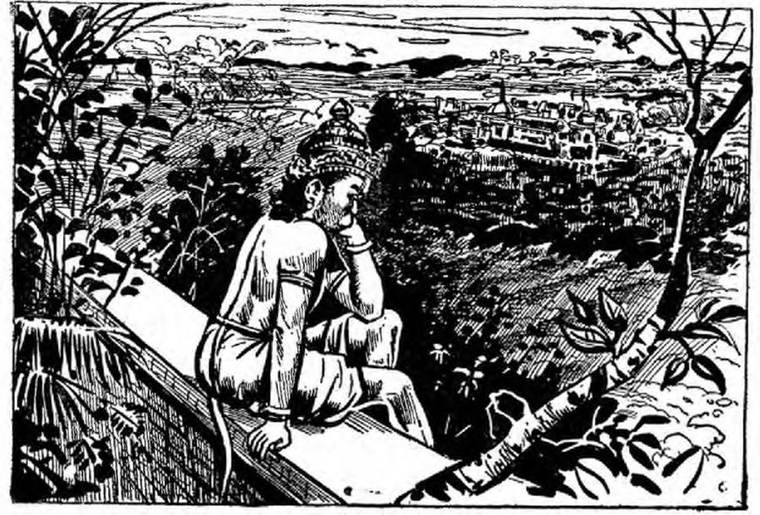
Two journeys
The outer Rāmāyaṇa is a journey from Ayodhyā to Laṅkā and back. The inner one is the same journey in every life: from the peace of the mind (Ayodhyā), through desire (the golden deer) into bondage to the ego (Laṅkā), and back — by discipline, devotion and knowledge — to the Self. Ayodhyā to Laṅkā is the material path; Laṅkā to Ayodhyā is the spiritual path.
How to read this page
These readings come from the Ramayana Symbolism notes and from the Vedānta tradition. They do not replace the story — Rāma, Sītā and Hanumān are honoured as real persons — but they let the story speak about our own mind.
The Yoga Vāsiṣṭha — Rāma’s inner education
Before Rāma leaves Ayodhyā with Viśvāmitra, he falls into a deep dispassion, and his guru Vasiṣṭha teaches him until he is free — the Yoga Vāsiṣṭha, also called the Mahā-Rāmāyaṇa. The epic shows how Rāma lived; that book shows the understanding he lived from. Study the Yoga Vāsiṣṭha →
The symbols
| Rāma | The Self (Ātman) Ramate iti rāmaḥ — one who revels in the Self; perfection in every role played. |
|---|---|
| Daśaratha | Master of the ten senses Only in one who controls the ten indriyas is Rāma born. His opposite is Daśamukha, Rāvaṇa — the one controlled by the ten. |
| Ayodhyā | The mind at peace A-yodhyā — “where there is no war”: when the senses are controlled there is no conflict in the mind. |
| Sītā | The jīva, or matter (prakṛti) Daughter of Mother Earth. The Self cannot remain idle, so it is wedded to the world. Without Sītā there is no Rām-āyaṇa (āyaṇa = journey, glory): without the manifest world one cannot understand the unmanifest God. |
| The golden deer | Māyā — desire for objects Sītā was happy with Rāma anywhere — in the kingdom or the jungle. But the jīva cannot hold its focus on the Ātman; once stunned by desire, it insists on the deer. |
| Mārīca’s cry in Rāma’s voice | Doubt Sītā forces Lakṣmaṇa to go — lacking confidence in Rāma. Desire is followed by doubt in the Self. |
| Lakṣmaṇa-rekhā | The power of discipline The line Lakṣmaṇa drew (in later tellings) is the power of his brahmacarya — the boundary that keeps the jīva safe. |
| Rāvaṇa as a sannyāsī | Evil in the garb of duty We camouflage our wrong acts in the robes of duty or purpose. |
| Laṅkā | Materiality and sensuality The golden city — the world of objects at its most seductive; Rāvaṇa is the head of it all. |
| Sītā under the Aśoka tree | The path from sensuality to spirituality She remained under a-śoka (“no sorrow”) even in śoka, remembering Rāma. Remembrance keeps the captive jīva untouched. |
| Rāma pining for Sītā | The Spirit seems affected Like the Self that appears to suffer through the mind it identifies with. |
| The vānaras | The restless mind Cañcala and asthira — restless and unsteady. Under Vāli (lust) the mind is extroverted; under Sugrīva (the well-reined) it is self-controlled. So Rāma chooses Sugrīva’s friendship. |
| Hanumān | Hope, and the surrendered mind He could have carried Sītā back, but she wanted Rāma to come, because only Rāma can punish and destroy Rāvaṇa — that is the permanent solution. |
| Burning Laṅkā | Mastery of the senses At this point of sādhana one gains suzerainty over the senses. |
| The bridge (setu) | Between the Absolute and the limited Built of stones that float by the Name — the means by which the heavy mind crosses to the Self. |
| Rāvaṇa’s death | The end of delusion Māyā arises from the most improbable causes; delusion ends when the ten-headed monster is killed. The jīva merges with the Paramātmā. |
| Agni-parīkṣā | Jñāna — the fire of knowledge When the ego meets Rāma it cannot remain. Sītā enters the fire and later merges with the Earth. |
| Ayodhyā → Laṅkā → Ayodhyā | The two paths Ayodhyā to Laṅkā is the material path; Laṅkā to Ayodhyā is the spiritual path. When Rāma returns, it is Rāma-rājya — the resurrection of spiritual culture. |
Each kāṇḍa, inwardly
Bāla Kāṇḍa
Daśaratha — “he of ten chariots” — is the one who has mastered the ten senses; only in such a person is Rāma, the Self that rejoices in itself, born. Ayodhyā, “the city that cannot be fought”, is the mind at peace. Viśvāmitra takes the Self out of the comfortable palace and into the forest of disciplines: real growth begins only when we leave our comfort. The wedding with Sītā, daughter of the Earth, is Spirit wedded to the world — without Sītā there is no Rām-āyaṇa, no “journey of Rāma”.
Ayodhyā Kāṇḍa
The moment of greatest success is the moment of greatest danger: a single thought (Mantharā) entering a good mind (Kaikeyī) is enough to turn joy into exile. Rāma’s unchanged face is the sthita-prajña of the Gītā — the person whose peace does not depend on gain or loss. Bharata shows the other half of spiritual life: the sincere seeker who will not enjoy what belongs to the Lord, and who lives as His trustee.
Araṇya Kāṇḍa
The forest is the world of the senses. The golden deer is māyā — the glittering object that draws the mind away from the Self; once the jīva (Sītā) turns from Rāma towards it, the ten-headed ego (Rāvaṇa, who uses all ten senses) carries it off in the disguise of a holy man. Separation from God is the result of desire, not of God’s neglect.
Kiṣkindhā Kāṇḍa
The monkeys are the restless mind (cañcala, asthira). Under Vāli — unbridled desire — the mind is extroverted and tyrannical; under Sugrīva — the mind that has suffered and learned — it can be trained and harnessed in the service of the Self. Rāma chooses Sugrīva. Hanumān is the mind fully surrendered: once reminded of what it truly is, it can cross any ocean.
Sundara Kāṇḍa
Hanumān is the sādhaka who has remembered his strength. He crosses the ocean of saṃsāra, overcomes the three obstacles — attachment to comfort (Maināka), tests of the intellect (Surasā), and the pull of the shadow (Siṃhikā) — enters the city of the senses, nearly gives up, and finds the jīva (Sītā) sitting under the a-śoka tree — the tree of “no sorrow” — holding on to the Name. Burning Laṅkā is the moment in sādhana when one gains mastery over the senses.
Yuddha Kāṇḍa
The war in Laṅkā is the inner war. Rāvaṇa’s ten heads are the ten senses turned outward, or the ten forms of ego (lust, anger, greed, delusion, pride, jealousy, mind, intellect, will and ego itself); as long as one head is cut another grows — until the arrow of Brahman (the brahmāstra, guided by the Āditya-hṛdaya, the knowledge of the Sun within) strikes the heart. Kumbhakarṇa is tamas — sleep and gluttony; Indrajit, “conqueror of Indra”, is the power of desire that defeats even the lord of the senses and can be killed only by Lakṣmaṇa, the one who has kept fourteen years of brahmacarya. When the ego dies, the jīva is purified in the fire of knowledge and returns with the Self to Ayodhyā: Rāma-rājya is the reign of the spirit in a person and a society.
Uttara Kāṇḍa
After realisation, the Self’s relationship with the world (Sītā) is transformed: the jīva returns to its source (the Earth, prakṛti, takes back what is hers), and the Self returns to the Infinite (Rāma enters the waters as Viṣṇu). The story ends where every life ends — in letting go.
Each person, inwardly
- Rāma — The Self (Ātman) — born of a mind that has mastered the ten senses (Daśaratha), wedded to the world (Sītā), separated from it by desire, and reunited by knowledge.
- Sītā — The jīva or prakṛti — the world of matter and the individual soul. Without Sītā there is no Rām-āyaṇa: the unmanifest is known only through the manifest. Her journey from Laṅkā to Ayodhyā is the path from sensuality to spirituality.
- Lakṣmaṇa — The one-pointed mind (or the jīva in perfect discipleship) that never leaves the Self; tradition says he is Ādiśeṣa, the serpent on which Viṣṇu rests.
- Bharata — The sincere devotee who holds the world as the Lord’s trust — the pādukā on the throne: ego dethroned, the Self enthroned.
- Daśaratha — The mind that rules the ten senses gives birth to the Self; the same mind, overcome by attachment (Kaikeyī), loses it.
- Kaikeyī — The good intellect that listens to the crooked thought (Mantharā) and is overcome by selfish desire.
- Mantharā — The crooked thought — fear and envy in a servant’s voice.
- Vasiṣṭha — Brahma-tejas — the power of spirit that is greater than all force.
- Viśvāmitra — The guru who takes the student out of comfort into discipline.
- Paraśurāma — Righteous anger that must finally surrender to the calm Self.
- Ahalyā — The mind turned to stone by a fall, awakened by the touch of the Self.
- Jaṭāyu — The conscience that resists evil even when it cannot win.
- Śabarī — The devotee for whom the Lord Himself comes.
- Hanumān — The disciplined mind (son of Prāṇa, the Wind) that, remembering its true nature, crosses the ocean of saṃsāra and unites the jīva with the Self.
- Sugrīva — The chastened mind that, having suffered under desire, can be harnessed in the service of the Self.
- Vāli — Lust and power that usurp the kingdom of the mind; it cannot be fought head-on, only avoided and struck from a distance.
- Jāmbavān — The guru who reminds the seeker of his true nature.
- Vibhīṣaṇa — The sāttvika conscience in the city of the ego, which, rejected, takes refuge in the Self.
- Rāvaṇa — The ego with ten heads: the ten senses turned outward. Daśa-mukha is the opposite of Daśa-ratha.
- Kumbhakarṇa — Tamas — sleep, gluttony and inertia.
- Indrajit — Subtle desire that defeats even the lord of the senses (Indra) and hides in illusion; only the disciplined mind can slay it.
- Śūrpaṇakhā — Lust that grasps; the first spark of the inner war.
- Mārīca — Māyā — the mirage that draws the mind away from the Self.
Episode by episode
- The Birth of the Poem — The hunter who kills a creature “in the midst of love” is desire (kāma) that destroys the very joy it seeks; the same pattern returns at the centre of the epic, when Rāvaṇa tears Sītā from Rāma.
- Ayodhyā, the Sacrifice and the Birth of Rāma — Daśa-ratha: one who drives the chariot of the ten senses. Only when the ten are mastered is Rāma born within. His three queens are often read as the three guṇas, and the four sons as the four goals of life — dharma, artha, kāma, mokṣa — with Rāma as dharma.
- Viśvāmitra Comes for Rāma — Viśvāmitra — “friend of the universe” — is the teacher who takes the student out of the palace of comfort into the forest of discipline.
- Tāṭakā and the Guarded Sacrifice — Tāṭakā is tamas — the gross, devouring inertia that lays waste to the forest of the mind; it is the first enemy any seeker must face.
- Stories on the Road — Knowledge descending from the infinite is too powerful for the unprepared intellect; it must first be held in contemplation (Śiva’s hair) before it can flow into life.
- Ahalyā Set Free — The mind that has fallen into desire becomes “stone” — insensitive, cut off. Long discipline prepares it, but it is the touch of the Self that awakens it.
- Viśvāmitra’s Own Story — Kṣatra (power) and brahma (spirit): every one of us is born a Kauśika and may become a Viśvāmitra.
- Śiva’s Bow and the Wedding of Sītā — Sītā, born of the earth, is the world — prakṛti — and Rāma the Spirit. Spirit wedded to the world: this is creation, and its whole story is the Rāmāyaṇa.
- Paraśurāma Humbled — Anger, even righteous anger that once had a purpose, must surrender to the calm strength of the Self.
- Mantharā’s Poison and Kaikeyī’s Two Boons — Mantharā, “the crooked one”, is the crooked thought; Kaikeyī is the good intellect that listens to it. The two boons — something for me (Bharata’s crown) and something against another (Rāma’s exile) — are the two faces of selfish desire.
- Rāma Receives the Sentence — The crown and the forest are the pairs of opposites (dvandvas). The Self wears both as costumes.
- Three Who Would Not Let Him Go — Sītā’s refusal to stay behind is the devotee who will not accept the world without the Lord. Lakṣmaṇa is the one-pointed mind that follows the Self into every forest.
- Leaving Ayodhyā — Guha and the Crossing — Crossing the Gaṅgā is crossing over from the world of royal identity to the life of the ascetic — a death and a rebirth.
- Bharata Refuses the Throne — Bharata is the sincere devotee who will not enjoy the Lord’s property; he will only hold it in trust.
- The Sandals on the Throne — The sandals on the throne: the ego steps down and the Self is enthroned, while the body-mind goes on working as its servant.
- Śūrpaṇakhā and the Fourteen Thousand — Śūrpaṇakhā, “she of winnowing-fan nails”, is lust that grasps; cutting her nose and ears is the cutting of the senses’ hold.
- The Golden Deer and the Abduction — Ayodhyā to Laṅkā is the path of desire: the jīva, distracted by the golden deer, loses the Self and is carried off by the ego. Laṅkā to Ayodhyā will be the path back.
- Rāma’s Grief and the Leashed Fury — The Spirit, separated from the jīva, seems to suffer — as the Self seems to suffer through the mind it identifies with.
- Kabandha and Śabarī — Kabandha — all appetite, no head — is the life of mere hunger; when it is cut down and burnt, guidance rises from it.
- Sugrīva’s Story and the Seven Sāla Trees — The seven sāla trees are read as the seven sheaths or the seven planes of ignorance pierced by one arrow of knowledge.
- The Killing of Vāli — Vāli is lust that has usurped the kingdom of the mind and taken what belongs to another; Sugrīva is the mind that, chastened, can become an ally of the Self. The Lord sides with the one who has turned to Him.
- The Monsoon and Lakṣmaṇa’s Anger — After the stormy season of the mind (monsoon), clarity (autumn) returns — and with it, sādhana must resume.
- The Search Begins — the Ring Given to Hanumān — The Name of the Lord, carried by the devoted mind, reaches the jīva in bondage before the Lord Himself arrives.
- Despair by the Sea — Sampāti and the Waking of Hanumān — Hanumān’s forgetting is avidyā; Jāmbavān’s reminder is the guru’s teaching; the leap is the Self-realised jīva crossing the ocean of saṃsāra.
- The Leap Across the Ocean — Becoming small to pass Surasā: the ego that can shrink when needed is the one that succeeds. Hanumān can be as large or as small as the work requires.
- Sītā in the Aśoka Grove — The jīva held captive by the ego sits under the tree of a-śoka (“no sorrow”) even in śoka (sorrow), holding on to the memory of the Lord. That remembrance is what keeps her untouched.
- Hanumān Meets Sītā — The ring with Rāma’s name reaches the jīva first; the jewel from her head returns to Rāma — the exchange of the Name and the surrendered self.
- From Grove to Court to Burning City — Burning Laṅkā: the point in sādhana when one gains sovereignty over the senses — the fire set by the enemy’s own hand consumes the city of desire.
- Vibhīṣaṇa’s Refuge — the Charter of Śaraṇāgati — Vibhīṣaṇa is the sāttvika voice in the city of the ego — conscience — which, when rejected by the ego, crosses over to the Self and is crowned.
- The Ocean and the Bridge — Setu — the bridge between the limited and the Absolute; Rāma’s name that makes stones float is the power of the Name to carry the heavy mind across saṃsāra.
- Kumbhakarṇa — Kumbhakarṇa is tamas — sleep, gluttony, inertia — vast, slow to wake, enormously destructive when it does.
- Indrajit’s War of Illusion — Indrajit, “conqueror of Indra (the lord of the senses)”, is desire at its most subtle — it hides, deceives and multiplies. Only the steady, self-controlled mind can kill it.
- The Āditya-hṛdaya and the Fall of Rāvaṇa — The ego’s heads grow back as long as we attack its expressions; it dies only when the source — the sense of separateness in the heart — is struck by knowledge.
- The Fire and the Revelation — The jīva that has passed through the city of the ego must be purified in the fire of knowledge before union. Agni gives back what was always pure.
- The Return and Rāma-rājya — Ayodhyā to Laṅkā: the material path; Laṅkā to Ayodhyā: the spiritual path. Rāma-rājya is the resurrection of spiritual culture in a person and a society.
- The Prehistory of Rāvaṇa — Ten heads: ten senses, or the ten “heads” of the ego. Ten-headed and twenty-armed, Rāvaṇa is the extroverted personality — immense capacity, all of it turned outward. Daśa-ratha (master of the ten) and Daśa-mukha (servant of the ten) are opposites.
- Sītā Returns to the Earth — Prakṛti returns to her source; the jīva, purified, merges back. “Without Sītā there is no Rāmāyaṇa” — and with her going, the story moves to its end.
- The Departures — The Self, having played every role perfectly, withdraws from the stage; the Infinite returns to the Infinite.
The apparent inconsistencies
Vālmīki highlighted one facet of Rāma’s personality to absolute perfection and could not do equal justice to the others — which is why some critics see apparent inconsistencies in his character. The perfect son abandoned his old father; the perfect king sent Sītā away at one dissenting voice — the greatest sacrifice — though he had shown superhuman powers to win her back; the perfect friend shot Vāli from hiding, because one cannot face lust head-on. And the perfect human carried his weapons at all times: aggressive goodness — inequity will always be there in the world; have the strength and conviction to fight it at all times.
Philosophical currents — from the study companion
Philosophical Currents
Threads that run through all seven books, gathered for cross-referenced study. Each names its anchor episodes so the theme can be traced in sequence through a reading.
❖ Golden boxes moments that define Rāma as Maryādā Puruṣottama Green boxes where Kamban’s Tamil Rāmāyaṇam tells it differently Verse cards ślokas worth memorising
Maryādā as the Epic's Master-Theme — Dharma Under Maximum Loadevery kāṇḍa's ❖ markers, in sequence
The Rāmāyaṇa never defines dharma; it stress-tests it and publishes the strain gauges. Trace the ❖ markers in order and a curriculum emerges: obedience above private scruple (Tāṭakā) → the word kept blind (the blank promise) → which loves may bind and which may not (the three protests) → the vow policed against one's own comfort (Guha's refused feast) → the vow's terrible price (the Araṇya breach) → the boundary held communally (Lakṣmaṇa reeling Rāma back) → the contested application (Vāli) → the boundary kept unseen (the seraglio scruple) → refuge above risk (Vibhīṣaṇa) → force as a court of appeals (the ocean) → war as due process (the spies, the embassy) → mercy in victory (the two mercies) → the standard above the self (parīkṣā, exile) → the vow outlasting its object (the golden Sītā). Vālmīki's honesty is that the curriculum includes its own hard cases — Vāli, the parīkṣā, Śambūka — argued by his own characters at full strength and left standing. A tradition that must keep arguing about dharma is one in which dharma is still alive; the epic is built to keep the argument going.
Śaraṇāgati — the Ladder of RefugeGuha → Śabarī → Sugrīva → Vibhīṣaṇa → the ocean
Trace the sequence as a graded doctrine: Guha (friendship across birth — refuge as embrace), Śabarī (devotion as the sole qualification — refuge as darśana earned by service), Sugrīva (alliance of the broken — refuge as mutual rescue), Vibhīṣaṇa (refuge across enemy lines — the carama-śloka: once, with "I am yours," is enough, "even were it Rāvaṇa"), and finally the ocean — which teaches the doctrine's other face: refuge is offered to the surrendered and enforced upon the obstinate. The Śrī Vaiṣṇava ācāryas mined this ladder into full prapatti-śāstra; Kambar, their Tamil-country contemporary-heir, wrote it back into the epic at triple length. Read this way, the Rāmāyaṇa is not a war story with devotional interludes but a taxonomy of the ways a soul may arrive.
Nara & Nārāyaṇa — the Veiled Avatāra Across Three RāmāyaṇasBāla 15–16 · Yuddha 117 · the retellings
Vālmīki's distinctive theology: divinity structurally necessary (the boon's human-shaped loophole) yet experientially absent — Rāma grieves, errs, rages and mourns as a man, and answers Brahmā's own revelation with ātmānaṁ mānuṣaṁ manye. Compare the three great tellings as three positions on one axis: Vālmīki (divinity veiled until the end — the ideal is usable by humans because its bearer works under human constraints); Kambar (divinity manifest throughout — humanity as gracious costume, the epic as bhakti's theatre); and the Adhyātma Rāmāyaṇa (the narrative sublimated into Advaita — Rāma as nirguṇa Brahman, Sītā as māyā-śakti, an illusory Sītā abducted while the real one waits in the fire). For the Vedāntin the three jointly enact adhyāropa-apavāda across a millennium of retelling: humanity superimposed, then progressively sublated. The study question the axis poses: is the Maryādā Puruṣottama diminished or completed by knowing himself Nārāyaṇa? Vālmīki's answer is the veil itself.
Satya & Anirveda — the Two Working InstructionsAyodhyā 109 · Sundara 12
If the epic's metaphysics is the veiled avatāra, its practical teaching compresses into two verses: satyān nāsti paraṁ padam (2.109) — truth as the load-bearing wall of world and self, kept when it costs a kingdom — and anirvedaḥ śriyo mūlam (5.12) — despair, not failure, as the true enemy of any undertaking. One governs what may never be surrendered; the other, what may never be indulged. Between them stand the epic's two exemplars, Rāma and Hanumān — the master of the first vow and the master of the second — and a complete, portable sādhana for the reader: hold to satya, refuse nirveda, and let results be what they are. Note how the pair maps onto the Gītā's karma-yoga a yuga later: adherence to dharma without bargaining for outcomes, effort without the right to despair.
The Frame — a Poem That Contains Its Own OriginBāla 1–4 · Uttara 93–97
The Rāmāyaṇa opens with its own composition (grief become metre, Brahmā's commission, the poem taught to two unnamed boys) and closes with its own first performance — those boys, revealed as Rāma's sons, singing his life to his face. The epic thus enacts its deepest claim about itself: that Rāma survives as story — Hanumān's immortality is indexed to the tale's recitation; the citizens who cannot outlive Rāma are outlived by the poem about him. For the student of Vedānta the frame is a meditation on śabda: the ideal man becomes transmissible only as word, and the word, properly received (Rāma weeping at his own biography, the model listener), completes the life it tells. Every subsequent Rāmāyaṇa — Kambar's included — is this frame still working.
Verses follow the Gita Press (southern) numbering, checked against valmikiramayan.net; other editions may differ by a few verses, and the critical edition omits some popular verses (marked). Stories are retold in brief from Vālmīki, with C. Rajagopalachari and Kamala Subramaniam for further reading; later additions (Tulasīdāsa, Kamban, folk tradition) are marked as such. The symbolic readings are offered for reflection — one way among several of hearing the story. Drawings: Vipin K. Das, from Children’s Illustrated Ramayanam, retold by Vishnu B (2011).