🔔 Online Vedanta Classes Now Enrolling — Know More →

Research › Vālmīki Rāmāyaṇa › Yuddha Kāṇḍa

युद्धकाण्डम्

Yuddha Kāṇḍa — The Book of War

The army marches south; Vibhīṣaṇa, cast out by Rāvaṇa, takes refuge with Rāma; the ocean is bridged; peace is offered and refused; Kumbhakarṇa, Indrajit and finally Rāvaṇa fall; Sītā passes through fire; and Rāma returns to Ayodhyā to be crowned.

Rāma and Rāvaṇa — the final duel
128 sargas≈ 5,700 ślokas11 episodes here14 verses studied

What this book is about

The victory of dharma — and how dharma fights. Rāma offers peace before war, receives the enemy’s brother as a friend, releases spies, spares a disarmed foe, honours a fallen enemy’s funeral. Its spiritual heart is not the battle but the charter of refuge given to Vibhīṣaṇa.

Its inner meaning

The war in Laṅkā is the inner war. Rāvaṇa’s ten heads are the ten senses turned outward, or the ten forms of ego (lust, anger, greed, delusion, pride, jealousy, mind, intellect, will and ego itself); as long as one head is cut another grows — until the arrow of Brahman (the brahmāstra, guided by the Āditya-hṛdaya, the knowledge of the Sun within) strikes the heart. Kumbhakarṇa is tamas — sleep and gluttony; Indrajit, “conqueror of Indra”, is the power of desire that defeats even the lord of the senses and can be killed only by Lakṣmaṇa, the one who has kept fourteen years of brahmacarya. When the ego dies, the jīva is purified in the fire of knowledge and returns with the Self to Ayodhyā: Rāma-rājya is the reign of the spirit in a person and a society.

In this kāṇḍa

  1. Two Councils sargas 1–16
  2. Vibhīṣaṇa’s Refuge — the Charter of Śaraṇāgati sargas 17–19
  3. The Ocean and the Bridge sargas 19–22
  4. Overtures and Ultimatums sargas 23–41
  5. The Battles Begin — and a Disarmed Enemy Sent Home sargas 42–59
  6. Kumbhakarṇa sargas 60–67
  7. Indrajit’s War of Illusion sargas 68–92
  8. Lakṣmaṇa Falls — Rāma’s Lament sargas 100–102
  9. The Āditya-hṛdaya and the Fall of Rāvaṇa sargas 102–113
  10. The Fire and the Revelation sargas 112–120
  11. The Return and Rāma-rājya sargas 121–128

Also on this page: the study companion — 8 topics with the ❖ Maryādā moments and Kamba variants.

Read further: C. Rajagopalachari, chapters 60–75 · Kamala Subramaniam, Yuddha 1–50

Two Councils Rāma plans; Rāvaṇa will not listen sargas 1–16 · 1 picture
Rāma’s council; Vibhīṣaṇa comes for refuge

The story

Rāma questions Hanumān about Laṅkā’s gates, walls and forces, and the vast army marches south under Nīla, roaring with joy, to the shore opposite Laṅkā.

In Laṅkā, Rāvaṇa calls his council. The generals boast. Only Vibhīṣaṇa, his youngest brother, speaks the truth: return Sītā; there is no shame in righting a wrong; ill omens fill the city. Kumbhakarṇa tells his brother bluntly he has acted wrongly — and then promises to fight for him anyway. Rāvaṇa turns on Vibhīṣaṇa: “A kinsman is a worse enemy than a foe.” Vibhīṣaṇa rises into the air with four companions, says that he spoke only for his brother’s good, and leaves for Rāma.

The deeper message

Two styles of leadership side by side. Rāma asks, listens and plans; Rāvaṇa demands agreement and punishes truth. A ruler surrounded by flatterers is already defeated.

Kumbhakarṇa is the tragedy of loyalty without conscience: he sees the wrong clearly and chooses to die for it.

Rāma here — which quality, and exactly where

  • The king He holds a full military council and questions Hanumān in detail before acting (6.3).
Vibhīṣaṇa’s Refuge — the Charter of Śaraṇāgati “To anyone who comes to Me even once…” sargas 17–19 · 2 verses

The story

Vibhīṣaṇa appears in the sky above the monkey army and asks for refuge. Sugrīva is alarmed: he is Rāvaṇa’s brother, a rākṣasa, a deserter — he will betray us. Rāma asks each counsellor’s view. Most advise caution or testing. Hanumān alone argues for accepting him: his face and words show no deceit, and he has come because he sees Rāma’s virtue and Rāvaṇa’s wrong.

Rāma decides. “I will not reject one who comes in friendship, even if he has faults. To anyone who comes to me even once and says ‘I am yours’, I give freedom from fear from all beings — that is my vow. Bring him, Sugrīva — whether it is Vibhīṣaṇa or Rāvaṇa himself.” He receives Vibhīṣaṇa, and before the war has begun anoints him king of Laṅkā with water from the sea.

Verses

Yuddha Kāṇḍa 6.18.3Rāma to Sugrīva

A friend is not abandoned

मित्रभावेन सम्प्राप्तं न त्यजेयं कथञ्चन ।
दोषो यद्यपि तस्य स्यात्सतामेतदगर्हितम् ॥
mitra-bhāvena samprāptaṃ na tyajeyaṃ kathañcana |
doṣo yady api tasya syāt satām etad agarhitam ||
Word by word
mitra-bhāvenain friendship
samprāptamone who has come
na tyajeyamI would not abandon
kathañcanain any way
doṣaḥ yadi apieven if a fault
tasya syātwere his
satāmfor the good
etat agarhitamthis is not blameworthy

MeaningOne who comes to me in friendship I will never abandon, even if he has faults; the good do not condemn this.

ContextRāma’s first response when Sugrīva and others argue that Vibhīṣaṇa should be rejected as a possible spy.

Philosophical aspectAcceptance before perfection. The Lord receives us as we are; transformation follows, not precedes, acceptance.

Yuddha Kāṇḍa 6.18.33–34Rāma to Sugrīva

Sakṛd eva prapannāya — the vow of refuge

सकृदेव प्रपन्नाय तवास्मीति च याचते ।
अभयं सर्वभूतेभ्यो ददाम्येतद्व्रतं मम ॥
आनयैनं हरिश्रेष्ठ दत्तो ऽस्याभयं मया ।
विभीषणो वा सुग्रीव यदि वा रावणः स्वयम् ॥
sakṛd eva prapannāya tavāsmīti ca yācate |
abhayaṃ sarva-bhūtebhyo dadāmy etad vrataṃ mama ||
ānayainaṃ hari-śreṣṭha datto 'syābhayaṃ mayā |
vibhīṣaṇo vā sugrīva yadi vā rāvaṇaḥ svayam ||
Word by word
sakṛt evaeven once
prapannāyato one who has taken refuge
tava asmi iti casaying “I am yours”
yācateto one who asks
abhayamfearlessness, protection
sarva-bhūtebhyaḥfrom all beings
dadāmiI give
etat vratam mamathis is my vow
ānaya enambring him
hari-śreṣṭhaO best of monkeys
dattaḥ asya abhayam mayāI have given him protection
vibhīṣaṇaḥ vāwhether he be Vibhīṣaṇa
yadi vā rāvaṇaḥ svayamor Rāvaṇa himself

MeaningTo anyone who comes to me even once and asks, saying “I am yours”, I give freedom from fear from all beings — this is my vow. Bring him, best of monkeys; I have given him protection — whether he is Vibhīṣaṇa, Sugrīva, or Rāvaṇa himself.

ContextCalled the Rāma-carama-śloka (Rāma’s ultimate verse) in the Śrīvaiṣṇava tradition, the counterpart of the Gītā’s carama-śloka (18.66). It closes the debate over Vibhīṣaṇa.

Philosophical aspectŚaraṇāgati — surrender — is complete in one sincere act (sakṛt). Its two parts are named: prapatti (coming to Him) and the confession tava asmi (“I am yours”). The Lord’s response is abhaya — not wealth or power, but freedom from fear, which is liberation itself.

The deeper message

This is the spiritual summit of the Rāmāyaṇa — the Śrīvaiṣṇava tradition calls 6.18.33 the Rāma-carama-śloka, Rāma’s final word. The Lord’s acceptance does not depend on the seeker’s past, birth or perfection, but on a single sincere turning: “I am yours.”

Rāma even says he would accept Rāvaṇa. Grace has no enemies; it is the ego that refuses it.

Inner meaning

Vibhīṣaṇa is the sāttvika voice in the city of the ego — conscience — which, when rejected by the ego, crosses over to the Self and is crowned.

Rāma here — which quality, and exactly where

  • The refuge of all “Abhayaṃ sarva-bhūtebhyo dadāmy etad vrataṃ mama” — his vow of refuge (6.18.33).
  • The friend “I will not abandon one who comes as a friend, even if he has faults” (6.18.3).
  • The king He hears every counsellor before deciding, and gives the reasons for his decision.
The Ocean and the Bridge Patience, wrath and engineering sargas 19–22 · 1 verse · 2 pictures
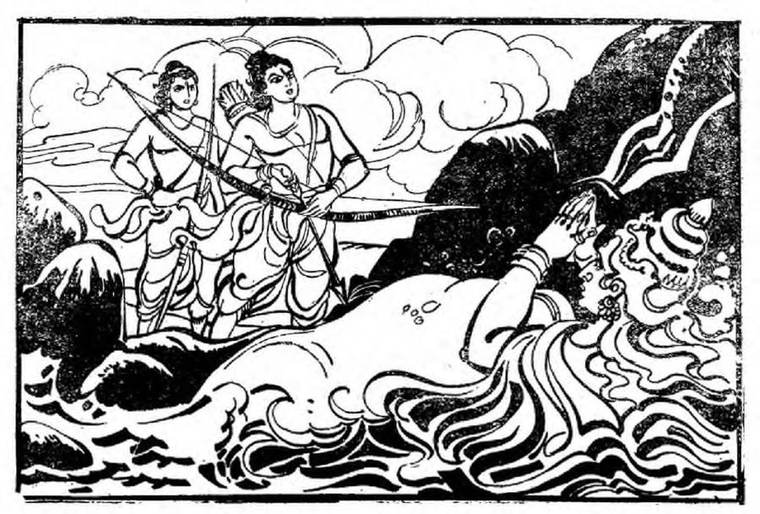
The Ocean rises before Rāma
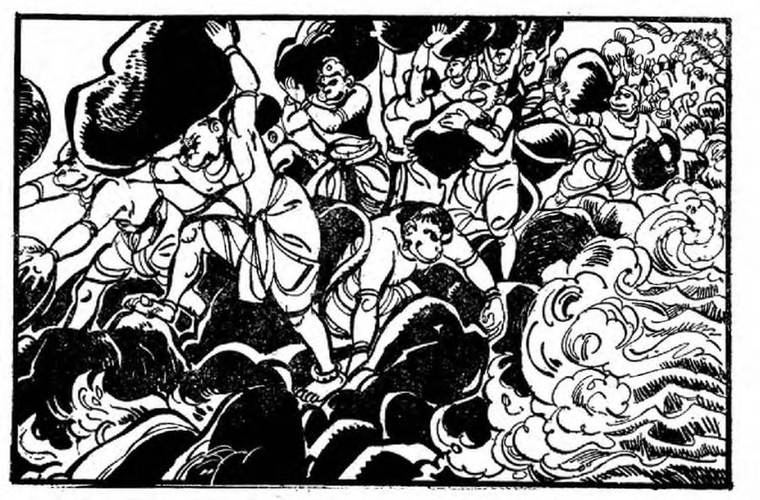
Building the bridge to Laṅkā

The story

On Vibhīṣaṇa’s advice Rāma lies on kuśa grass on the shore for three days and nights, praying to the Ocean for a way. The Ocean does not answer. Rāma rises in anger: gentleness is taken for weakness. He looses fiery arrows; the sea boils. The Ocean-god rises, joined-palmed: I cannot change my nature, but let Nala, son of Viśvakarmā, build a bridge, and I will hold it up.

In five days the monkeys build a causeway a hundred leagues long of rocks, trees and mountains. (Later tellings add the squirrel who rolled in sand to help, and the stones that floated because Rāma’s name was written on them.)

Verses

Yuddha Kāṇḍa 6.21.14–15Rāma to Lakṣmaṇa, at the shore

Virtues mistaken for weakness

प्रशमश्च क्षमा चैव आर्जवं प्रियवादिता ।
असामर्थ्यं फलन्त्येते निर्गुणेषु सतां गुणाः ॥
praśamaś ca kṣamā caiva ārjavaṃ priya-vāditā |
asāmarthyaṃ phalanty ete nirguṇeṣu satāṃ guṇāḥ ||
Word by word
praśamaḥ cacalmness
kṣamā ca evaand forbearance
ārjavamstraightforwardness
priya-vāditāgentle speech
asāmarthyam phalantibear the fruit of (seeming) incapacity
etethese
nirguṇeṣuamong the ungracious
satām guṇāḥvirtues of the good

MeaningCalmness, forbearance, straightforwardness and gentle speech — these virtues of the good, among those without virtue, are taken for weakness.

ContextAfter three days of prayer the Ocean has not answered. Rāma, his eyes reddening, says this to Lakṣmaṇa and takes up his bow.

Philosophical aspectGentleness must know when it is being exploited. The ideal is not passivity but the right response to each situation — and Rāma’s anger, once it has done its work, is laid down at once.

The deeper message

Rāma tries patience first and force second — and uses force only to bring the other to reason, not to destroy. The Ocean’s answer is also wise: nature cannot be broken, but it can be worked with. Spiritual life is not violence against our nature but a bridge across it.

The bridge is built by thousands, not by Rāma alone. Every small effort counts — the meaning of the squirrel story.

Inner meaning

Setu — the bridge between the limited and the Absolute; Rāma’s name that makes stones float is the power of the Name to carry the heavy mind across saṃsāra.

Rāma here — which quality, and exactly where

  • Equanimity Three days of patient prayer before any anger (6.21).
  • Anger on a leash His wrath at the ocean is controlled and stopped as soon as the Ocean submits (6.21–22).
Overtures and Ultimatums Spies released, Sugrīva’s rashness, Aṅgada’s embassy sargas 23–41 · 1 picture
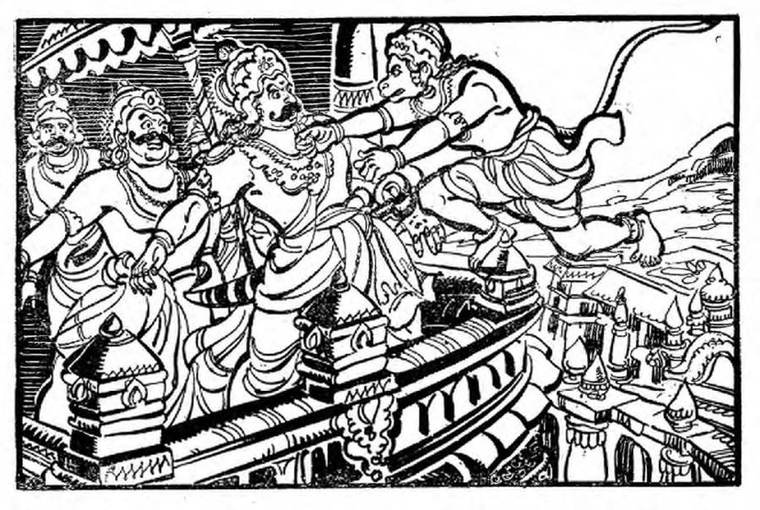
Sugrīva leaps at Rāvaṇa

The story

Rāvaṇa sends spies, Śuka and Sāraṇa, disguised as monkeys. Caught, they are brought to Rāma, who laughs, shows them the whole army and sends them back to report. Rāvaṇa tries to break Sītā with a magic severed head of Rāma; a kind rākṣasī, Saramā, tells her the truth.

From a peak Sugrīva sees Rāvaṇa on his palace terrace, leaps across, wrestles him and leaps back — and Rāma rebukes him: a king must not risk himself rashly. Before the first arrow, Rāma sends Aṅgada as envoy: return Sītā and you may yet live. Aṅgada delivers the message in Rāvaṇa’s court, breaks free of the guards, and smashes the palace roof as he leaps away.

The deeper message

Dharma-yuddha has rules: peace is offered before war, envoys and spies are not killed, impulsive heroics are discouraged. Rāma fights a just war justly.

Rāma here — which quality, and exactly where

  • Compassion Releases the enemy’s spies unharmed (6.25).
  • The king Rebukes Sugrīva for risking his life — a commander’s care for his friend (6.41).
  • Dharma embodied Offers peace through Aṅgada before the battle (6.41).
The Battles Begin — and a Disarmed Enemy Sent Home Nāgapāśa, Garuḍa, “go and rest” sargas 42–59 · 1 picture
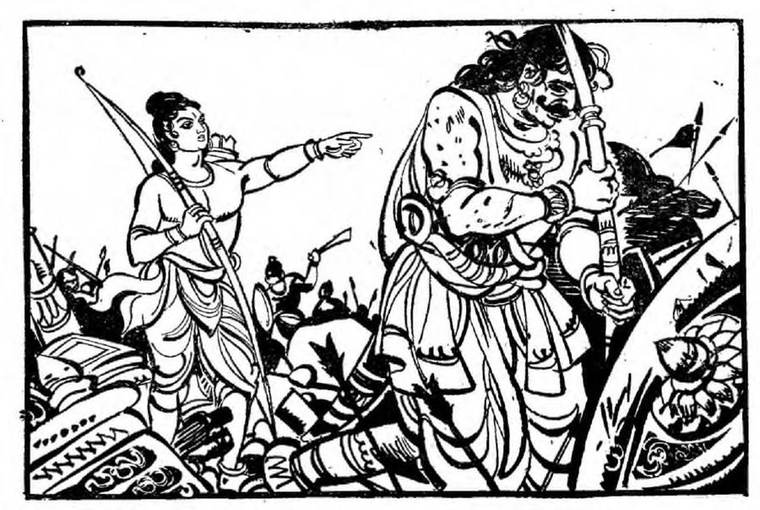
Rāma sends the disarmed Rāvaṇa home to rest

The story

Laṅkā is besieged. Indrajit, invisible, binds Rāma and Lakṣmaṇa with serpent-arrows; they fall as if dead, and Sītā, shown them from the Puṣpaka, is consoled by Trijaṭā. Garuḍa descends and the serpents flee. One by one the great rākṣasa generals fall — Dhūmrākṣa, Akampana, Prahasta.

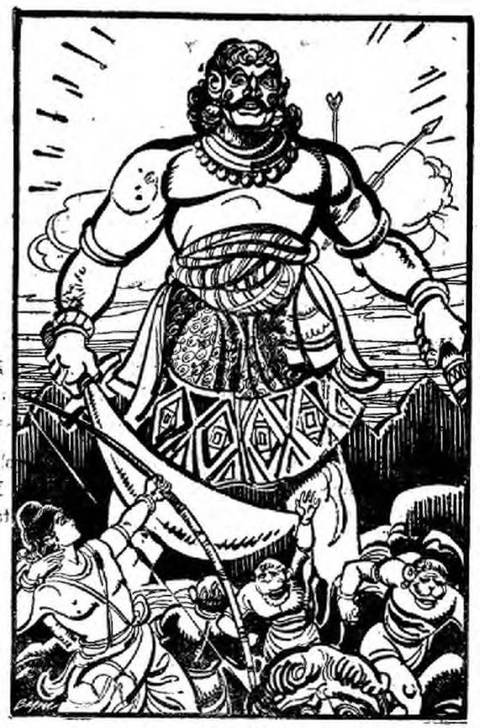
Rāvaṇa himself takes the field, strikes down Lakṣmaṇa with a spear, and meets Rāma. Rāma shatters his chariot, horses, bow and crown. Rāvaṇa stands disarmed and exhausted. Rāma says: “You have fought hard today and you are tired. I will not kill you now. Go back to Laṅkā, rest, and come out tomorrow with a chariot and bow; then you will see my strength.” Rāvaṇa returns, humiliated.

The deeper message

The most chivalrous act in the epic: to spare the enemy who is at your mercy and who has wronged you most. Rāma will not strike a man who cannot strike back. Dharma is not suspended in war; it is tested there.

It is also a final chance for Rāvaṇa. Every mercy is an invitation to change.

Rāma here — which quality, and exactly where

  • Compassion “Go and rest, come back tomorrow” — he spares a disarmed Rāvaṇa (6.59).
  • Valour Strips Rāvaṇa of chariot, bow and crown in single combat (6.59).
Kumbhakarṇa The giant of sleep wakes, advises, and dies loyal sargas 60–67 · 1 verse · 2 pictures
Waking Kumbhakarṇa
Waking Kumbhakarṇa
Kumbhakarṇa marches out

The story

Rāvaṇa orders his brother woken. Kumbhakarṇa — who by a slip of the tongue asked Brahmā for endless sleep instead of Indra’s seat — is roused by drums, conches, elephants trampling him, and mountains of food and drink. He hears what has happened and tells Rāvaṇa plainly: you have done wrong and ignored all advice. Then: “But you are my brother; I will fight for you.”

He devours monkeys by the thousand, knocks out Sugrīva and carries him off (Sugrīva bites off his ears and nose and escapes). Rāma cuts off his arms, then his legs, and finally his head with an arrow of Indra. It falls into the sea.

Verses

Yuddha Kāṇḍa 6.63.5Kumbhakarṇa to Rāvaṇa

Doing first what should come later

यः पश्चात्पूर्वकार्याणि कुर्यादैश्वर्यमास्थितः ।
पूर्वं चोत्तरकार्याणि न स वेद नयानयौ ॥
yaḥ paścāt pūrva-kāryāṇi kuryād aiśvaryam āsthitaḥ |
pūrvaṃ cottara-kāryāṇi na sa veda nayānayau ||
Word by word
yaḥone who
paścātafterwards
pūrva-kāryāṇiwhat should be done first
kuryātdoes
aiśvaryam āsthitaḥestablished in power
pūrvam caand first
uttara-kāryāṇiwhat should be done later
na saḥ vedahe does not know
naya-anayaugood policy from bad

MeaningA ruler who does afterwards what should be done first, and first what should come later, does not know good policy from bad.

ContextWoken in the middle of the war, Kumbhakarṇa tells his brother plainly that he acted first (abducting Sītā) and is consulting only now — then promises to fight for him anyway.

Philosophical aspectReflection before action, not after. Kumbhakarṇa sees the truth clearly and still chooses loyalty over dharma — knowledge that does not govern the will is the tragedy of the whole house of Rāvaṇa.

The deeper message

Kumbhakarṇa is the noblest of the rākṣasas after Vibhīṣaṇa: honest, generous, without guile. His tragedy is that he chooses blood over truth. Vibhīṣaṇa and Kumbhakarṇa are the two choices before every person whose family does wrong.

Inner meaning

Kumbhakarṇa is tamas — sleep, gluttony, inertia — vast, slow to wake, enormously destructive when it does.

Rāma here — which quality, and exactly where

  • Valour Fells the giant whom the whole army could not stop (6.67).
Indrajit’s War of Illusion The Brahmāstra, the mountain of herbs, Lakṣmaṇa’s oath sargas 68–92 · 1 verse · 2 pictures
Hanumān carries the mountain of herbs
Indrajit’s war of arrows

The story

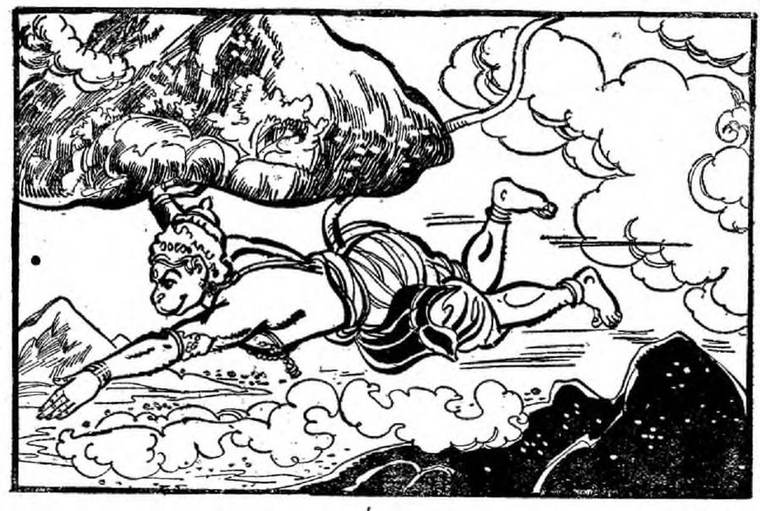
Indrajit, Rāvaṇa’s son, who once defeated Indra, fights invisibly from the clouds and fells Rāma, Lakṣmaṇa and almost the whole army with the Brahmāstra. Only Vibhīṣaṇa and Hanumān remain standing. The wounded Jāmbavān asks one question: “Is Hanumān alive?” — for if he lives, all live. Hanumān flies to the Himālaya for four healing herbs; unable to identify them, he lifts the whole mountain and brings it. The fragrance alone revives the army.

Indrajit kills a magic image of Sītā before the army’s eyes; Rāma faints with grief, and Vibhīṣaṇa reveals it as illusion. Indrajit goes to the Nikumbhilā grove to complete a sacrifice that will make him invincible; Lakṣmaṇa, guided by Vibhīṣaṇa, interrupts it. After a long duel Lakṣmaṇa sets an arrow and swears: “If Rāma, son of Daśaratha, is devoted to dharma and true to his word, and unrivalled in valour, may this arrow kill Indrajit” — and cuts off his head.

Verses

Yuddha Kāṇḍa 6.90.71 (6.91.73 in some editions)Lakṣmaṇa, loosing the arrow at Indrajit

Lakṣmaṇa’s oath of truth

धर्मात्मा सत्यसन्धश्च रामो दाशरथिर्यदि ।
पौरुषे चाप्रतिद्वन्द्वस्तदैनं जहि रावणिम् ॥
dharmātmā satya-sandhaś ca rāmo dāśarathir yadi |
pauruṣe cāpratidvandvas tadainaṃ jahi rāvaṇim ||
Word by word
dharma-ātmādevoted to dharma
satya-sandhaḥ caand true to his word
rāmaḥ dāśarathiḥRāma, son of Daśaratha
yadiif
pauruṣein valour
ca apratidvandvaḥand unrivalled
tadāthen
enam jahislay this
rāvaṇimson of Rāvaṇa

MeaningIf Rāma, son of Daśaratha, is devoted to dharma, true to his word and unrivalled in valour — then, arrow, slay this son of Rāvaṇa.

ContextLakṣmaṇa’s satya-kriyā, an “act of truth”: the power of a truth is invoked to make something happen. The arrow cuts off Indrajit’s head.

Philosophical aspectTruth as power. Lakṣmaṇa stakes the outcome not on his own skill but on Rāma’s character. A life of truth becomes a force in the world.

The deeper message

Indrajit fights with illusion — invisibility and false images. He can be defeated only by discrimination (Vibhīṣaṇa, who sees through the illusions) and by Lakṣmaṇa’s purity. Tradition says Indrajit could be killed only by one who had not slept for fourteen years.

Lakṣmaṇa’s oath makes Rāma’s character itself the weapon: truth is power. Jāmbavān’s question shows where the army’s hope lies — in the devotee.

Inner meaning

Indrajit, “conqueror of Indra (the lord of the senses)”, is desire at its most subtle — it hides, deceives and multiplies. Only the steady, self-controlled mind can kill it.

Rāma here — which quality, and exactly where

  • Dharma embodied Lakṣmaṇa uses Rāma’s truthfulness as the guarantee of his arrow (6.90.71).
Lakṣmaṇa Falls — Rāma’s Lament The brother without whom victory is nothing sargas 100–102 · 1 verse

The story

Maddened by his son’s death, Rāvaṇa hurls a terrible spear (śakti) meant for Vibhīṣaṇa; Lakṣmaṇa steps in front and is pierced. Rāma pulls out the spear, breaks it, and fights on in fury, then sits by his brother weeping: “What is victory to me, or Sītā, or life, if Lakṣmaṇa is gone? Wives may be found in every land, kinsmen in every land; but I see no land where a brother born of the same mother can be found.” Suṣeṇa the physician sends Hanumān again for the herbs; Lakṣmaṇa revives and urges Rāma to finish Rāvaṇa before sunset.

Verses

Yuddha Kāṇḍa 6.101.15 (vulgate; not in the critical edition)Rāma over the fallen Lakṣmaṇa

No land where a brother can be found

देशे देशे कलत्राणि देशे देशे च बान्धवाः ।
तं तु देशं न पश्यामि यत्र भ्राता सहोदरः ॥
deśe deśe kalatrāṇi deśe deśe ca bāndhavāḥ |
taṃ tu deśaṃ na paśyāmi yatra bhrātā sahodaraḥ ||
Word by word
deśe deśein land after land
kalatrāṇiwives
ca bāndhavāḥand kinsmen (may be found)
tam tu deśambut that land
na paśyāmiI do not see
yatrawhere
bhrātā sahodaraḥa brother born of the same womb (may be found)

MeaningWives may be found in every land, and kinsmen in every land; but I see no land where a brother born of the same mother can be found.

ContextPart of Rāma’s lament when Lakṣmaṇa falls to Rāvaṇa’s spear. The verse is in the popular (vulgate) text and widely quoted, but not in the critical edition.

Philosophical aspectNot a judgment on wives but a cry of grief: some bonds are given by birth and shared suffering and cannot be replaced. Lakṣmaṇa is the one who gave up everything to follow.

The deeper message

Lakṣmaṇa takes a blow meant for someone else — the refugee Vibhīṣaṇa — and so keeps Rāma’s vow of refuge with his own body. Rāma’s lament is the loudest cry of the epic, louder than for Sītā: the companion who has given everything is the one we cannot bear to lose.

Rāma here — which quality, and exactly where

The Āditya-hṛdaya and the Fall of Rāvaṇa The duel of the age; enmity ends with death sargas 102–113 · 4 verses · 1 picture
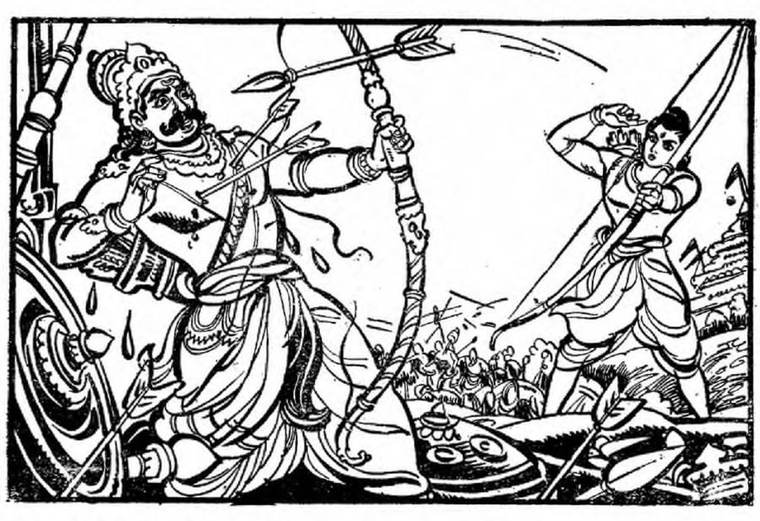
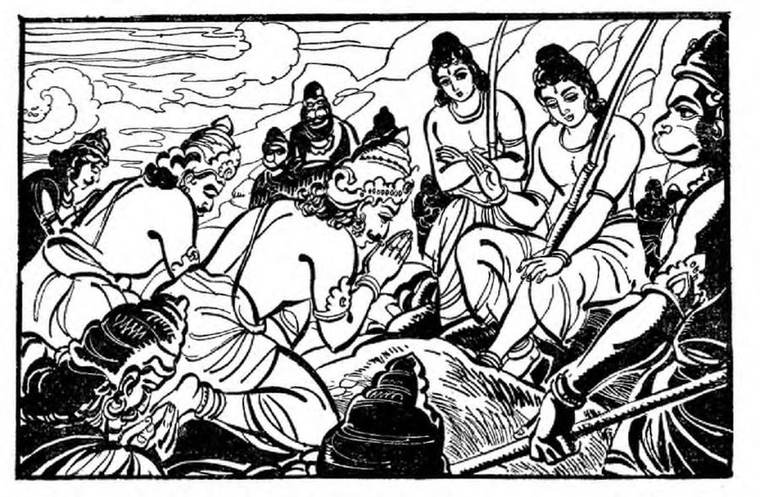
Rāma and Rāvaṇa — the final duel

The story

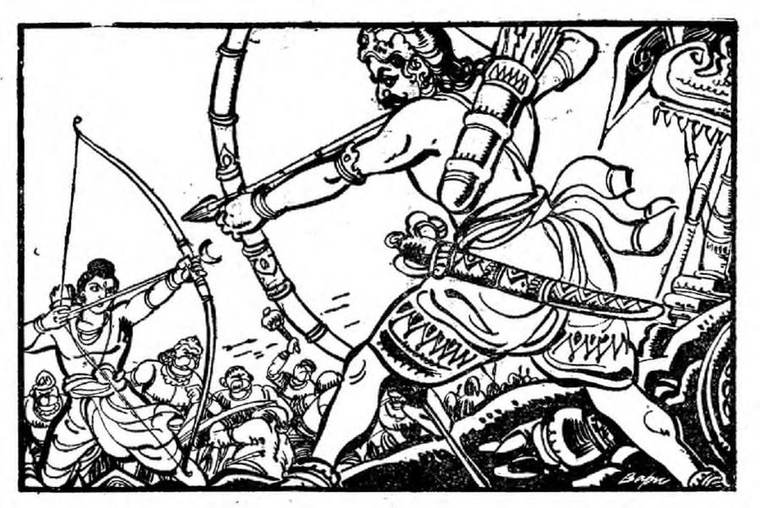
Indra sends his own chariot and charioteer Mātali. The duel goes on for days. Rāma cuts off Rāvaṇa’s heads, and they grow again. Rāma, weary, stands thinking. The sage Agastya comes to the field and teaches him the Āditya-hṛdaya, the hymn to the Sun in the heart: “Rāma, mighty-armed, hear this eternal secret by which you will conquer all foes.” Rāma recites it three times, sipping water, and is filled with joy and strength.

On Mātali’s advice he takes up the Brahmāstra given by Agastya, and it pierces Rāvaṇa’s heart. He falls. Vibhīṣaṇa, grieving, hesitates to perform his brother’s funeral. Rāma says: “Enmity ends with death. Our purpose is fulfilled. Perform his rites — he is as much mine as yours.” Mandodarī’s lament over her husband is one of the most moving passages in the epic.

Verses

Yuddha Kāṇḍa 6.105.3 (6.107.3 in some editions)Agastya to Rāma

Āditya-hṛdaya — the secret in the heart

राम राम महाबाहो शृणु गुह्यं सनातनम् ।
येन सर्वानरीन् वत्स समरे विजयिष्यसि ॥
rāma rāma mahā-bāho śṛṇu guhyaṃ sanātanam |
yena sarvān arīn vatsa samare vijayiṣyasi ||
Word by word
rāma rāmaO Rāma, Rāma
mahā-bāhomighty-armed one
śṛṇuhear
guhyamthe secret
sanātanameternal
yenaby which
sarvān arīnall enemies
vatsamy child
samarein battle
vijayiṣyasiyou will conquer

MeaningRāma, mighty-armed Rāma, listen to this eternal secret, my child, by which you will conquer all your enemies in battle.

ContextAgastya’s introduction to the Āditya-hṛdaya, the hymn to the Sun recited by Rāma before the final duel. It is chanted daily by many to this day.

Philosophical aspectĀditya-hṛdaya means both “the heart of the Sun” and “the Sun in the heart” — the light of consciousness within. Victory over the ego comes from that inner light, not from more arrows.

Yuddha Kāṇḍa 6.109.25 (6.112.26 in some editions)Rāma to Vibhīṣaṇa

Maraṇāntāni vairāṇi — enmity ends with death

मरणान्तानि वैराणि निर्वृत्तं नः प्रयोजनम् ।
क्रियतामस्य संस्कारो ममाप्येष यथा तव ॥
maraṇāntāni vairāṇi nirvṛttaṃ naḥ prayojanam |
kriyatām asya saṃskāro mamāpy eṣa yathā tava ||
Word by word
maraṇa-antāniend with death
vairāṇienmities
nirvṛttamis accomplished
naḥ prayojanamour purpose
kriyatāmlet be performed
asya saṃskāraḥhis funeral rites
mama api eṣaḥhe is mine too
yathā tavaas he is yours

MeaningEnmity ends with death. Our purpose is fulfilled. Let his funeral rites be performed — he is mine as much as he is yours.

ContextVibhīṣaṇa hesitates to cremate the brother who wronged everyone. Rāma insists on full honours for the fallen enemy.

Philosophical aspectWe oppose the wrong, not the person. When adharma is ended, the being who carried it is again simply a soul to be honoured. This is the end of hatred.

Yuddha Kāṇḍa 6.105.4Agastya to Rāma

The Āditya-hṛdaya — holy, victorious, eternal

आदित्यहृदयं पुण्यं सर्वशत्रुविनाशनम् ।
जयावहं जपेन् नित्यमक्षय्यं परमं शिवम् ॥
āditya-hṛdayaṃ puṇyaṃ sarva-śatru-vināśanam |
jayāvahaṃ japen nityam akṣayyaṃ paramaṃ śivam ||
Word by word
āditya-hṛdayamthe Heart of the Sun
puṇyamholy
sarva-śatru-vināśanamdestroyer of all enemies
jaya-āvahambringer of victory
japet nityamone should recite it always
akṣayyamimperishable
paramam śivamsupremely auspicious

MeaningThe Āditya-hṛdaya is holy, destroys all enemies and brings victory; recite it always — it is imperishable and supremely auspicious.

ContextThe second verse of Agastya’s teaching on the battlefield, after “rāma rāma mahābāho”.

Philosophical aspectThe enemies it destroys are, inwardly, the six — desire, anger, greed, delusion, pride and envy. The light in the heart is the one weapon against which the ego’s heads do not grow back.

Yuddha Kāṇḍa 6.111.18Mandodarī, lamenting Rāvaṇa

Conquered by the senses he once conquered

इन्द्रियाणि पुरा जित्वा जितं त्रिभुवनं त्वया ।
स्मरद्भिरिव तद्वैरमिन्द्रियैरेव निर्जितः ॥
indriyāṇi purā jitvā jitaṃ tribhuvanaṃ tvayā |
smaradbhir iva tad vairam indriyair eva nirjitaḥ ||
Word by word
indriyāṇithe senses
purā jitvāhaving once conquered
jitam tri-bhuvanam tvayāyou conquered the three worlds
smaradbhiḥ ivaas if remembering
tat vairamthat enmity
indriyaiḥ evaby the senses themselves
nirjitaḥyou have been conquered

MeaningOnce you conquered your senses, and so conquered the three worlds. Now the senses, as if remembering that old enmity, have conquered you.

ContextFrom Mandodarī’s lament over Rāvaṇa’s body. His power came from the tapas of his youth; his fall from lust in his age.

Philosophical aspectThe deepest verse on Rāvaṇa. Self-control won him everything; its loss took everything away. The senses are never finally defeated — they wait. Vigilance is lifelong.

The deeper message

Even Rāma needs to be reminded of the source of his strength. The Āditya-hṛdaya is knowledge (the Sun) awakened in the heart — and with it the ego’s many heads cannot regrow: the arrow must go to the heart, not the heads.

“Maraṇāntāni vairāṇi” is the ethical crown of the war. Hatred is for the wrong, not the person; when the wrong is ended, the person is honoured.

Inner meaning

The ego’s heads grow back as long as we attack its expressions; it dies only when the source — the sense of separateness in the heart — is struck by knowledge.

Rāma here — which quality, and exactly where

  • Valour The final duel (6.107–108).
  • Compassion “Enmity ends with death” — he orders Rāvaṇa’s funeral with honour (6.109.25).
  • The disciple Receives the Āditya-hṛdaya from Agastya in the middle of battle (6.105).
The Fire and the Revelation Sītā’s ordeal, the gods speak, Rāma’s reply sargas 112–120 · 2 verses · 2 pictures
Hanumān brings Sītā the news of victory
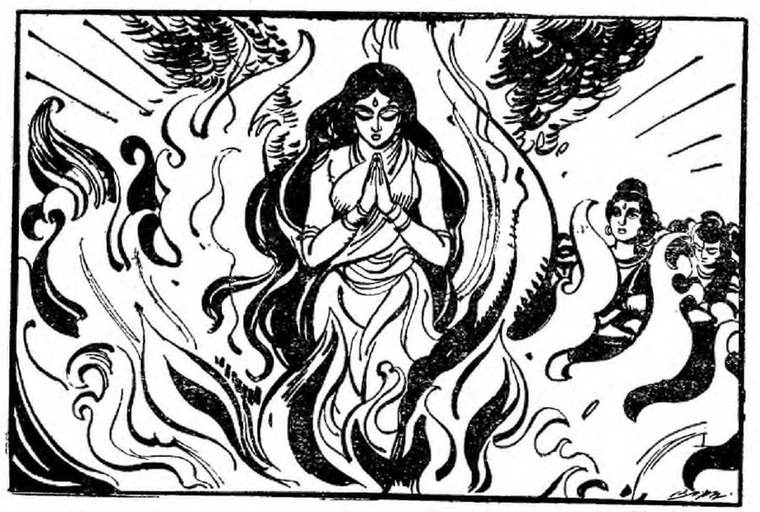
Sītā’s ordeal by fire

The story

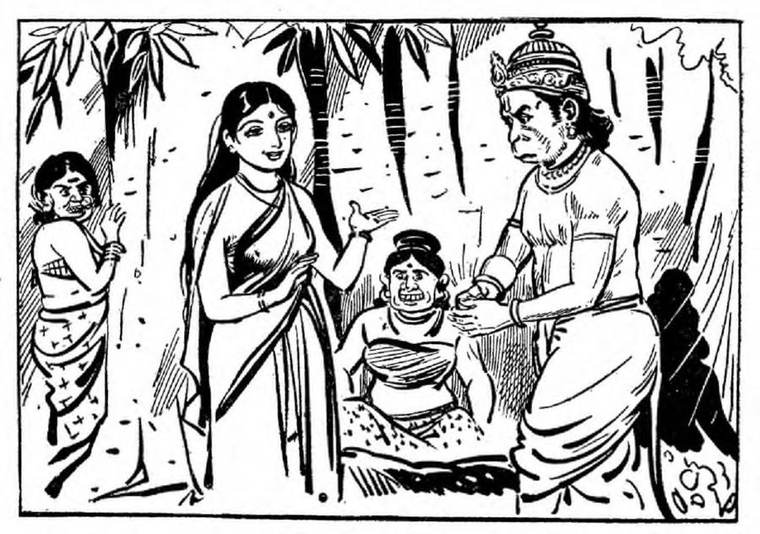
Vibhīṣaṇa is crowned. Hanumān brings Sītā the news; she is speechless with joy. He asks leave to kill the rākṣasīs who tormented her; she refuses: they were obeying orders; the noble show compassion to the sinful and the good alike — who has never done wrong?

Brought before Rāma in front of the whole army, Sītā is met with words cold as ice: I fought to wipe out the insult to my line; you lived a year in another man’s house; you may go where you please. Sītā, stunned, answers with dignity: you speak like a common man to a common woman; my body was seized when I was helpless, but my heart was always yours. She asks Lakṣmaṇa to build a pyre and walks into the fire. Agni himself rises carrying her, unharmed, and declares her pure.

The gods and Brahmā appear and tell Rāma that he is Nārāyaṇa. Rāma answers: “I think of myself as a man, Rāma, son of Daśaratha. Who I am and where I come from, let the Lord tell me.” He receives Sītā: I never doubted her; but the world had to see her purity. Daśaratha appears from heaven to bless them.

Verses

Yuddha Kāṇḍa 6.113.45–46 (6.116.44 in some editions)Sītā to Hanumān

Who has never erred?

पापानां वा शुभानां वा वधार्हाणामथापि वा ।
कार्यं कारुण्यमार्येण न कश्चिन् नापराध्यति ॥
pāpānāṃ vā śubhānāṃ vā vadhārhāṇām athāpi vā |
kāryaṃ kāruṇyam āryeṇa na kaścin nāparādhyati ||
Word by word
pāpānām vāto the sinful
śubhānām vāor to the good
vadha-arhāṇām atha api vāor even to those who deserve death
kāryamshould be shown
kāruṇyamcompassion
āryeṇaby the noble
na kaścitthere is no one
na aparādhyatiwho does not err

MeaningTo the sinful and the good, even to those who deserve death, the noble should show compassion — for there is no one who never does wrong.

ContextHanumān asks Sītā’s permission to kill the rākṣasīs who tormented her for ten months. She refuses: they were under orders; and she tells him the story of the bear and the tiger.

Philosophical aspectThe victim forgives first. Sītā, who suffered most, has the most compassion — the mark of the Divine Mother. Śrīvaiṣṇavas see in this verse why the Mother is approached before the Lord.

Yuddha Kāṇḍa 6.117.11 (6.120.11 in some editions)Rāma to Brahmā and the gods

“I think of myself as a man”

आत्मानं मानुषं मन्ये रामं दशरथात्मजम् ।
सो ऽहं यश्च यतश्चाहं भगवांस्तद्ब्रवीतु मे ॥
ātmānaṃ mānuṣaṃ manye rāmaṃ daśarathātmajam |
so 'haṃ yaś ca yataś cāhaṃ bhagavāṃs tad bravītu me ||
Word by word
ātmānammyself
mānuṣam manyeI consider a man
rāmamRāma
daśaratha-ātmajamson of Daśaratha
saḥ ahamthat I am
yaḥ caand who I am
yataḥ ca ahamand where I come from
bhagavānthe Lord
tat bravītu melet him tell me that

MeaningI think of myself as a man — Rāma, son of Daśaratha. Who I really am and where I come from, let the Lord tell me.

ContextAfter Sītā’s ordeal the gods tell Rāma that he is Nārāyaṇa. This is his answer; Brahmā then sings his divinity.

Philosophical aspectThe avatāra lives entirely within his human role. That is what makes him an example: a god we could not imitate; a man we can. Philosophically, it is also the stance of every seeker — “who am I?” is a question to be answered by the Lord (the guru, the śāstra), not assumed.

The deeper message

The most painful scene in the epic, and Vālmīki does not soften it. Rāma’s words wound, and Sītā answers him as an equal. The tradition offers many readings: Rāma acts as king and not as husband; the trial is for the world’s sake; the fire reveals rather than tests.

Sītā’s refusal to let Hanumān punish the rākṣasīs is one of the epic’s great verses on forgiveness: na kaścin nāparādhyati — there is no one who has never erred.

Rāma’s reply to the gods is the heart of his character: he will not claim divinity. He lives entirely as a man, so that men can follow him.

Inner meaning

The jīva that has passed through the city of the ego must be purified in the fire of knowledge before union. Agni gives back what was always pure.

Rāma here — which quality, and exactly where

  • Humility “I think of myself as a man, Rāma, son of Daśaratha” (6.117.11).
  • The king He subjects his own heart to the people’s scrutiny — the beginning of the tension that will break in the Uttara Kāṇḍa.
The Return and Rāma-rājya The Puṣpaka, Bharata at Nandigrāma, the coronation sargas 121–128 · 1 verse · 2 pictures
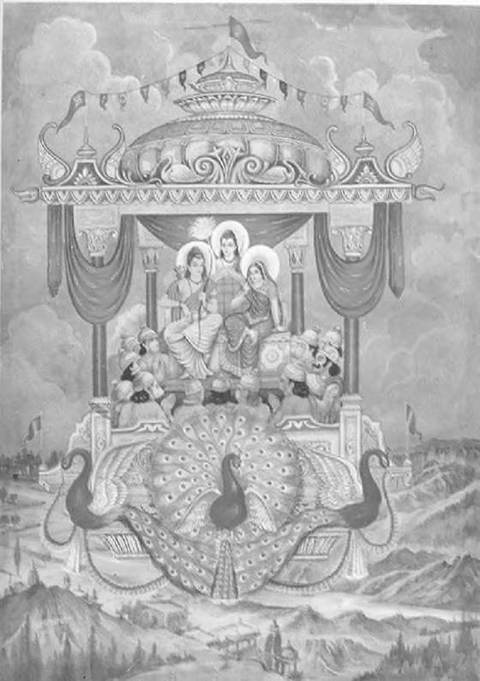
The Puṣpaka chariot carries them home
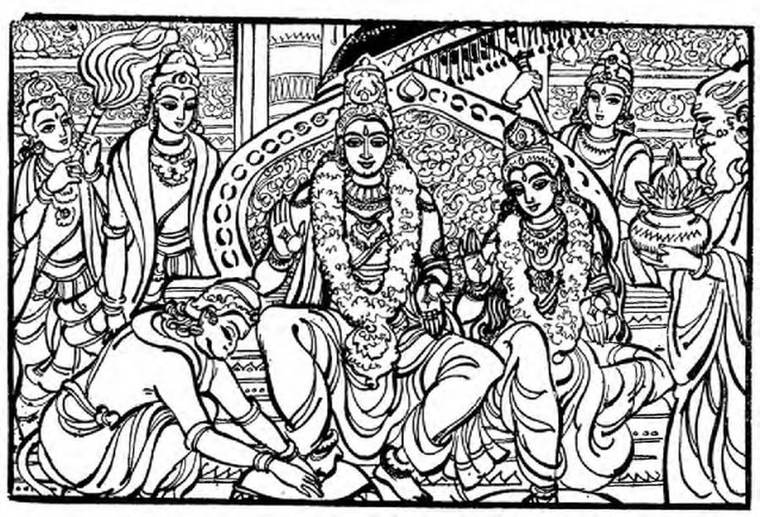
The coronation of Rāma

The story

Rāma will not stay a single night in Laṅkā: Bharata has vowed to enter the fire if Rāma is not back on the last day of the fourteen years. In the Puṣpaka chariot he flies north with Sītā, Lakṣmaṇa, Vibhīṣaṇa, Sugrīva and the monkeys, showing Sītā every place of the journey from the air. He sends Hanumān ahead — to see Guha, and to watch Bharata’s face: if he has come to enjoy the kingdom, let him keep it.

Hanumān finds Bharata at Nandigrāma, thin, in bark, living for Rāma. The brothers meet; Bharata returns the kingdom and the sandals. Rāma is crowned by Vasiṣṭha, with Sītā beside him. He gives gifts to all; Sītā gives her pearl necklace to Hanumān. Rāma rules for eleven thousand years, and in his reign no widow mourned, no one feared snakes or disease, there were no thieves, and everyone did their duty with joy.

Verses

Yuddha Kāṇḍa 6.128.99–100the narrator

Rāma-rājya

न पर्यदेवन् विधवा न च व्यालकृतं भयम् ।
न व्याधिजं भयं वापि रामे राज्यं प्रशासति ॥
निर्दस्युरभवल्लोको नानर्थः कञ्चिदस्पृशत् ।
na paryadevan vidhavā na ca vyāla-kṛtaṃ bhayam |
na vyādhijaṃ bhayaṃ vāpi rāme rājyaṃ praśāsati ||
nirdasyur abhaval loko nānarthaḥ kañcid aspṛśat |
Word by word
na paryadevandid not lament
vidhavāḥwidows
na ca vyāla-kṛtam bhayamnor was there fear of wild beasts
na vyādhi-jam bhayam vā apinor fear born of disease
rāme rājyam praśāsatiwhile Rāma ruled the kingdom
nirdasyuḥ abhavat lokaḥthe world was free of robbers
na anarthaḥ kañcit aspṛśatno misfortune touched anyone

MeaningWhile Rāma ruled, no widow lamented, there was no fear of wild beasts or of disease; the world was free of thieves, and no misfortune touched anyone.

ContextFrom the description of Rāma’s reign at the end of the Yuddha Kāṇḍa (the original ending of the epic in many scholars’ view).

Philosophical aspectRāma-rājya is not a utopia of wealth but of security and dharma: people do their own duty, the ruler serves, and fear disappears. Inwardly it is the mind ruled by the Self — free of fear.

The deeper message

Rāma’s first concern on victory is the vow of another — Bharata’s — and his test of Bharata is a test of himself: he is ready to give the kingdom away again. The journey home retraces the journey out: Laṅkā to Ayodhyā is the spiritual path, the return of the jīva to its source.

Rāma-rājya has become India’s word for ideal government: rule as service, in which the king’s dharma becomes the people’s.

Inner meaning

Ayodhyā to Laṅkā: the material path; Laṅkā to Ayodhyā: the spiritual path. Rāma-rājya is the resurrection of spiritual culture in a person and a society.

Rāma here — which quality, and exactly where

  • The brother He hurries home to keep Bharata from the fire, and is ready to give him the kingdom (6.125).
  • The king Rāma-rājya (6.128).
  • Gratitude He honours every ally — Guha, Sugrīva, Vibhīṣaṇa, Hanumān — at the coronation.

Study companion — Yuddha Kāṇḍa

ṣaṣṭhaḥ kāṇḍaḥ

Yuddha Kāṇḍa — The Book of War

128 sargas · Vibhīṣaṇa's refuge, the bridge, the ten great duels, the fire-ordeal, the coronation

The longest kāṇḍa and doctrinally the richest: śaraṇāgati receives its charter here, the ocean learns the sequence of Rāma's patience and wrath, and the war is framed throughout as dharma's due process — ultimatums served, spies released, funerals granted the enemy. It ends with the revelation Rāma declines to be impressed by, and the coronation the whole epic has withheld.

❖ Golden boxes moments that define Rāma as Maryādā Puruṣottama Green boxes where Kamban’s Tamil Rāmāyaṇam tells it differently Verse cards ślokas worth memorising

Vibhīṣaṇa-Śaraṇāgati — the Charter of Refugesargas 1–19StoryVerse❖ MaryādāBhakti

Sargas 6–16, Laṅkā's councils: the sycophants promise easy victory; Kumbhakarṇa tells his brother the truth and pledges his life anyway; Vibhīṣaṇa alone argues policy — return Sītā, for this Rāma is beyond us — and persists through insult until Rāvaṇa's foot answers his counsel. Sarga 17: Vibhīṣaṇa with four companions crosses the sea and stands in the air above the vānara camp — refuge sought from a hover, submission without surrender of dignity — "I have abandoned Laṅkā, kingdom and friends; my life and welfare now rest on Rāma." Sarga 17–18, the council: Sugrīva votes execution (a rākṣasa, a brother-deserter, a probable spy); others propose tests; Hanumān argues from voice, face and circumstance that the refugee is genuine. Rāma's ruling ends the debate and founds a theology: friend or spy, he cannot be refused — I could no more turn away one come as a friend than the ocean refuse rivers; and then the vow:

Yuddha Kāṇḍa 18.33 — the Rāma-carama-śloka
सकृदेव प्रपन्नाय तवास्मीति च याचते ।
अभयं सर्वभूतेभ्यो ददाम्येतद् व्रतं मम ॥
sakṛd eva prapannāya tavāsmīti ca yācate |
abhayaṁ sarva-bhūtebhyo dadāmy etad vrataṁ mama ||
sakṛt eva — even once, just once
prapannāya — to one who has taken refuge
tava asmi iti — "I am yours" — with these words
ca yācate — and who so entreats
abhayam — fearlessness, protection
sarva-bhūtebhyaḥ — from all beings
dadāmi — I give
etat vratam mama — this is my vow

Śrī Vaiṣṇava tradition counts this the epic's parallel to the Gītā's sarva-dharmān parityajya: refuge sought once, in the bare formula "I am yours," obligates the Lord totally — no qualification, no repetition, no merit required. And Rāma extends it past all prudence in the same breath: "bring him — even were it Rāvaṇa himself, I would not turn him away." Then the act that outruns even the vow: sea-water is brought, and Vibhīṣaṇa is consecrated king of Laṅkā on the spot — the refugee crowned before the war for his kingdom has begun. Refuge, in Rāma's hands, is not shelter but coronation.

Maryādā Puruṣottama — the calculus he refuses

Every realist argument (Sugrīva's) is strategically sound, and Rāma does not rebut it — he overrules it: the śaraṇāgata-rakṣā vow is not subject to risk-assessment, because a protection contingent on the protector's convenience is not protection. He adds the seal of self-reference: "I would not abandon one come in friendship even if he bore a fault — the good would blame me" (mitrabhāvena samprāptaṁ na tyajeyaṁ kathañcana / doṣo yady api tasya syāt satām etad agarhitam). The boundary that defines him here is drawn around the other's safety, at his own risk — maryādā's most generous geometry.

Kamba Rāmāyaṇam differs

Kambar, writing where prapatti doctrine was crystallizing, expands the scene enormously — his Rāma declares that had Rāvaṇa himself come, he would have received back Laṅkā and Ayodhyā besides. Kambar also inserts into Laṅkā's councils the story of Prahlāda and Hiraṇyaṉ (Iraṇiyaṉ vataip paṭalam), absent from Vālmīki: a prior tyrant who denied the Lord, held up as a mirror to Rāvaṇa — making Vibhīṣaṇa a second Prahlāda and binding the Rāma story into the larger avatāra cycle.

The Ocean & the Bridge — Patience, Wrath, Engineeringsargas 19–22Story❖ Maryādā

On Vibhīṣaṇa's counsel Rāma seeks passage from the ocean-god by the gentle road first: three days and nights of darbha-grass fasting supplication on the shore — ignored. Sarga 21: the sequence reverses — "the world honours the insolent and slights the mild; I will dry you to sand and the army will walk" — and the bow that terrifies creation bends; the sea boils, creatures blaze, the vaḍavā-fire gapes. Samudra rises, jewelled and contrite, pleads his constitution (depth and immovability are his svabhāva) and offers the alternative: I will bear a bridge and hold it; and the drawn arrow, which cannot return unspent, is redirected at his own request to the marauders of Drumakulya. Sarga 22: Nala, Viśvakarman's son, engineers the setu — a hundred yojanas in five days, mountains and trees streaming from the vānara chains into the sea.

Maryādā Puruṣottama — the ordering of means

The template scene for Rāma's use of force: courtesy first, exhaustively (three full days — the patience is not token); wrath second, sufficient and terrifying (the sixteenth guṇa displayed, so that its earlier restraint is revealed as choice, not incapacity); and the instant the object submits, the wrath is re-sheathed and even the loosed arrow is bent to a lawful target. Power in Rāma is a court of appeals: mildness, then force, then mercy — in that order, always, and never skipping the first step.

Overtures & Ultimatums — Spies Released, Śuka-Sāraṇa, Aṅgada's Embassysargas 20, 25–29, 41Story❖ Maryādā

Interleaved with the crossing, Vālmīki runs a study in belligerents' law. Rāvaṇa's spies Śuka and Sāraṇa, caught walking the vānara camp in monkey-form, are seized by the troops — and released by Rāma with a message: "You have seen our forces; look again if anything remains unseen; tell Rāvaṇa what you saw" (sargas 25–26; their honest report home nearly costs them their heads). A second spy-ring under Śārdūla, likewise caught, likewise freed. Rāvaṇa meanwhile fights with illusions: the sorcerer Vidyujjihva conjures Rāma's severed head and bow before Sītā (sargas 31–32) — grief interrupted, pointedly, by a war-summons; Sītā is saved from despair by the guard Saramā, Vibhīṣaṇa's wife, the grove's one kind spy. And on the brink of battle Rāma serves final process: Aṅgada goes as herald (sarga 41) — return Sītā and seek pardon, or the throne of Laṅkā attends your funeral. Rāvaṇa's answer is to order the envoy seized; Aṅgada shakes off four captors, stamps the palace roof to splinters, and returns.

Maryādā Puruṣottama — war as due process

Count the steps Rāma will not skip even against the abductor of his wife: spies fed and freed (twice), intelligence gifted to the enemy, a formal last offer of peace delivered after the army stands on Laṅkā's soil. The contrast is the argument — Rāvaṇa's side fights with disguises, illusions and seized envoys; Rāma's fights on the record. Dharma-yuddha is not naivety here but identity: he would rather lengthen the war than shorten the standard.

The Ten Great Duels — from Nāga-pāśa to Kumbhakarṇasargas 42–68StoryKamba

The war proper is an escalating sequence of set-piece reversals. Sargas 44–50: Indrajit's first triumph — invisible from the sky, he binds both brothers in the serpent-arrows (nāga-pāśa); the army despairs over the fallen princes until Garuḍa's unsummoned advent (the serpents' ancient enemy — the snakes flee at his approach) frees and heals them. Sargas 51–58: the generals' ladder — Dhūmrākṣa falls to Hanumān, Vajradaṁṣṭra to Aṅgada, Akampana to Hanumān, and the marshal Prahasta to Nīla. Sargas 59: Rāvaṇa himself takes the field — his śakti fells Lakṣmaṇa (lifted away by Hanumān, healed by his own divine substance); and then the moment studied below at "the humiliation": Rāma, afoot, against Rāvaṇa charioted — and Rāvaṇa disarmed, crownless, spared. Sargas 60–68: the waking of Kumbhakarṇa.

Kumbhakarṇa — the clear head, the doomed heart

Woken from cursed sleep by drums, tusked elephants walking on him, and mountains of food, the colossus hears the situation and tells Rāvaṇa the plain truth: you were counselled rightly and did wrong; Sītā should go home. Then he fights — because a brother is not deserted in war — devouring vānaras by the fistful, felling Sugrīva, shrugging off Hanumān, until Rāma dismantles him arrow by arrow (arms, legs, and the vast head last, rolling into the sea). Vālmīki's tragedy of loyalty: the one Laṅkān who sees clearly, spending his sight on the wrong side knowingly.

Kamba Rāmāyaṇam differs

Kambar raises Kumbhakarṇa into one of his noblest figures — the counsel and death scenes are among the most quoted Tamil verses, the giant dying with the Lord in mind. His Rāvaṇa too is granted tragic grandeur: Śiva-bhakta, scholar, vīṇā-master, ten heads of accomplishment ruined by one appetite — a fallen hero more than a monster. The Tamil epic lights its villains from within, so that the Lord's victory reads as their rescue too.

Indrajit's War of Māyā — and Lakṣmaṇa's Oathsargas 69–91StoryVerse❖ Maryādā

After the princes Narāntaka, Devāntaka, Triśiras and the mountainous Atikāya fall (Atikāya to Lakṣmaṇa's brahmāstra — Vāyu having whispered the one weapon his armour respects), Indrajit returns as the war's terror: sargas 73–74, his second invisible assault with the brahmāstra levels the entire army — the two brothers among sixty-seven crores down — and only Hanumān, Vibhīṣaṇa and a handful stand. Jāmbavān, half-conscious, asks first not for Rāma but for Hanumān — "if he lives, the slain army lives" — and sends him north: the first flight to the Himālaya for Mount Droṇa's healing herbs; the herbs hide; Hanumān brings the peak entire. Sargas 80–84: Indrajit's cruellest stroke — before Hanumān's eyes he butchers an illusory Sītā, and the news guts the army and fells Rāma into a faint — until Vibhīṣaṇa decodes it: a feint to buy time for the Nikumbhilā sacrifice which, completed, makes Indrajit invincible. The counter is immediate: Lakṣmaṇa, with Vibhīṣaṇa guiding and Hanumān's shoulders for a chariot, interrupts the rite (sargas 85–90) and fights the war's longest duel. At its crisis, Lakṣmaṇa fits the aindra-astra and stakes the shot on a proposition:

Yuddha Kāṇḍa 91.73 (vulgate) — Lakṣmaṇa's oath
धर्मात्मा सत्यसन्धश्च रामो दाशरथिर्यदि ।
पौरुषे चाप्रतिद्वन्द्वः शरैनं जहि रावणिम् ॥
dharmātmā satya-sandhaś ca rāmo dāśarathir yadi |
pauruṣe cāpratidvandvaḥ śaraiṇaṁ jahi rāvaṇim ||
dharmātmā — of dharma-souled nature
satya-sandhaḥ ca — and true to his bond
rāmaḥ dāśarathiḥ yadi — if Rāma, Daśaratha's son, is such
pauruṣe ca apratidvandvaḥ — and matchless in manliness
śara — O arrow
enam jahi rāvaṇim — slay this son of Rāvaṇa

The satya-kriyā — the act of truth — in its purest epic form: the arrow's warhead is a fact about Rāma's character, staked publicly, falsifiable in flight. It flies true and takes Indrajit's head, and the tradition reads the physics plainly: in this universe, Rāma's dharma is a force-carrying field. That his brother could bet a war on it, and win, is the epic's own verdict on the Maryādā Puruṣottama — sworn testimony, tested under fire.

Rāvaṇa's Endgame — the Śakti, the Brothers' Bond, the Final Duelsargas 92–111StoryVerse❖ Maryādā

Indrajit's death breaks Rāvaṇa: grief becomes a rush at Sītā with drawn sword, stopped at the last instant by the minister Supārśva's counsel (kill a woman, and become forever what your enemies say you are — even Laṅkā's court has a maryādā-keeper). Sargas 96–101: the final sorties. Rāvaṇa's dart aimed at Vibhīṣaṇa — the traitor first — is intercepted by Lakṣmaṇa's body: the invincible śakti, Maya's masterwork, drops him apparently dead. Rāma's lament over his brother is the epic's charter of fraternal love:

Yuddha Kāṇḍa 101 (vulgate) — Rāma over the fallen Lakṣmaṇa
देशे देशे कलत्राणि देशे देशे च बान्धवाः ।
तं तु देशं न पश्यामि यत्र भ्राता सहोदरः ॥
deśe deśe kalatrāṇi deśe deśe ca bāndhavāḥ |
taṁ tu deśaṁ na paśyāmi yatra bhrātā sahodaraḥ ||
deśe deśe — in land after land
kalatrāṇi — wives (may be found)
bāndhavāḥ ca — and kinsmen too
tam tu deśam na paśyāmi — but that land I do not see
yatra — where (one might find)
bhrātā sahodaraḥ — a brother born of the same womb

"What is Sītā to me, what is victory, what is life itself, with you lying here?" — the man who has waged the war of an age for his wife declares, over his brother's body, that the brother is the irreplaceable one. The verse must be held together with its rescue: Hanumān's second Himālayan flight (the physician Suṣeṇa names the herbs; the mountain comes again), Lakṣmaṇa restored — and his first words a rebuke to Rāma's despair: your vow stands; grieve later, fight now. The bond runs both ways: each brother is the other's keeper of the code.

The duel of the age

Sargas 102–111: Indra sends his own chariot and charioteer Mātali — heaven balancing the field. (In the vulgate's cherished sarga 105, Agastya arrives mid-battle to teach Rāma the Āditya-hṛdayam, the sun-hymn of victory; its recension status varies, its recitation tradition does not.) The duel outruns all similes — "the sky is like the sky, the ocean like the ocean, and the Rāma-Rāvaṇa war like the Rāma-Rāvaṇa war" (gaganaṁ gaganākāraṁ sāgaraḥ sāgaropamaḥ / rāma-rāvaṇayor yuddhaṁ rāma-rāvaṇayor iva). Heads cut regrow; the arsenal empties; until Mātali reminds Rāma of the brahmāstra Agastya gave — wind in its feathers, sun and fire in its head, Meru's mass in its weight — and Rāma sends it not at the heads but the heart, where the boon never applied. The world exhales; flowers rain on the chariot.

Maryādā Puruṣottama — the two mercies

Hold the endgame's two ❖ moments together. First, the earlier humiliation-mercy (sarga 59): Rāvaṇa disarmed, chariot smashed, crown struck off — and Rāma lowers the bow: "You are tired. Go home, rest, return tomorrow with fresh weapons and chariot, and see my strength then." Vālmīki's fighters know this is worse than death — and it is also exactly the fence: the unarmed are not killed, even this unarmed man. Second, the victory-mercy: rejoicing is forbidden (maraṇāntāni vairāṇi — "enmities end at death; he is now ours as much as yours"), and Vibhīṣaṇa is ordered to give his brother the full royal funeral. The war's last command is a cremation performed with honour for the man who caused it all.

Agni-parīkṣā, the Revelation & the Returnsargas 112–127Story❖ MaryādāPhilosophyKamba

Sargas 112–118: Vibhīṣaṇa crowned in Laṅkā (the vow of sarga 19 redeemed to the letter); Hanumān carries the news to Sītā — and asks leave to slaughter her tormentor-rākṣasīs, which she refuses with the epic's great verse of clemency: servants act under orders; my own karma, not they, earned my suffering; and "the noble deal compassionately even with the wicked, for no one is guiltless" (na kaścin nāparādhyati). Then the reunion Vālmīki refuses to soften: Sītā, bathed and adorned at Rāma's insistence, is received before the whole army with a public coldness that stuns it — the war was for honour, not for you; twelve months in another man's house end my claim; go where you will. Her reply cuts to the bone — "you speak like a common man to a common woman... my birth from the Earth you never weighed; the heart that never left you, you never knew" — and she orders the pyre from Lakṣmaṇa, whose eyes ask Rāma and receive silence. She circles her husband, invokes Agni as witness of her purity, and enters.

The testimony of fire, and the reply to Brahmā

Sargas 117–120: the gods descend in a body — this of all things cannot stand — and Brahmā speaks the revelation: you are Nārāyaṇa, the imperishable; Sītā is Lakṣmī; the abduction was the device of your descent. Rāma's answer first (117.11), before any acceptance: ātmānaṁ mānuṣaṁ manye rāmaṁ daśarathātmajam — "I hold myself a man, Rāma, Daśaratha's son; who I am, and whence, let the Lord himself say." Then Agni rises from the pyre bearing Sītā untouched, testifying on oath to her absolute purity in thought, word and glance — and Rāma receives her with the tradition's key gloss: he never doubted; but the world would not have believed his private knowledge, and the queen of the standard-bearer must be vindicated publicly or the standard dies. Vālmīki has arranged that Sītā's exoneration is delivered by god and element, not granted by her husband — her honour owes Rāma nothing. Daśaratha appears from heaven, blesses both, and at Rāma's asking pardons Kaikeyī; Indra revives the fallen vānara host.

Maryādā Puruṣottama — the costliest boundary, and the declined divinity

Two ❖ readings, held in tension by the tradition itself. The parīkṣā: the king's private certainty may not overrule the public standard — the most expensive application of "the ruler is the copybook," paid for by the two people least deserving of the bill; whether the principle justified the price is the argument Vālmīki deliberately leaves running (and the Uttara will reopen). The revelation: told to his face that he is God, Rāma declines to be relieved of his humanity — the maryādā holds even against Brahmā, for an ideal man who knew himself divine would be no ideal for men. The fence's last test is flattery from heaven, and it holds.

The return — the road home replayed

Sargas 121–127: fourteen years expire the next morning; the Puṣpaka vimāna (Vibhīṣaṇa's gift of Kubera's stolen craft) carries the whole company north as Rāma narrates the entire journey to Sītā in reverse — setu, Kiṣkindhā (where the vānara wives join at Sītā's asking), Ṛṣyamūka, Pañcavaṭī, the āśramas, Citrakūṭa, the rivers — the epic recapitulating itself from the air. At Bharadvāja's, Hanumān is sent ahead to Nandigrāma in human form on the mission the tradition loves: watch Bharata's face as the news lands — if the regent flinches at losing the regency, say nothing and return. Bharata, matted-haired, emaciated beside the enthroned sandals, hears — and floods with joy. Sarga 127: the reunion of the four brothers; the sandals restored to Rāma's feet by Bharata's own hands with the kingdom "returned with interest — its treasuries and armies tenfold."

Kamba Rāmāyaṇam differs — where the epic ends

Kambar's epic concludes with the paṭṭābhiṣeka: no rumour, no second exile, no final separation — the traditional Tamil Uttara Kāṇḍam is attributed to Oṭṭakkūttar, not Kambar. The devotional logic is exact: an epic of the Lord's saving descent properly ends in enthronement and union, Lakṣmī and Nārāyaṇa restored, the world set right. The tragic coda belongs to Vālmīki's colder and vaster design — see the Uttara below.
Paṭṭābhiṣeka — the Coronation & Rāma-Rājyasarga 128Story❖ Maryādā

Vasiṣṭha and the sages consecrate Rāma on the ancestral throne with the waters of the four seas and five hundred rivers; Sugrīva, Vibhīṣaṇa, Aṅgada, Hanumān and the allies are honoured with gifts fitting an age's gratitude. The beloved detail: Sītā, unclasping her pearl necklace, looks at Rāma; reading her, he says "give it to the one with whom you are most pleased" — and it goes to Hanumān, who (in the tradition's cherished elaboration) bites each pearl seeking Rāma inside. The kāṇḍa closes on Rāma-rājya, the eleven thousand years the phrase still names: no widows' grief, no disease, no famine; rains in season; each order in its dharma; "all creatures delighted, all intent on dharma, looking to Rāma alone" — the ruler as copybook, at last with a kingdom copying. The phala-śruti that follows reads like the epic's original ending — which, many scholars hold, it once was.

Maryādā Puruṣottama — the point of the whole exercise

Rāma-rājya is what the maryādā was for. Every boundary kept in exile — the word, the vow, the discipline of force, the refusal of shortcuts — is now revealed as statecraft in advance: a people will keep limits only for a king who visibly kept his own when keeping them cost everything. The fourteen-year detour was the constitution being written in conduct. This is the note to carry into a first reading: the epic is not about a throne lost and regained, but about what has to be true of a man before a golden age can be true of his kingdom.

Verses follow the Gita Press (southern) numbering, checked against valmikiramayan.net; other editions may differ by a few verses, and the critical edition omits some popular verses (marked). Stories are retold in brief from Vālmīki, with C. Rajagopalachari and Kamala Subramaniam for further reading; later additions (Tulasīdāsa, Kamban, folk tradition) are marked as such. The symbolic readings are offered for reflection — one way among several of hearing the story. Drawings: Vipin K. Das, from Children’s Illustrated Ramayanam, retold by Vishnu B (2011).