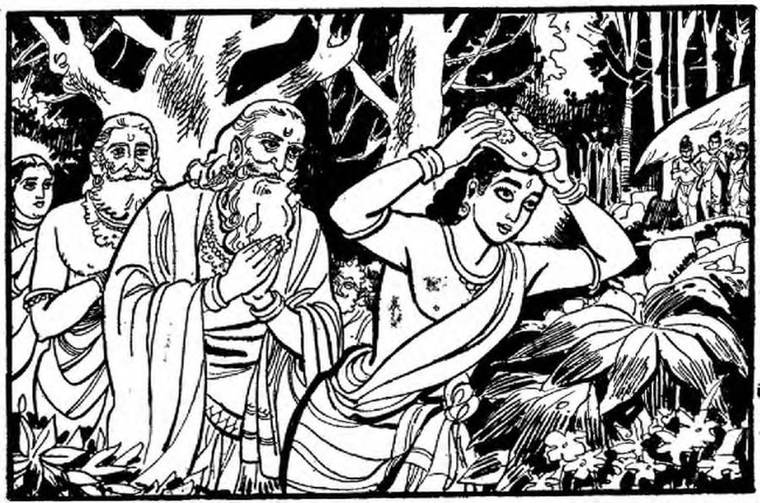
On the eve of his coronation Rāma is sent into the forest for fourteen years. He goes without a trace of resentment, Sītā and Lakṣmaṇa insist on going with him, Daśaratha dies of grief, and Bharata refuses the throne and rules in Rāma’s name with Rāma’s sandals on it.
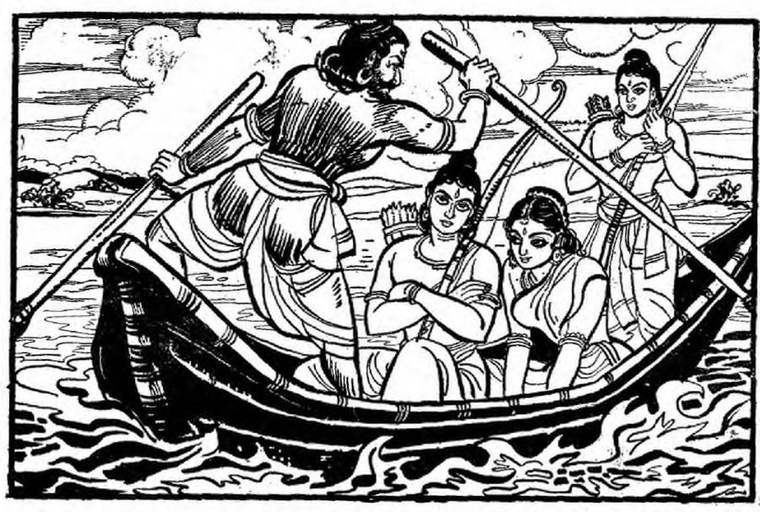
Guha ferries Rāma, Sītā and Lakṣmaṇa across the Gaṅgā
Dharma under pressure. Every relationship — father and son, mother and son, husband and wife, brother and brother, king and people — is tested in a single day, and each answers differently. It is the kāṇḍa of renunciation (tyāga), and it has two heroes: Rāma who gives up the kingdom, and Bharata who refuses to take it.
Its inner meaning
The moment of greatest success is the moment of greatest danger: a single thought (Mantharā) entering a good mind (Kaikeyī) is enough to turn joy into exile. Rāma’s unchanged face is the sthita-prajña of the Gītā — the person whose peace does not depend on gain or loss. Bharata shows the other half of spiritual life: the sincere seeker who will not enjoy what belongs to the Lord, and who lives as His trustee.
The Coronation AnnouncedRāma as Ayodhyā sees himsargas 1–5 · 1 verse · 1 picture
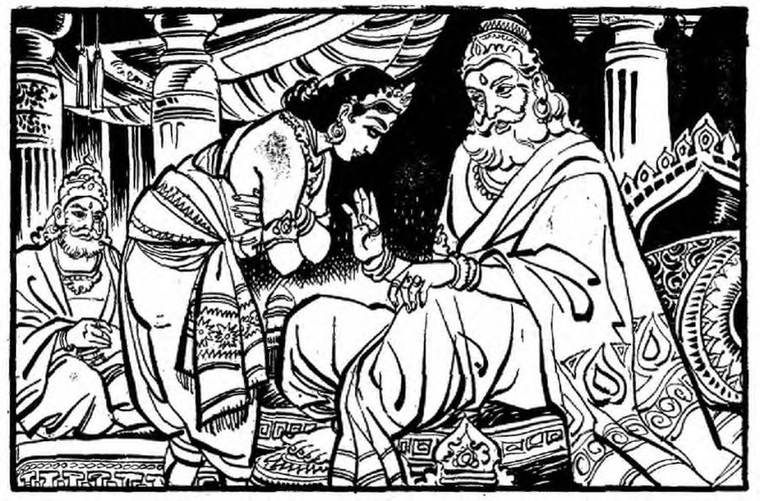
Daśaratha tells Rāma he is to be crowned
The story
Daśaratha is growing old. He calls an assembly of princes, ministers and citizens and proposes that Rāma be made yuvarāja, crown prince. The assembly’s answer is a roar of joy, and when the king asks why they want Rāma so much, they answer with a portrait: he is soft-spoken and never harsh even when spoken to harshly; he remembers a single kindness and forgets a hundred injuries; he asks every citizen about his family as a father would; he is learned yet humble, brave yet gentle.
The coronation is fixed for the next morning, when the moon enters Puṣya. Daśaratha, uneasy with bad dreams, tells Rāma to fast that night with Sītā and to be crowned at dawn — quickly, while Bharata is away at his uncle’s.
स च नित्यं प्रशान्तात्मा मृदुपूर्वं च भाषते । उच्यमानो ऽपि परुषं नोत्तरं प्रतिपद्यते ॥ कथञ्चिदुपकारेण कृतेनैकेन तुष्यति । न स्मरत्यपकाराणां शतमप्यात्मवत्तया ॥
sa ca nityaṃ praśāntātmā mṛdu-pūrvaṃ ca bhāṣate | ucyamāno 'pi paruṣaṃ nottaraṃ pratipadyate || kathañcid upakāreṇa kṛtenaikena tuṣyati | na smaraty apakārāṇāṃ śatam apy ātmavattayā ||
Word by word
saḥ caand he
nityamalways
praśānta-ātmāof tranquil mind
mṛdu-pūrvamgently, and first
bhāṣatespeaks
ucyamānaḥ api paruṣameven when spoken to harshly
na uttaram pratipadyatedoes not retort
kathañcitsomehow, even slightly
ekena upakāreṇa kṛtenaby a single kindness done
tuṣyatihe is pleased
na smaratidoes not remember
apakārāṇām śatam apieven a hundred injuries
ātmavattayābecause of his self-possession
MeaningEver tranquil, he speaks gently and speaks first; even when spoken to harshly he does not answer back. He is pleased by a single kindness done to him somehow, and because he is self-possessed he does not remember even a hundred wrongs.
ContextThe poet’s description of Rāma at the start of the Ayodhyā Kāṇḍa — the qualities the citizens love. Mṛdu-pūrvam also means he is the first to speak (pūrva-bhāṣī): he greets others before they greet him.
Philosophical aspectThe cause is given in one word: ātmavattayā — because he rests in the Self. A mind that is full does not need to hit back, and does not keep accounts of injuries. Gratitude and forgiveness are not techniques; they are the natural behaviour of a contented mind.
The deeper message
Vālmīki lets the people describe Rāma before any test begins: we are shown the character first, so that when the blow falls we know exactly what is being tested. The qualities they praise are almost all qualities of the mind — gentle speech, gratitude, patience, care for others — not of power.
Note the old king’s haste. Even a good man, attached to an outcome, starts arranging things quietly; the shadow that falls next will enter through exactly that anxiety.
Rāma here — which quality, and exactly where
Gentle speech “He always speaks gently and first; even when spoken to harshly he does not answer back” (2.1.10).
Gratitude “He is satisfied with a single good turn and does not remember a hundred wrongs” (2.1.11).
The king The citizens choose him: his authority is the people’s love before it is the throne.
Mantharā’s Poison and Kaikeyī’s Two BoonsHow one thought turns a good heartsargas 7–14 · 1 picture
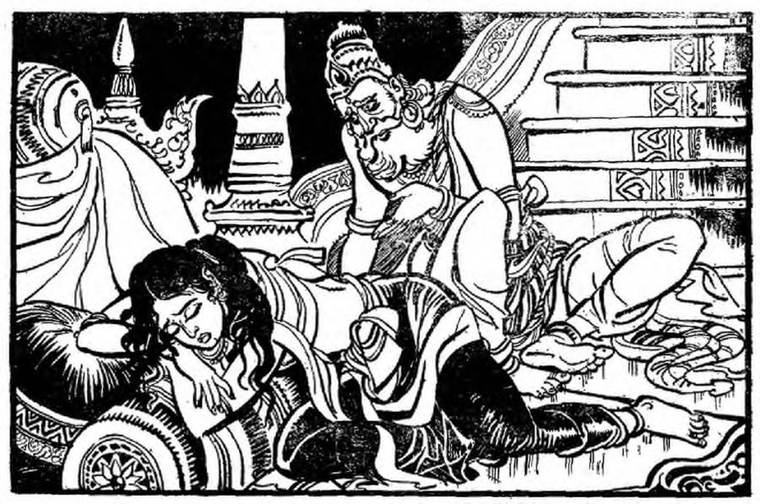
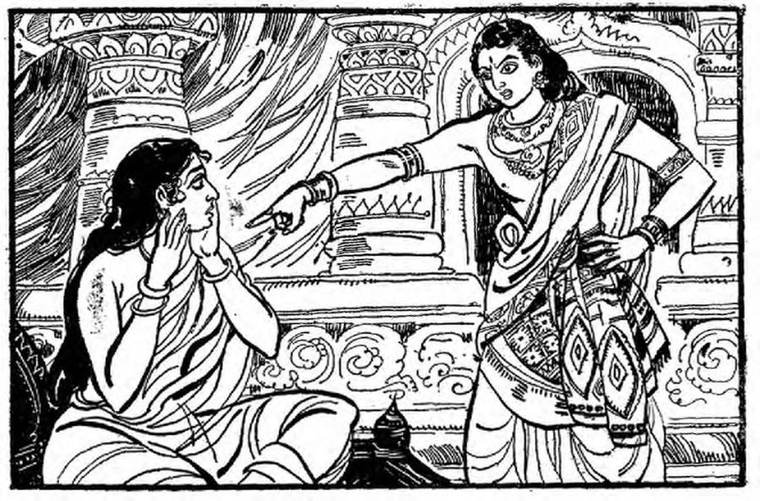
Kaikeyī in the chamber of anger; Daśaratha pleads
The story
From the palace roof the hunchbacked maid Mantharā sees the city decorated and learns why. She rushes to Kaikeyī. Kaikeyī’s first response is pure joy — she gives Mantharā a jewel for the news: “Rāma is as dear to me as Bharata.” Mantharā throws the jewel down and begins to work: when Rāma is king, Kausalyā will be queen-mother and you her servant; Bharata will be exiled or killed; your son’s life is in danger.
Slowly Kaikeyī’s face changes. Mantharā reminds her of two boons Daśaratha once granted when she saved his life in battle. Kaikeyī strips off her ornaments and lies on the floor of the “chamber of anger”. When the king comes, she makes him swear by Rāma, and then names the boons: Bharata to be crowned, and Rāma to be exiled to the Daṇḍaka forest for fourteen years, dressed as an ascetic. The king faints, pleads, falls at her feet. She does not yield.
The deeper message
This is the epic’s great study of the mind. Kaikeyī is not evil; she loves Rāma. But she gives a hearing to the wrong voice, and a thought repeated becomes a conviction, and a conviction becomes a demand. The Gītā’s ladder of fall (2.62–63) — dwelling, attachment, desire, anger, delusion — happens in one evening.
Satsaṅga matters. Kaikeyī’s goodness was real but undefended. Mantharā is any influence — a friend, a feed, a fear — that we allow to whisper unexamined.
Inner meaning
Mantharā, “the crooked one”, is the crooked thought; Kaikeyī is the good intellect that listens to it. The two boons — something for me (Bharata’s crown) and something against another (Rāma’s exile) — are the two faces of selfish desire.
Kaikeyī tells Rāma of the exile as Daśaratha lies stricken
The story
At dawn Rāma is summoned — not to the coronation hall, but to Kaikeyī’s chamber. His father lies broken and cannot speak. Kaikeyī says the king has something to say but is ashamed to say it. Rāma answers at once: “For my father’s word I would leap into fire, drink poison, drown myself in the sea. Tell me what he wishes; I promise it. Rāma does not speak twice.”
Kaikeyī tells him. Rāma’s reply is calm: “So be it. I will go to the forest today, wearing bark and matted hair. Only one thing pains me — that father did not tell me himself. I do not live for wealth; know me to be like the sages, devoted only to dharma.” He bows to his father and to Kaikeyī and walks out. Vālmīki says that no change could be seen in his mind — he left the kingdom as one who had risen above the world.
Verses
Ayodhyā Kāṇḍa 2.18.28–30Rāma to Kaikeyī
Rāmo dvir nābhibhāṣate — Rāma does not speak twice
ahaṃ hi vacanād rājñaḥ pateyam api pāvake | bhakṣayeyaṃ viṣaṃ tīkṣṇaṃ majjeyam api cārṇave || tad brūhi vacanaṃ devi rājño yad abhikāṅkṣitam | kariṣye pratijāne ca rāmo dvir nābhibhāṣate ||
majjeyam api ca arṇavewould even sink into the sea
tat brūhiso tell me
vacanamthe word
deviO queen
rājñaḥ yat abhikāṅkṣitamthat the king desires
kariṣyeI will do it
pratijāne caand I promise
rāmaḥRāma
dviḥtwice
na abhibhāṣatedoes not speak
MeaningAt the king’s word I would fall into fire, swallow deadly poison, or throw myself into the sea. So tell me, O queen, what the king wishes. I will do it — I promise. Rāma does not speak twice.
ContextRāma commits himself before he even knows what is asked. The last pāda has become a proverb: Rāma’s word, once given, is final; he never needs to say a thing a second time, and never takes it back.
Philosophical aspectSatya is not only not lying; it is making one’s word so reliable that it becomes a fact. The person who “does not speak twice” has become one with his speech — vāk and artha united.
MeaningI do not live for wealth, O queen, nor wish to dwell in the world for its own sake. Know me to be like the sages — established in dharma alone.
ContextRāma’s answer to the sentence of exile. The loss of the kingdom does not touch him because the kingdom was never his goal.
Philosophical aspectFreedom from artha and kāma as ends in themselves: the householder with the heart of a ṛṣi. This is the vairāgya that makes renunciation light — he does not give up the crown; it simply falls away.
Ayodhyā Kāṇḍa 2.19.33the narrator
No change in his mind
न वनं गन्तुकामस्य त्यजतश्च वसुन्धराम् । सर्वलोकातिगस्येव लक्ष्यते चित्तविक्रिया ॥
na vanaṃ gantu-kāmasya tyajataś ca vasundharām | sarva-lokātigasyeva lakṣyate citta-vikriyā ||
Word by word
na lakṣyatewas not seen
vanam gantu-kāmasyaof him who was set to go to the forest
tyajataḥ ca vasundharāmand was giving up the earth
sarva-loka-atigasya ivaas of one who has gone beyond all worlds
citta-vikriyāany disturbance of mind
MeaningAs he prepared to go to the forest and give up the earth, no disturbance could be seen in his mind — as in one who has risen above all the worlds.
ContextVālmīki’s comment as Rāma leaves Kaikeyī’s chamber. Tradition adds: his face on the morning of the coronation and on the morning of the exile was the same.
Philosophical aspectThe sthita-prajña of the Gītā: one established in the Self is not moved by gain or loss. Sarva-lokātiga — gone beyond all worlds — is how the Upaniṣads describe the jīvan-mukta.
The deeper message
This is the summit of the epic’s ethics. Rāma does not argue that the boons were unjust (they were), or that the king was trapped (he was). He sees only one thing: a father’s word must not become a lie because of his son. His joy did not depend on the crown, so its loss could not shake him.
In Vedānta terms this is sthita-prajñatā: duḥkheṣvanudvigna-manāḥsukheṣuvigata-spṛhaḥ (Gītā 2.56) — unshaken in sorrow, free of craving in joy. Tradition says his face was the same on the morning of the coronation and the morning of the exile.
Inner meaning
The crown and the forest are the pairs of opposites (dvandvas). The Self wears both as costumes.
Rāma here — which quality, and exactly where
Truthfulness “Rāmo dvir nābhibhāṣate” — Rāma does not speak twice (2.18.30).
The son Accepts exile to make his father’s word true, without being asked by him (2.18.28–30).
Equanimity No change was seen in him as he gave up the earth (2.19.33).
Anger on a leash Not one harsh word to Kaikeyī; he bows to her as he leaves.
Three Who Would Not Let Him GoKausalyā, Lakṣmaṇa and Sītāsargas 20–40 · 4 verses · 1 picture
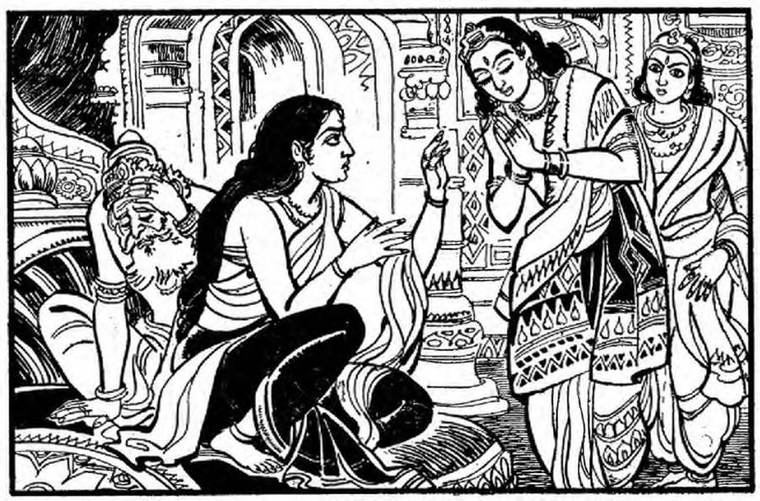
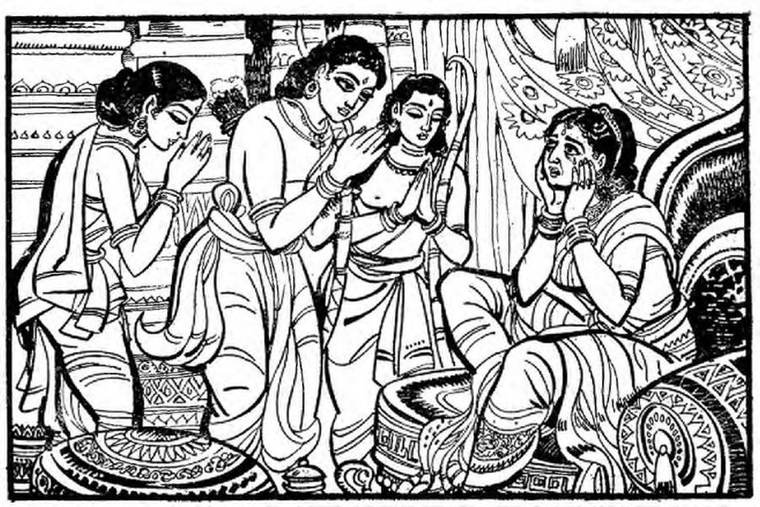
Rāma takes leave of Kausalyā, with Sītā and Lakṣmaṇa
The story
Kausalyā, who has waited a lifetime for this day, collapses. Then she argues: a mother’s command is as binding as a father’s — stay. Lakṣmaṇa blazes with anger: the king is senile and enslaved to a woman; let me take the kingdom by force. Rāma answers both. To his mother he speaks of dharma as the highest thing in the world, rooted in truth. To Lakṣmaṇa he says that this is not Kaikeyī’s doing but destiny’s, and that anger against her is pointless.
Then Sītā. Rāma asks her to stay, serve his parents and not mention his name to Bharata. She refuses, first gently, then with fire: “A wife shares her husband’s fortune. I will walk ahead of you, crushing the thorns. Without you heaven is hell; with you the forest is heaven.” She even taunts him — did my father marry me to a woman in a man’s form? Rāma yields.
Lakṣmaṇa begs to come too, and Sumitrā sends him with the immortal blessing: “Think of Rāma as Daśaratha, of Sītā as me, of the forest as Ayodhyā. Go, my son, in joy.”
dharmo hi paramo loke dharme satyaṃ pratiṣṭhitam | dharma-saṃśritam etac ca pitur vacanam uttamam ||
Word by word
dharmaḥ hidharma indeed
paramaḥ lokeis supreme in the world
dharmein dharma
satyamtruth
pratiṣṭhitamis established
dharma-saṃśritamrests on dharma
etat caand this
pituḥ vacanamfather’s word
uttamamis supreme (binding)
MeaningDharma is supreme in the world, and truth is established in dharma. This word of my father rests on dharma and is supremely binding.
ContextKausalyā argues that a mother’s word equals a father’s; Rāma does not dismiss her but places both under dharma. The father’s promise binds because it is a promise.
Philosophical aspectSatya and dharma hold each other up: truth is the foundation of right action, and right action is truth lived. A society’s order rests on kept promises.
bhukta-śeṣam udakam ivalike water left after a meal
MeaningI will go ahead of you, trampling the thorns and the sharp kuśa grass, casting out every jealousy and resentment like the water left over after a meal.
ContextSītā will not stay behind; she will not even walk behind. Her argument in this sarga is that a wife’s dharma is to share her husband’s lot, and that the forest with Rāma is better than a palace without him.
Philosophical aspectThe devotee does not follow the Lord from a distance; she clears His path. Notice what she promises to throw away first: jealousy and anger, the two feelings that would make the hardship bitter.
daśaratham viddhiknow to be Daśaratha (your father)
mām viddhiknow to be me (your mother)
janaka-ātmajāmJanaka’s daughter, Sītā
ayodhyām viddhiknow to be Ayodhyā
aṭavīmthe forest
gacchago
tātamy child
yathā-sukhamhappily
MeaningLook on Rāma as your father Daśaratha, on Sītā as me, and on the forest as Ayodhyā. Go, my son, and be happy.
ContextSumitrā, the quietest of the three queens, says the wisest thing in the kāṇḍa. Commentators read a second meaning: “Know Rāma to be Viṣṇu (who rests on Garuḍa, daśa-ratha), Sītā to be Lakṣmī (mā), and the forest where they are to be Vaikuṇṭha (a-yodhyā).”
Philosophical aspectHome is not a place but a presence. When the heart is with the Lord, every place is Ayodhyā; when it is not, even Ayodhyā is a forest.
yan maṅgalaṃ sahasrākṣe sarva-deva-namaskṛte | vṛtra-nāśe samabhavat tat te bhavatu maṅgalam ||
Word by word
yat maṅgalamthe auspiciousness that
sahasra-akṣein the thousand-eyed (Indra)
sarva-deva-namaskṛteworshipped by all the gods
vṛtra-nāśeat the destruction of Vṛtra
samabhavatarose
tatthat
teto you
bhavatu maṅgalammay it be auspicious
MeaningThe blessing that came to thousand-eyed Indra, worshipped by all the gods, when he destroyed Vṛtra — may that blessing be yours.
ContextFrom Kausalyā’s svasty-ayana — the long series of blessings with which she sends Rāma into exile, once she has accepted that he must go. The series is still recited as a blessing for travellers.
Philosophical aspectLove that has let go becomes blessing. Kausalyā moves from “stay” to “go well”: the shift from attachment to goodwill that every parent, and every seeker, has to make.
The deeper message
Each protest is a different kind of love. Kausalyā’s is the love that clings; Lakṣmaṇa’s, the love that fights; Sītā’s, the love that follows. Rāma meets the first two with dharma and gentleness; the third he cannot refuse, because it is itself dharma.
Sumitrā’s verse is one of the most quoted in the epic: when love is right, the place does not matter. Wherever the Lord is, that is home.
Inner meaning
Sītā’s refusal to stay behind is the devotee who will not accept the world without the Lord. Lakṣmaṇa is the one-pointed mind that follows the Self into every forest.
Rāma here — which quality, and exactly where
The son He consoles Kausalyā and asks her to care for his father — the son who comforts the parent who cannot accept his sacrifice.
The brother He restrains Lakṣmaṇa’s anger without a word against Kaikeyī (2.22).
Dharma embodied “Dharma is supreme in the world; truth rests in dharma” (2.21.41).
Leaving Ayodhyā — Guha and the CrossingThe citizens follow, a hunter-king servessargas 40–56 · 1 picture
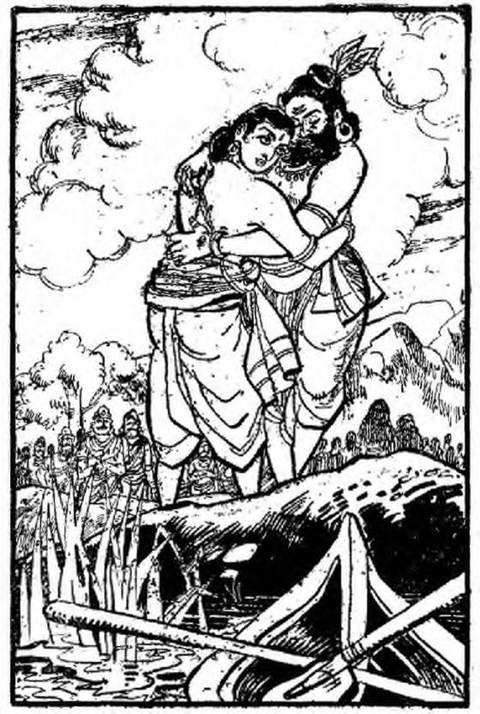
Guha ferries Rāma, Sītā and Lakṣmaṇa across the Gaṅgā
The story
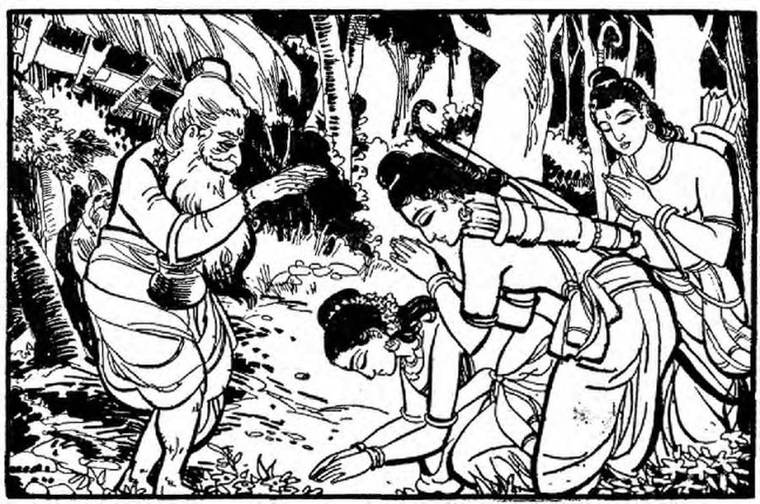
The whole city follows Rāma’s chariot. On the bank of the Tamasā he slips away before dawn so that they will go home. At Śṛṅgaverapura on the Gaṅgā the chief of the hunters, Guha, comes with food and offers his kingdom. Rāma embraces him as a friend, declines everything, and sleeps on the ground. Lakṣmaṇa stays awake all night guarding them, and Guha stays awake with him, weeping at the sight of the prince of Ayodhyā on a bed of grass.
At dawn Rāma sends the charioteer Sumantra back, mats his hair with banyan sap, and Guha ferries the three across the Gaṅgā. At Prayāga the sage Bharadvāja directs them to Citrakūṭa, where Lakṣmaṇa builds a hut of leaves.
The deeper message
Rāma’s first friend outside the palace is a tribal chief. In the epic Rāma is always at home with those society keeps at the edge — the hunter Guha, the tribal woman Śabarī, the vulture Jaṭāyu, the monkeys, the demon Vibhīṣaṇa. Friendship is the great equaliser.
Lakṣmaṇa’s night watch is the picture of sevā: service that asks nothing and sleeps not.
Inner meaning
Crossing the Gaṅgā is crossing over from the world of royal identity to the life of the ascetic — a death and a rebirth.
Rāma here — which quality, and exactly where
The friend Embraces Guha as an equal and calls him friend (2.50).
Compassion Slips away at night so that the citizens will not suffer following him into the forest (2.46).
The Death of DaśarathaThe curse of Śravaṇa’s fathersargas 57–66 · 1 verse
The story
Sumantra returns with an empty chariot. In the sixth night, sleepless, Daśaratha tells Kausalyā a secret from his youth. Hunting at night by the Sarayū, proud of his skill at shooting by sound, he heard what he thought was an elephant drinking and loosed an arrow. It was a young ascetic filling a pot for his blind, aged parents. The dying boy asked him to take the water to them. The father, hearing the truth, cursed the king: “You too will die grieving for your son.”
Daśaratha calls out “Rāma! Rāma!” and dies before dawn. There is no son at hand to perform his rites; his body is kept in oil until Bharata can be brought from Kekaya.
Verses
Ayodhyā Kāṇḍa 2.63.6Daśaratha to Kausalyā
One reaps what one sows
यदाचरति कल्याणि शुभं वा यदि वाशुभम् । तदेव लभते भद्रे कर्ता कर्मजमात्मनः ॥
yad ācarati kalyāṇi śubhaṃ vā yadi vāśubham | tad eva labhate bhadre kartā karma-jam ātmanaḥ ||
Word by word
yat ācaratiwhatever one does
kalyāṇiO auspicious one
śubham vāgood
yadi vā aśubhamor bad
tat evathat alone
labhatereceives
bhadreO gentle lady
kartāthe doer
karma-jamborn of the action
ātmanaḥhis own
MeaningWhatever one does, good or bad, O gentle lady, that alone the doer receives — the fruit born of his own action.
ContextSpoken by the dying king as he tells Kausalyā how he killed the young ascetic by mistake and was cursed to die grieving for his son.
Philosophical aspectThe law of karma in one line. Daśaratha does not blame Kaikeyī, fate or the gods; he sees his own past act returning. Responsibility is the beginning of peace.
The deeper message
Karma returns. Daśaratha’s sin was not malice but carelessness born of pride in a skill; its fruit waited for decades. The epic never lets us forget that we are actors and reapers both — what one does, good or bad, one receives.
He dies of attachment as much as grief: he loved Rāma more than his own word, and yet could not break his word. Caught between love and truth, the body gave way.
Bharata Refuses the ThroneThe second hero of the kāṇḍasargas 67–91 · 2 pictures
Bharata turns on KaikeyīGuha embraces Bharata
The story
Bharata arrives to a silent city. Kaikeyī tells him proudly that the kingdom is his. He recoils in horror and denounces her — “you have killed my father and exiled my brother; I will not be called your son.” Śatrughna catches Mantharā and would kill her, but Bharata stops him: Rāma would never forgive the killing of a woman.
Kausalyā, in her grief, suspects Bharata. He swears a string of terrible oaths that he knew nothing, until she embraces him. After the funeral rites he refuses the crown before the whole assembly and sets out with the army, the queens and the citizens to bring Rāma back. Guha, seeing an army, suspects an attack, and then, seeing Bharata in bark, weeps with him. At Bharadvāja’s hermitage too he is suspected and proves himself.
The deeper message
Bharata is the purest character in the epic — Rāma himself says so. Offered the world on a plate, he sees only that it is not his. His refusal is not politeness; it is identity: “I am Rāma’s servant.”
Notice how often he is suspected — by Kausalyā, Guha, Bharadvāja, even Lakṣmaṇa. Innocence is not exempt from doubt; it simply endures it without bitterness.
Inner meaning
Bharata is the sincere devotee who will not enjoy the Lord’s property; he will only hold it in trust.
The Meeting at CitrakūṭaRāma teaches Bharata — on duty, death and truthsargas 92–111 · 6 verses · 1 picture
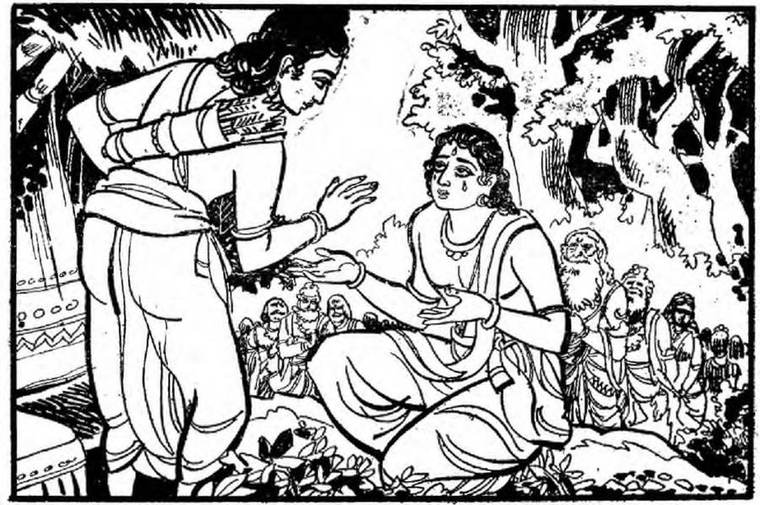
Bharata pleads with Rāma at Citrakūṭa
The story
Seeing the dust of an army, Lakṣmaṇa climbs a tree and grows furious: Bharata has come to kill them. Rāma rebukes him — “Bharata would never harm us. If you want the kingdom, I will ask him to give it to you.” Lakṣmaṇa falls silent, ashamed.
Bharata falls at Rāma’s feet. Rāma lifts him and, before anything else, asks how the kingdom is being run — a whole sarga of questions on good governance (“kaccit…?”: do you consult wise ministers, pay soldiers on time, protect farmers, guard against wasted effort?). Then the news of his father’s death; Rāma offers water to his father’s spirit.
Bharata pleads: the kingdom is yours; I will go to the forest in your place. Rāma answers with a great discourse on impermanence: all accumulation ends in loss, all rising in falling, all meeting in parting, all life in death — why grieve? Our father gave his word; let us both keep it. The sage Jābāli argues like a materialist: this life is all, enjoy the kingdom. Rāma rejects him with passion: truth is the root of everything; there is nothing higher than truth.
MeaningAll accumulation ends in loss, all rising ends in falling, all meeting ends in parting, and life ends in death.
ContextThe heart of Rāma’s consolation to Bharata at Citrakūṭa after the news of Daśaratha’s death. The verses around it compare the days of life to waves that do not return, and say that we grieve for the dead while we ourselves are dying every day.
Philosophical aspectThe Upaniṣadic insight into anitya — impermanence — taught not as gloom but as the cure for grief. What is in the nature of things is not to be mourned but understood; then the mind is free to do its duty.
Ayodhyā Kāṇḍa 2.105.26–27Rāma to Bharata
Two logs on the ocean
यथा काष्ठं च काष्ठं च समेयातां महार्णवे । समेत्य च व्यपेयातां कालमासाद्य कञ्चन ॥ एवं भार्याश्च पुत्राश्च ज्ञातयश्च वसूनि च । समेत्य व्यवधावन्ति ध्रुवो ह्येषां विनाभवः ॥
yathā kāṣṭhaṃ ca kāṣṭhaṃ ca sameyātāṃ mahārṇave | sametya ca vyapeyātāṃ kālam āsādya kañcana || evaṃ bhāryāś ca putrāś ca jñātayaś ca vasūni ca | sametya vyavadhāvanti dhruvo hy eṣāṃ vinā-bhavaḥ ||
Word by word
yathājust as
kāṣṭham ca kāṣṭham caone log and another
sameyātāmmay meet
mahā-arṇavein the great ocean
sametya caand having met
vyapeyātāmdrift apart
kālam āsādya kañcanaafter some time
evamso too
bhāryāḥ ca putrāḥ cawives and sons
jñātayaḥ ca vasūni carelatives and wealth
sametya vyavadhāvantimeet and run apart
dhruvaḥ hicertain indeed
eṣām vinā-bhavaḥis their separation
MeaningAs two logs meet in the great ocean and, having met, drift apart after a while — so wives, sons, kinsmen and wealth come together and part; their separation is certain.
ContextOne of the most quoted images in Indian literature, from the same discourse at Citrakūṭa. The Mahābhārata and the Purāṇas repeat it.
Philosophical aspectRelationships are real but not permanent; to love without clinging is to remember the ocean. This is vairāgya without coldness: Rāma weeps for his father and in the same breath teaches this verse.
MeaningTruth alone is the Lord in this world; dharma always rests on truth. Everything is rooted in truth; there is no state higher than truth.
ContextSome editions read the second pāda as satyaṃpadmāsamāśritā — “on truth Lakṣmī (prosperity) rests”. Jābāli has argued that this life is all and a dead father’s promise is nothing — enjoy the kingdom. Rāma rejects the argument with anger and gives the epic’s strongest statement on satya.
Philosophical aspectVedānta’s highest name for Brahman is Satyam. Rāma’s point is also practical: if the king breaks his word, the people learn to break theirs — yathārājātathāprajā.
MeaningI hope that, having decided on an undertaking that costs little and yields much, you begin it at once and do not delay, O Rāghava.
ContextOne of the many questions of the “kaccit” sarga, in which Rāma, meeting Bharata in the forest, asks him how the kingdom is governed — a whole manual of administration.
Philosophical aspectViveka in action: weigh means against ends, and once the decision is right, act without procrastination. Dīrgha-sūtratā — dragging things out — is named in the Gītā (18.28) as a mark of tāmasic action.
ātmānam anuśoca tvaṃ kim anyam anuśocasi | āyus te hīyate yasya sthitasya ca gatasya ca || sahaiva mṛtyur vrajati saha mṛtyur niṣīdati | gatvā sudīrgham adhvānaṃ saha mṛtyur nivartate ||
Word by word
ātmānam anuśoca tvamgrieve for yourself
kim anyam anuśocasiwhy grieve for another?
āyuḥ te hīyateyour life is ebbing
yasyayou whose (life)
sthitasya ca gatasya cawhether you stand still or move
saha evatogether with you
mṛtyuḥ vrajatideath walks
saha mṛtyuḥ niṣīdatideath sits down with you
gatvā sudīrgham adhvānamhaving gone a very long way
saha mṛtyuḥ nivartatedeath returns with you
MeaningGrieve for yourself — why grieve for another? Your own life is ebbing away, whether you stand or move. Death walks with us, death sits with us; go as far as we may, death comes back with us.
ContextFrom Rāma’s consolation to Bharata at Citrakūṭa, just before the verse on all that rises falling.
Philosophical aspectThe turn from grief to self-enquiry. We mourn the dead as if death had happened to them; it is happening to us every moment. This is the Kaṭha Upaniṣad’s teaching in a single image — the awareness of death that wakes one up to the Self.
Ayodhyā Kāṇḍa 2.109.4Rāma to Jābāli
Conduct alone reveals a person
कुलीनमकुलीनं वा वीरं पुरुषमानिनम् । चारित्रमेव व्याख्याति शुचिं वा यदि वाशुचिम् ॥
puruṣa-māninamor one who only thinks himself a man
cāritram evaconduct alone
vyākhyātireveals
śucim vāwhether pure
yadi vā aśucimor impure
MeaningWhether a man is noble or base, a hero or a mere braggart, pure or impure — his conduct alone reveals it.
ContextRāma’s opening reply to the materialist Jābāli, who urged him to break his word and take the kingdom.
Philosophical aspectCharacter is shown, not claimed. Birth, reputation and self-image prove nothing; what we do under pressure is who we are. The whole Ayodhyā Kāṇḍa illustrates this verse.
The deeper message
Rāma’s speech to Bharata is the Bhagavad-Gītā of the Rāmāyaṇa. Grief, he says, comes from forgetting that every meeting contains a parting, like two logs that meet in the ocean and drift apart. The wise do not grieve for what is in the nature of things; they do their duty.
The reply to Jābāli is the epic’s manifesto on satya. A kingdom gained by breaking one’s word would rest on a lie, and a king who lies teaches the whole people to lie.
Rāma here — which quality, and exactly where
The brother Defends the absent Bharata against Lakṣmaṇa’s suspicion (2.97).
The king His first concern on meeting Bharata is the welfare of the kingdom he has given up — the “kaccit” sarga (2.100).
Truthfulness Rejects Jābāli: “satyam eveśvaro loke” — truth is the Lord in this world (2.109).
Equanimity Teaches Bharata the impermanence of all things (2.105).
The Sandals on the ThroneBharata rules as Rāma’s trusteesargas 112–115 · 1 picture
Bharata takes Rāma’s sandals on his head
The story
Neither brother will yield. Bharata vows to fast until Rāma agrees; Rāma refuses even that. At last, on the sages’ advice, Bharata asks for Rāma’s sandals. Rāma steps into a pair of gold-worked pādukās and gives them to him.
Bharata carries them on his head to Ayodhyā, places them on the throne, and does not enter the city. At Nandigrāma, just outside, he lives for fourteen years as an ascetic, in bark and matted hair, sleeping on the ground, governing in the sandals’ name and laying every decision before them. He vows to enter fire if Rāma does not return on the day the fourteen years end.
The deeper message
This is the most beautiful image of trusteeship in Indian thought. Bharata owns nothing; he administers everything. The Gītā calls it acting without the sense of “mine”. Gandhiji took “Rāma-rājya” and trusteeship from this very scene.
For the devotee, the pādukā is the Lord’s grace in a form one can carry. Bharata could not have Rāma, so he had what Rāma touched.
Inner meaning
The sandals on the throne: the ego steps down and the Self is enthroned, while the body-mind goes on working as its servant.
Rāma here — which quality, and exactly where
The brother He gives Bharata his sandals and his blessing, honouring Bharata’s love without breaking his own word (2.112).
The three walk deeper into the forestThe sage Atri blesses the exiles
The story
Citrakūṭa is now too full of memories and visitors; the three move south. At the hermitage of the sage Atri, his aged wife Anasūyā — whose tapas once made the Mandākinī flow on earth — receives Sītā with great love, speaks to her on the strength of a devoted wife, and gives her celestial garlands, garments and an ointment that will keep her beautiful forever. Sītā tells her the story of her birth and wedding. Then the three walk into the great forest of Daṇḍaka.
The deeper message
Before Sītā’s great trial begins, an elder woman blesses and arms her. Anasūyā means “free from envy” — the one virtue that sustains a woman in a world of rivals.
119 sargas · From the coronation announcement to Bharata's rule-by-pādukā
The moral centre of the epic and the making of the Maryādā Puruṣottama. No rākṣasas, no astras — only human beings colliding over a throne, and one man refusing every honourable exit from a promise. Four answers to power are staged against each other: Rāma's (renounce it for truth), Bharata's (refuse it for love), Lakṣmaṇa's (seize it for justice — overruled), and Kaikeyī's (grasp it and lose everything). Read slowly; this kāṇḍa is where the golden markers cluster thickest.
❖ Golden boxes moments that define Rāma as Maryādā Puruṣottama
Green boxes where Kamban’s Tamil Rāmāyaṇam tells it differently
Verse cards ślokas worth memorising
The Coronation Announced — Rāma as the City Sees Himsargas 1–6Story❖ Maryādā
Sarga 1 is the epic's fullest prose-portrait of Rāma's character and belongs beside Nārada's sixteen guṇas: he speaks first and gently (pūrvābhāṣī, smita-pūrvābhibhāṣī); remembers one service and forgets a hundred injuries; visits elders and citizens in their homes; is learned in Veda and Vedāṅga, master of the bow, but "never spoke an untruth even in jest." The aging Daśaratha, reading omens, convenes the assembly; kings and citizens acclaim Rāma with a spontaneity that startles the king into asking why they are so eager while he still reigns — and their answer is the portrait repeated back. The consecration is fixed for the very next day (Puṣya), pointedly while Bharata is away at his uncle Yudhājit's in Kekaya.
Maryādā Puruṣottama — greatness as others' testimony
Vālmīki's method throughout: Rāma's virtues are almost always reported by others — citizens, ministers, enemies — rather than displayed by authorial assertion. The ideal man is a public fact before he is a private consciousness. Note also Daśaratha's counsel to Rāma in sarga 3 (humility, sense-control, accessibility to the people): the father hands over a code the son will keep more perfectly than the father himself managed.
Manthara's Poison & the Two Boonssargas 7–14StoryKambaDharma
Sargas 7–9: Manthara, Kaikeyī's hunchbacked nurse, sees the festive city from the terrace and converts joy to catastrophe in three speeches — Bharata will be Rāma's servant, you will be Kausalyā's; strike now. Kaikeyī's first response is to reward her with a jewel for the "good news" of Rāma's coronation — Vālmīki insists her corruption is manufactured, not native. Manthara supplies the weapon: the two boons promised in the Sambara war when Kaikeyī saved the wounded king. Sargas 10–14: the krodhāgāra (chamber of anger) — Kaikeyī on the bare floor, ornaments scattered; Daśaratha's tender arrival; the trap sprung with an oath extracted first; the demands — Bharata crowned, Rāma exiled fourteen years as a matted-haired forest ascetic. The king faints, pleads, offers his life; bound by satya, he can neither refuse nor pronounce it. Dawn comes with the coronation materials ready and the sentence unspoken.
Study note
The machinery of satya
Watch the transfer of Rāma's exile through three keepings of word: Daśaratha's boons to Kaikeyī (a warrior's gratitude), his oath to her before hearing the demand (uxorious folly — and the epic knows it), and Rāma's blank promise before hearing anything at all (filial perfection). Same instrument — the irrevocable word — held by weakness, by malice, and by dharma. The kāṇḍa is a controlled experiment on one variable.
Kamba Rāmāyaṇam differs
Kambar labours to keep the royal house untarnished: Kaikeyī's fall is dramatized as almost wholly Kūṉi's (Manthara's) achievement, an extended verse-by-verse seduction of a loving stepmother out of her own nature; and his Daśaratha rages and threatens where Vālmīki's king mostly collapses. The Tamil epic protects everyone's dignity a shade more; Vālmīki is the colder anatomist of how good people are talked into evil.
Rāma Receives the Sentence — the Unmoved Facesargas 15–22Story❖ MaryādāVerse
Summoned at dawn for anointing, Rāma finds his father speechless, ruined, able only to say "Rāma" — and Kaikeyī crisp as a clerk: the king has promised; will you make his word true? Rāma's distress is for one thing only — that his father doubted him enough to grieve. The reply comes before the terms are finished:
ahaṁ hi vacanād rājñaḥ pateyam api pāvake | bhakṣayeyaṁ viṣaṁ tīkṣṇaṁ pateyam api cārṇave || tad brūhi vacanaṁ devi rājño yad abhikāṅkṣitam | kariṣye pratijāne ca rāmo dvir nābhibhāṣate ||
aham hi vacanāt rājñaḥ — for at the king's word I
pateyam api pāvake — would fall even into fire
bhakṣayeyam viṣam tīkṣṇam — would swallow sharp poison
pateyam api ca arṇave — would fall even into the sea
tat brūhi vacanam devi — so speak the word, O queen
kariṣye pratijāne ca — I shall do it, and I promise it now
rāmaḥ dviḥ na abhibhāṣate — Rāma does not speak twice
The promise is signed before the terms are read — because for Rāma the father's word is the term. When the exile is then pronounced, Vālmīki gives the epic's most studied line: na vanaṁ gantukāmasya tyajato vasudhām imām | sarvalokātigasyeva lakṣyate citta-vikriyā — "no disturbance of mind was seen in him, like one beyond all the world, as he gave up the earth and set out for the forest." He asks only for speed: let Bharata be fetched, let me leave today.
Maryādā Puruṣottama — the samatva scene
This is the ur-scene of Rāma's ātmavān and dṛḍhavrata guṇas, and Vālmīki's proto-Gītā: identical countenance for coronation and exile because his inner state was never mortgaged to outcomes. Crucially, Rāma also refuses every technicality offered him for the rest of the kāṇḍa — that Daśaratha never actually spoke the sentence, that a coerced boon doesn't bind, that the people's will overrides — because maryādā keeps the spirit of the bond, not merely its letter. The fence is only a fence if it holds when no one would blame you for stepping over.
The Three Protests — Kausalyā, Lakṣmaṇa, Sītāsargas 20–30Story❖ MaryādāPhilosophy
Three loves now assault the decision, each with a real argument, and Rāma's three answers map his code precisely.
Kausalyā — the mother's claim
"A mother's word outranks a father's extracted by a co-wife; I command you to stay — or take me with you." Rāma: a wife's place is with her husband, especially a broken one; and a son has no authority to weigh parents against each other — he can only obey the one whose word is in play. He asks her blessing, not her permission. (Her eventual blessing, sarga 25, is one of the epic's tenderest passages — every deity and element invoked over her departing son.)
Lakṣmaṇa — the revolutionary's claim
Fury itself: the king is senile and infatuated; Kaikeyī's plot deserves resistance, not reverence; "with my arrows I will empty Ayodhyā of opposition — let me make you king today." Rāma's answer defines the book: kingship taken by breaking a father's word is not kingship but theft with ceremony; dharma is the root of everything (dharmo hi paramo loke); and destiny (daiva) has spoken through Kaikeyī — against which mere prowess is a child's fist. Lakṣmaṇa is not convinced; he is overruled — and then converts wholly: if Rāma goes, he goes, walking ahead with bow strung, serving both while they sleep. Rāma accepts the companion having refused the coup.
Sītā — the wife's claim (and victory)
Sargas 26–30: told to remain and honour the new regime, Sītā deploys every register — doctrine (a wife shares the husband's fate as the shadow the body: chāyeva anugatā), childhood prophecy (astrologers foretold her a forest-dwelling), tenderness ("grass-blades and thorns will feel like cotton with you"), and finally the barb that breaks him: "did my father knowingly give his daughter to a woman in a man's form?" Rāma yields — the sole argument he loses in the kāṇḍa, and pointedly it is Sītā's. She distributes her wealth and dresses in bark over silk, the court weeping as she ties it.
Maryādā Puruṣottama — which claims bind, and which don't
The triptych teaches Rāma's hierarchy of obligations: the father's word-in-play binds absolutely; the mother's countermand cannot (obedience is not a menu); the brother's force-solution is rejected on principle (right ends never launder wrong means); the wife's claim to share the duty — not cancel it — is the only one granted, because it asks him to widen the vow, not break it.
Leaving Ayodhyā — the Citizens, Guha & the Crossingsargas 31–52Story❖ MaryādāBhakti
Rāma gives away his wealth to brāhmaṇas, dependents and friends (the Trijaṭa episode: a poor brāhmaṇa told to throw his staff — cows to fill the distance it lands; it flies across the Sarayū). Kaikeyī herself brings the bark garments; Vasiṣṭha explodes that Sītā at least shall go adorned as a queen. The chariot leaves through a city hanging from rooftops; Daśaratha collapses in the road watching the dust; the citizens follow to the Tamasā, resolved to share the exile. In the night, Rāma has the chariot loop and cover its tracks, and leaves his people asleep on the riverbank — the kindest deception in the epic. Then: the auspicious Vedaśrutī, Gomatī crossings; the southern edge of Kosala, where Rāma turns and salutes his homeland with joined palms.
Story
Guha at Śṛṅgaverapura
Sargas 50–52: the Niṣāda chieftain Guha — hunter-king of the Gaṅgā crossing, Rāma's old friend — arrives with his people and every comfort. Rāma declines all but water and fodder for the horses (an ascetic now, he may accept nothing more), sleeps on spread grass while Guha and Lakṣmaṇa keep armed watch and talk through the night of Daśaratha's grief. At dawn the brothers mat their hair with banyan sap — the outward seal of the vow — and Guha ferries them across; mid-river Sītā prays to Gaṅgā for a safe return. Sumantra the charioteer is sent back with messages, watching until the figures vanish.
Maryādā Puruṣottama — precision of the vow
Two calibrations to note. The vow's terms are kept to the letter against his own comfort: hospitality refused, hair matted, forest-diet only — Rāma polices the boundary no one else would check. And the vow is kept against others' love: the citizens' devotion, which would have turned exile into a royal progress, is gently defeated by stealth, because their suffering was never part of the sentence. Maryādā includes not letting others pay your debts.
Citrakūṭa — and Death in Ayodhyāsargas 54–65Story
Bharadvāja at Prayāga directs them to Citrakūṭa; the trio build (Lakṣmaṇa builds — Rāma performs the vāstu rites) a leaf-thatched cottage above the Mandākinī, and Vālmīki grants them a brief, real happiness — sargas of Rāma showing Sītā the mountain like a man with nowhere better to be. Meanwhile Ayodhyā: Sumantra returns to a city like an eclipsed moon; Daśaratha, hearing the report, remembers the sin that has found him.
Backstory
The curse of Śravaṇa's parents
Sargas 63–64: as a young prince hunting by sound (śabda-vedhī), Daśaratha loosed an arrow at what he took for an elephant drinking — and killed a hermit boy filling a pitcher for his blind, aged parents. Carrying water to them, confessing, he heard the father's curse through the father's grief: "As we die of sorrow for our son, so shall you." The old couple died on their son's pyre. Now, in the night of the ninth day of exile, telling Kausalyā the story, Daśaratha feels his sight withdraw, calls "Rāma, Rāma," and dies of the wound he inflicted sixty years before. The epic's causality is long and exact.
Bharata's Refusal & the March to Citrakūṭasargas 66–93Story❖ MaryādāDharma
A kingless kingdom (sarga 67 is a famous meditation on anarchy — "in a land without a king, the rain does not…"), messengers ride to Kekaya with sealed lips. Bharata returns through a silent city to his mother's triumphant news, delivered as good tidings — and Vālmīki gives him one of the epic's great scenes of moral fury: he curses her, disowns her act, swears the full fourteen-fold oath ("may the sin of the cow-killer, the poisoner, the ingrate fall on him by whose counsel Rāma went") and refuses the throne outright before the assembly. He performs his father's funeral rites, endures Kausalyā's initial suspicion, and marches the entire population — army, elders, mothers, artisans — to bring Rāma home. Guha's suspicion of the host melts into alliance; Bharadvāja tests Bharata's heart, then feasts the whole army by miracle (sarga 91, a beloved set-piece of divine hospitality).
Maryādā Puruṣottama — mirrored in a brother
Bharata is Rāma's maryādā refracted: he refuses a throne that is legally his (the boon was valid!) because it is morally poisoned — right title, wrong root. Tradition ranks his renunciation above Rāma's: Rāma gave up a kingdom he was ordered to leave; Bharata one pressed on him by mother, ministers and law alike. Vālmīki is building the case that the Ikṣvāku greatness is a culture, not one man's genius — and that maryādā is contagious.
The Great Debate — Bharata, Jābāli, Vasiṣṭha & the Pādukāsargas 94–115Story❖ MaryādāVerseKamba
The armies' dust reaches Citrakūṭa; Lakṣmaṇa, sighting Bharata's banner, erupts — treachery! — and is rebuked by Rāma with total confidence in Bharata (a quiet ❖ moment: Rāma's refusal to suspect a brother even circumstantially). The meeting: Bharata and Śatrughna fall at Rāma's feet; Rāma's first questions are a manual of statecraft (the famous kaccit-sarga, 100 — "do you honour the ministers? pay the army on time? trust one wise man over a thousand fools?") — asked of the brother he believes has come as king. Then the news of Daśaratha's death fells him mid-sentence; the brothers offer piṇḍa and libations to the father at the riverside.
The arguments, in ascending order
Bharata: the kingdom is yours by primogeniture and by everyone's will — including Kaikeyī's, now repentant; my accepting it destroys me. Rāma: both of us are owned by the father's word — you were given the kingdom, I the forest; each must honour his allotment or the word dies with the dead. Jābāli (sarga 108) — the priest tries nāstika shock therapy: the dead are nothing, kinship is a travellers' halt, ritual is clever men's invention; eat well and take the throne. Rāma's reply (sarga 109) is the epic's confession of faith — anger first (that such counsel sat in his father's court), then the doctrine:
Ayodhyā Kāṇḍa 109.13 — satya, the ground of everything
satya-mūlāni sarvāṇi — all things are rooted in truth
satyāt — than truth
na asti param padam — there is no higher station
Rāma's argument to Jābāli is not that materialism miscalculates pleasure but that it dissolves the load-bearing wall: if the king's word is negotiable, every word is, and the world runs on words. Read with Vedāntic eyes, satya shades from truth-telling into Truth-being — the satyasya satyam of the Bṛhadāraṇyaka; the ethical vow participates in the ontological fact. (Jābāli then discloses he spoke as devil's advocate to turn Rāma home — Vālmīki lets the nāstika case be heard at full strength, then reabsorbed.)
The resolution
Vasiṣṭha's genealogical appeal (the eldest reigns — a recital of the whole solar line) also fails against the fixed vow. The pādukā compromise: Bharata places gold-worked sandals on Rāma's feet and takes them back as the throne's occupant; he will rule from the village of Nandigrāma, outside the capital, in bark and matted hair, an ascetic regent — with a vow of his own: if Rāma is not back the day the fourteen years end, "I enter the fire." Sarga 115: the sandals enthroned, the white umbrella held over them, all business reported to them daily.
Maryādā Puruṣottama — authority without occupancy
The pādukā-rājya is the kāṇḍa's summarizing image: legitimate authority separated from personal enjoyment of it. Rāma rules while renouncing; Bharata governs while refusing; the throne holds only the sign of the rightful king. Fourteen years of a kingdom administered in trust for a word — the political philosophy of maryādā in a single tableau.
Kamba Rāmāyaṇam differs
Kambar hugely expands Guha's adoption — Rāma embracing the hunter-chief and declaring Daśaratha now has five sons — beginning the Tamil epic's signature theme of the family widened past caste and species (Guha, then Sugrīva, then Vibhīṣaṇa each welcomed as "brother"). His Bharata scenes are likewise heightened into pure bhakti: Bharata as the archetypal devotee whose separation-tapas outweighs ritual by orders of magnitude.
Citrakūṭa, now trampled by armies and grief, and troubled by rākṣasa harassment of the local ascetics, is left behind. The trio come to Atri's āśrama, where the aged Anasūyā — whose tapas once made the Gaṅgā flow and ten nights of drought into fruit — receives Sītā as a daughter. Their exchange (sarga 117–118) is a locus classicus of strī-dharma discussed woman to woman: Sītā recounts her svayaṁvara and her view of a wife's vocation; Anasūyā gifts her celestial garments, ornaments and cosmetics that never fade — the finery Sītā will be wearing when Rāvaṇa comes, and shedding over Kiṣkindhā as a trail. The kāṇḍa closes at the forest's true edge: ahead, the Daṇḍaka.
Verses follow the Gita Press (southern) numbering, checked against valmikiramayan.net; other editions may differ by a few verses,
and the critical edition omits some popular verses (marked). Stories are retold in brief from Vālmīki, with C. Rajagopalachari and Kamala Subramaniam
for further reading; later additions (Tulasīdāsa, Kamban, folk tradition) are marked as such. The symbolic readings are offered for reflection —
one way among several of hearing the story. Drawings: Vipin K. Das, from Children’s Illustrated Ramayanam, retold by Vishnu B (2011).
Online Classes
Know More About Classes
Fill in your details and we’ll reach out with class schedule, fees, and more.
✓
Thank you!
We’ve received your enquiry and will get back to you within 24 hours.