🔔 Online Vedanta Classes Now Enrolling — Know More →

Research › Vālmīki Rāmāyaṇa › Bāla Kāṇḍa

बालकाण्डम्

Bāla Kāṇḍa — The Book of Childhood

The poem is born of compassion; Viṣṇu is born as a man; a teacher takes the boy Rāma into the forest and hands him the powers he will need; the bow is broken and Sītā is won.

The wedding of Rāma and Sītā
77 sargas≈ 2,280 ślokas9 episodes here12 verses studied

What this book is about

Preparation. Before dharma is tested it is formed: by birth into a good line, by a guru’s discipline, by the stories of those who walked the road before, and by the first acts of courage. Bāla is the education of the hero.

Its inner meaning

Daśaratha — “he of ten chariots” — is the one who has mastered the ten senses; only in such a person is Rāma, the Self that rejoices in itself, born. Ayodhyā, “the city that cannot be fought”, is the mind at peace. Viśvāmitra takes the Self out of the comfortable palace and into the forest of disciplines: real growth begins only when we leave our comfort. The wedding with Sītā, daughter of the Earth, is Spirit wedded to the world — without Sītā there is no Rām-āyaṇa, no “journey of Rāma”.

In this kāṇḍa

  1. The Birth of the Poem sargas 1–4
  2. Ayodhyā, the Sacrifice and the Birth of Rāma sargas 5–18
  3. Viśvāmitra Comes for Rāma sargas 18–22
  4. Tāṭakā and the Guarded Sacrifice sargas 22–31
  5. Stories on the Road sargas 32–44
  6. Ahalyā Set Free sargas 48–49
  7. Viśvāmitra’s Own Story sargas 51–65
  8. Śiva’s Bow and the Wedding of Sītā sargas 66–73
  9. Paraśurāma Humbled sargas 74–77

Also on this page: the study companion — 7 topics with the ❖ Maryādā moments and Kamba variants.

Read further: C. Rajagopalachari, chapters 1–10 · Kamala Subramaniam, Bāla 1–32

The Birth of the Poem Nārada’s portrait, the krauñca birds, the first śloka sargas 1–4 · 6 verses

The story

Vālmīki, a sage on the banks of the Tamasā, asks the wandering seer Nārada a simple and enormous question: is there, in the world today — not in heaven, not in legend — one human being who has every virtue, who is truthful, firm in vows, grateful, kind to all creatures, learned, self-possessed, free of envy and master of his anger? Nārada answers that such a man is rare, but there is one: Rāma, born in the line of Ikṣvāku. In a hundred verses he tells the whole story in brief.

Soon after, walking to the river, Vālmīki sees a pair of krauñca birds lost in love. A hunter’s arrow strikes the male; he falls, and his mate circles him crying. Grief floods the sage, and words break from him in a metre no one had heard — a curse on the hunter, and yet perfectly measured. Shaken, he wonders what he has said. Brahmā appears and tells him: this metre is My gift; with it, sing the whole life of Rāma. Whatever you sing will be true, and the poem will live as long as mountains stand and rivers flow.

Vālmīki sits in meditation, sees the whole story as clearly as a fruit in the palm, composes twenty-four thousand verses, and teaches them to two young disciples — Lava and Kuśa, Rāma’s own sons — who will one day sing it in their father’s court.

Verses

Bāla Kāṇḍa 1.1.2–3Vālmīki to Nārada

The question that begins the epic

को न्वस्मिन् साम्प्रतं लोके गुणवान् कश्च वीर्यवान् ।
धर्मज्ञश्च कृतज्ञश्च सत्यवाक्यो दृढव्रतः ॥
चारित्रेण च को युक्तः सर्वभूतेषु को हितः ।
विद्वान् कः कः समर्थश्च कश्चैकप्रियदर्शनः ॥
ko nv asmin sāmprataṃ loke guṇavān kaś ca vīryavān |
dharmajñaś ca kṛtajñaś ca satya-vākyo dṛḍha-vrataḥ ||
cāritreṇa ca ko yuktaḥ sarva-bhūteṣu ko hitaḥ |
vidvān kaḥ kaḥ samarthaś ca kaś caika-priya-darśanaḥ ||
Word by word
kaḥ nuwho indeed
asmin lokein this world
sāmpratamat present, now
guṇavānpossessed of virtues
kaḥ ca vīryavānand who is valorous
dharmajñaḥknower of dharma
ca kṛtajñaḥand grateful
satya-vākyaḥtruthful in speech
dṛḍha-vrataḥfirm in his vows
cāritreṇa ca yuktaḥendowed with good conduct
kaḥ sarva-bhūteṣu hitaḥwho is the well-wisher of all beings
vidvānlearned
kaḥ samarthaḥwho is capable
ca kaḥ eka-priya-darśanaḥand who is uniquely pleasing to behold

MeaningWho in this world today is virtuous and valiant, knows dharma, is grateful, truthful and firm in his vows? Who is of good conduct, the well-wisher of all beings, learned, capable, and uniquely delightful to see?

ContextThe next two verses complete the list — ātmavān (self-possessed), jita-krodhaḥ (master of anger), dyutimān (radiant), anasūyakaḥ (free of envy), and one whose anger even the gods fear in battle. These sixteen qualities are the table of contents of Rāma’s character; every kāṇḍa shows several of them under pressure.

Philosophical aspectThe epic opens with an ideal, not an event. Vedānta says we become what we contemplate; Vālmīki gives the reader a perfect human being to contemplate. Note the word sāmpratam — “now”: perfection is not a myth of the past but a possibility in every age.

Bāla Kāṇḍa 1.2.15Vālmīki, at the death of the krauñca bird

Mā niṣāda — the first verse of poetry

मा निषाद प्रतिष्ठां त्वमगमः शाश्वतीः समाः ।
यत्क्रौञ्चमिथुनादेकमवधीः काममोहितम् ॥
mā niṣāda pratiṣṭhāṃ tvam agamaḥ śāśvatīḥ samāḥ |
yat krauñca-mithunād ekam avadhīḥ kāma-mohitam ||
Word by word
māmay not
niṣādaO hunter
pratiṣṭhāmpeace, a stable place, glory
tvamyou
agamaḥattain
śāśvatīḥ samāḥfor endless years
yatbecause
krauñca-mithunātfrom the pair of krauñca birds
ekamone
avadhīḥyou killed
kāma-mohitamlost in love

MeaningO hunter, may you find no rest for endless years, for you killed one of the pair of krauñca birds while it was lost in love.

ContextThe first śloka: grief (śoka) became verse (śloka). The commentators also read it as a blessing addressed to Rāma: mā-niṣāda — “O dweller with Lakṣmī (Mā)” — “may you be glorious for ever, for you killed one of the pair (Rāvaṇa and Mandodarī), the one deluded by lust.” So the whole Rāmāyaṇa is seeded in its first verse.

Philosophical aspectCompassion is the source of art and of dharma. A heart that can feel the pain of a bird is the heart that can tell the story of God.

Bāla Kāṇḍa 1.2.36Brahmā to Vālmīki

As long as mountains stand

यावत्स्थास्यन्ति गिरयः सरितश्च महीतले ।
तावद्रामायणकथा लोकेषु प्रचरिष्यति ॥
yāvat sthāsyanti girayaḥ saritaś ca mahī-tale |
tāvad rāmāyaṇa-kathā lokeṣu pracariṣyati ||
Word by word
yāvatas long as
sthāsyantiwill stand
girayaḥthe mountains
saritaḥ caand the rivers
mahī-taleon the face of the earth
tāvatso long
rāmāyaṇa-kathāthe story of the Rāmāyaṇa
lokeṣuin the worlds
pracariṣyatiwill spread, will be told

MeaningAs long as the mountains stand and the rivers flow on the earth, so long will the story of the Rāmāyaṇa be told in the world.

ContextBrahmā’s promise to the poet. Two and a half thousand years later it is still being kept — in Kamban’s Tamil, Tulasīdāsa’s Hindi, Kṛttivāsa’s Bengali, in the Rāmlīlā of every village and the shadow plays of Java and Thailand.

Philosophical aspectWhat is founded on truth and compassion endures; what is founded on power passes. The story outlives every kingdom in it.

Bāla Kāṇḍa 1.1.4Vālmīki to Nārada

The last of the sixteen — anger that the gods fear

आत्मवान् को जितक्रोधो द्युतिमान् को ऽनसूयकः ।
कस्य बिभ्यति देवाश्च जातरोषस्य संयुगे ॥
ātmavān ko jita-krodho dyutimān ko 'nasūyakaḥ |
kasya bibhyati devāś ca jāta-roṣasya saṃyuge ||
Word by word
ātmavānself-possessed, master of himself
kaḥwho
jita-krodhaḥhas conquered anger
dyutimānradiant
kaḥ anasūyakaḥwho is free from envy
kasyaof whom
bibhyati devāḥ caeven the gods are afraid
jāta-roṣasyawhen his anger is roused
saṃyugein battle

MeaningWho is self-possessed, who has conquered anger, who is radiant and free from envy? Whose anger, once roused in battle, do even the gods fear?

ContextThe verse that completes Nārada’s sixteen qualities. It joins two things that seem opposite — jita-krodha, one who has conquered anger, and one whose anger the gods fear.

Philosophical aspectMastery of anger is not its absence. The sage-king holds immense force on a leash and lets it out only for dharma. Ātmavān comes first: only one established in the Self can own his anger instead of being owned by it.

Bāla Kāṇḍa 1.1.8Nārada to Vālmīki

Nārada names the man

इक्ष्वाकुवंशप्रभवो रामो नाम जनैः श्रुतः ।
नियतात्मा महावीर्यो द्युतिमान् धृतिमान् वशी ॥
ikṣvāku-vaṃśa-prabhavo rāmo nāma janaiḥ śrutaḥ |
niyatātmā mahā-vīryo dyutimān dhṛtimān vaśī ||
Word by word
ikṣvāku-vaṃśa-prabhavaḥborn in the line of Ikṣvāku
rāmaḥ nāmanamed Rāma
janaiḥ śrutaḥknown to the people
niyata-ātmāof controlled mind
mahā-vīryaḥof great valour
dyutimānradiant
dhṛtimānsteadfast
vaśīmaster of his senses

MeaningBorn in the line of Ikṣvāku, known among the people by the name Rāma — his mind is controlled; he is mighty, radiant, steadfast, and master of his senses.

ContextThe answer to Vālmīki’s question. Nārada’s first words about Rāma are not about his deeds but about his inner discipline.

Philosophical aspectNiyatātmā and vaśī — the controlled mind and the mastered senses — come before valour and radiance. In Vedānta self-mastery is the foundation on which every other virtue stands; it is what the Gītā calls vaśe hi yasyendriyāṇi tasya prajñā pratiṣṭhitā.

Bāla Kāṇḍa 1.1.17–19Nārada to Vālmīki

Deep as the ocean, firm as the Himālaya

समुद्र इव गाम्भीर्ये धैर्येण हिमवानिव ।
विष्णुना सदृशो वीर्ये सोमवत्प्रियदर्शनः ॥
कालाग्निसदृशः क्रोधे क्षमया पृथिवीसमः ।
धनदेन समस्त्यागे सत्ये धर्म इवापरः ॥
samudra iva gāmbhīrye dhairyeṇa himavān iva |
viṣṇunā sadṛśo vīrye somavat priya-darśanaḥ ||
kālāgni-sadṛśaḥ krodhe kṣamayā pṛthivī-samaḥ |
dhanadena samas tyāge satye dharma ivāparaḥ ||
Word by word
samudraḥ ivalike the ocean
gāmbhīryein depth
dhairyeṇain steadiness
himavān ivalike the Himālaya
viṣṇunā sadṛśaḥequal to Viṣṇu
vīryein valour
somavatlike the moon
priya-darśanaḥdelightful to see
kāla-agni-sadṛśaḥlike the fire of dissolution
krodhein anger
kṣamayāin forbearance
pṛthivī-samaḥequal to the earth
dhanadena samaḥequal to Kubera
tyāgein giving
satyein truth
dharmaḥ iva aparaḥlike a second Dharma

MeaningLike the ocean in depth, like the Himālaya in steadiness, equal to Viṣṇu in valour, delightful to see as the moon; like the fire at the end of time in anger, like the earth in forbearance, like Kubera in giving, and in truth like Dharma himself.

ContextNārada’s portrait, in pairs of images taken from nature and the gods.

Philosophical aspectThe images balance each other: the fire of dissolution and the patience of the earth live in the same person. The ideal is not one virtue pushed to its limit but every virtue in its place — the harmony Vedānta calls sattva.

The deeper message

The Rāmāyaṇa begins not with a hero but with a question — the seeker’s question: is perfection possible for a human being? The whole epic is the answer, and its sixteen qualities are a syllabus for life. Notice that Rāma is presented first as a man (nara), not a god: the point is that these qualities can be lived.

Poetry is born of compassion (karuṇā). The first verse of world literature (ādi-kāvya) comes from a heart that felt another creature’s grief as its own — śoka became śloka, sorrow became song. That is the mood in which the whole epic is to be read: not as an adventure but as a study of how a great heart meets suffering.
Inner meaning

The hunter who kills a creature “in the midst of love” is desire (kāma) that destroys the very joy it seeks; the same pattern returns at the centre of the epic, when Rāvaṇa tears Sītā from Rāma.

Rāma here — which quality, and exactly where

  • Dharma embodied Nārada’s answer names Rāma as the living answer to Vālmīki’s sixteen questions — the epic’s own thesis (1.1.2–19).
  • Equanimity Among the sixteen: ātmavān, self-possessed, and jita-krodhaḥ, one who has conquered anger.
Ayodhyā, the Sacrifice and the Birth of Rāma Daśaratha’s longing, the gods’ plea, four princes sargas 5–18 · 2 verses · 2 pictures
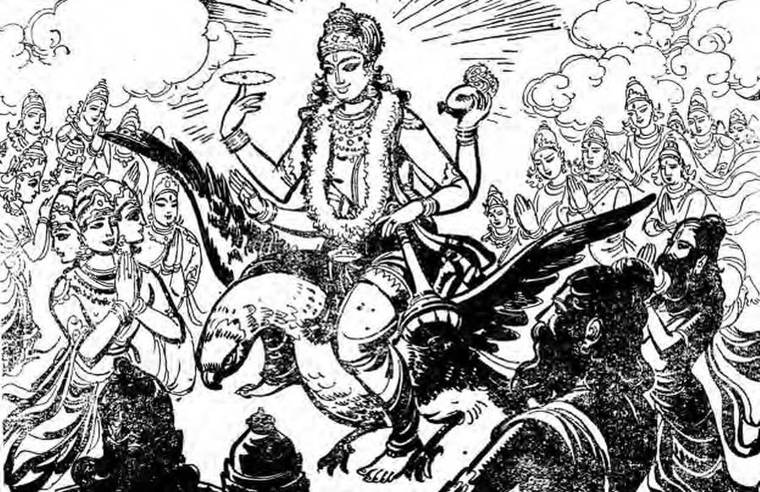
Viṣṇu on Garuḍa promises the gods he will be born as a man
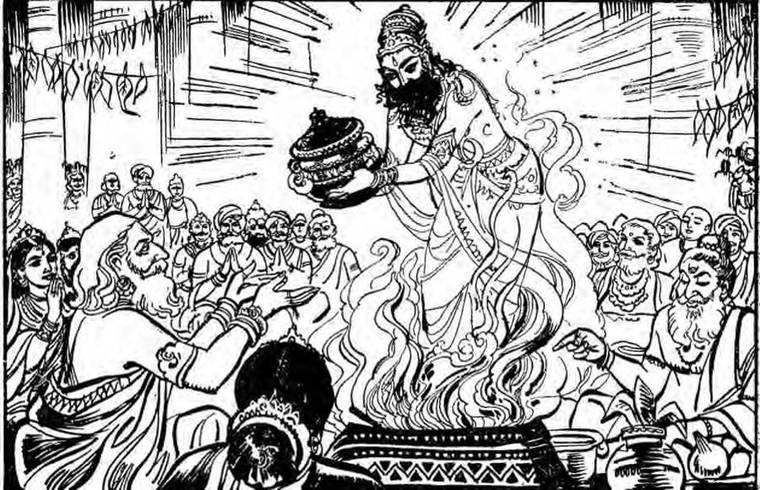
From the sacrificial fire a radiant being brings the pāyasa

The story

Ayodhyā on the Sarayū is a city of plenty, governed by Daśaratha with eight wise ministers and the sage Vasiṣṭha as his guide. Yet the king has no son. On counsel he performs the great horse sacrifice and then the putra-kāmeṣṭi, the rite for progeny, with the sage Ṛṣyaśṛṅga as priest.

Meanwhile the gods stand before Brahmā in distress: Rāvaṇa, king of Laṅkā, has a boon that no god, demon or spirit can kill him — in his pride he never thought to ask protection from men and monkeys. Viṣṇu, the Preserver, agrees to be born as a man, as Daśaratha’s son. From the sacrificial fire a radiant being rises carrying a golden vessel of pāyasa; the king divides it among his three queens.

In the month of Caitra, on the ninth day of the bright fortnight, Kausalyā gives birth to Rāma; Kaikeyī to Bharata; Sumitrā to the twins Lakṣmaṇa and Śatrughna. The gods themselves take birth as vānaras to help. From childhood Lakṣmaṇa is Rāma’s shadow, and Śatrughna Bharata’s.

Verses

Bāla Kāṇḍa 1.18.8–10the narrator

The birth of Rāma

ततो यज्ञे समाप्ते तु ऋतूनां षट्समत्ययुः ।
ततश्च द्वादशे मासे चैत्रे नावमिके तिथौ ॥
tato yajñe samāpte tu ṛtūnāṃ ṣaṭ samatyayuḥ |
tataś ca dvādaśe māse caitre nāvamike tithau ||
Word by word
tataḥthen
yajñe samāpte tuwhen the sacrifice was completed
ṛtūnām ṣaṭsix seasons
samatyayuḥpassed by
tataḥ caand then
dvādaśe māsein the twelfth month
caitrein Caitra
nāvamike tithauon the ninth lunar day

MeaningWhen the sacrifice was over, six seasons passed; then, in the twelfth month, in Caitra, on the ninth day of the bright fortnight —

ContextThe verses go on to give the horoscope: Punarvasu nakṣatra, five planets exalted, Cancer rising, as Kausalyā gives birth to Rāma, “Jagannātha, honoured by all the worlds”. This is why Śrī Rāma Navamī is celebrated on Caitra śukla navamī.

Philosophical aspectThe infinite consents to be dated. The avatāra enters time and place, takes a birthday, so that human beings may find the divine within ordinary human life.

Bāla Kāṇḍa 1.18.30–31the narrator

Rāma could not sleep without Lakṣmaṇa

न च तेन विना निद्रां लभते पुरुषोत्तमः ।
मृष्टमन्नमुपानीतमश्नाति न हि तं विना ॥
na ca tena vinā nidrāṃ labhate puruṣottamaḥ |
mṛṣṭam annam upānītam aśnāti na hi taṃ vinā ||
Word by word
na caand not
tena vināwithout him (Lakṣmaṇa)
nidrām labhatedoes he get sleep
puruṣa-uttamaḥthe best of men
mṛṣṭam annamdelicious food
upānītambrought to him
aśnātieats
na hi tam vinānot without him

MeaningThe best of men could not fall asleep without him; nor would he eat the delicious food brought to him without him.

ContextFrom the description of the four princes’ childhood. Lakṣmaṇa was Rāma’s “second life outside his body” (bahiḥ-prāṇa).

Philosophical aspectThe love between the Lord and the devotee is mutual: Lakṣmaṇa will not leave Rāma, and Rāma cannot rest without Lakṣmaṇa. Bhakti is not a one-way road.

The deeper message

Rāvaṇa’s fatal blind spot is contempt: he thought humans too small to fear. Arrogance always leaves one door unguarded. The Lord enters exactly there — as an ordinary human being, through the door ego despised.

The avatāra is born of a sincere prayer (the gods), a sincere sacrifice (the king) and a sincere longing (the queens). Grace answers effort; it does not replace it. And the pairing of brothers — Lakṣmaṇa with Rāma, Śatrughna with Bharata — is the epic’s first lesson in loyalty: every great soul needs, and creates, devoted companions.

Inner meaning

Daśa-ratha: one who drives the chariot of the ten senses. Only when the ten are mastered is Rāma born within. His three queens are often read as the three guṇas, and the four sons as the four goals of life — dharma, artha, kāma, mokṣa — with Rāma as dharma.

Rāma here — which quality, and exactly where

  • Humility Viṣṇu chooses the most limited form — a mortal, born of a womb, subject to grief — because only a human can kill Rāvaṇa and only a human can be an example.
Viśvāmitra Comes for Rāma A father’s attachment and a guru’s claim sargas 18–22 · 1 verse · 1 picture
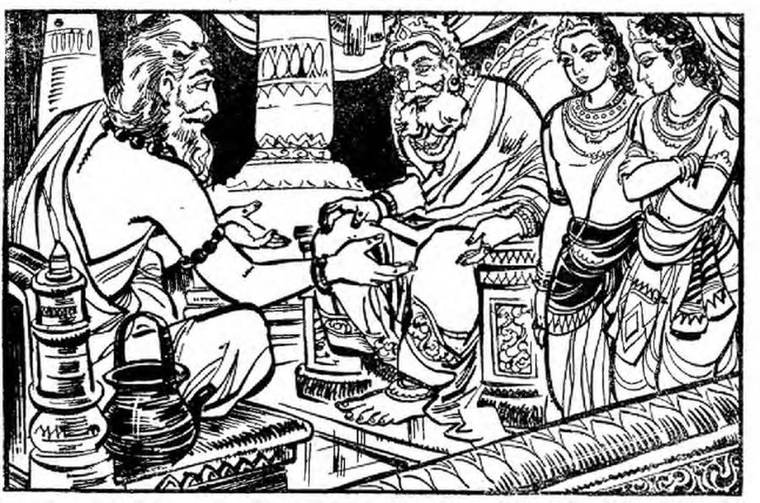
Viśvāmitra asks Daśaratha for Rāma

The story

When Rāma is not yet sixteen, the fiery sage Viśvāmitra arrives at court. Daśaratha, overjoyed, promises to grant whatever he asks. The sage asks for Rāma — to guard his sacrifice from two rākṣasas, Mārīca and Subāhu, who rain blood and flesh on the altar.

The king turns pale. “He is a child, he has never seen battle; take me and my whole army instead.” Viśvāmitra rises in anger: a king of the Raghu line does not go back on his word. Vasiṣṭha gently reminds Daśaratha that a promise is a promise, and that Rāma will be safer with Viśvāmitra than anywhere on earth — the sage knows every divine weapon. The king relents, and Rāma and Lakṣmaṇa walk out of the palace behind the sage, bows in hand.

Verses

Bāla Kāṇḍa 1.19.14Viśvāmitra to Daśaratha

“I know who Rāma is”

अहं वेद्मि महात्मानं रामं सत्यपराक्रमम् ।
वसिष्ठो ऽपि महातेजा ये चेमे तपसि स्थिताः ॥
ahaṃ vedmi mahātmānaṃ rāmaṃ satya-parākramam |
vasiṣṭho 'pi mahā-tejā ye ceme tapasi sthitāḥ ||
Word by word
ahamI
vedmiknow
mahātmānamthe great-souled
rāmamRāma
satya-parākramamwhose valour is true, never fails
vasiṣṭhaḥ apiVasiṣṭha also
mahā-tejāḥof great radiance
ye ca imeand these who
tapasi sthitāḥare established in austerity

MeaningI know the great-souled Rāma, whose valour is truth; so does the radiant Vasiṣṭha, and so do all these who are established in tapas.

ContextDaśaratha sees a child; the sages see who Rāma really is. Viśvāmitra’s claim is not on a boy’s strength but on his nature.

Philosophical aspectParents see the body and its age; the guru sees the Self and its potential. Satya-parākrama — valour founded on truth — is the epithet the whole epic proves.

The deeper message

Attachment wears the mask of love. Daśaratha truly loves Rāma, but his love would keep Rāma small. The guru’s love asks for the child so that he may grow. Every seeker has to be “given” to the teacher by the family-mind that wants to keep him safe.

This episode also rehearses the epic’s central crisis: a king bound by his own word. Here Daśaratha bends and keeps it; in Ayodhyā Kāṇḍa the same principle will cost him his son and his life.

Inner meaning

Viśvāmitra — “friend of the universe” — is the teacher who takes the student out of the palace of comfort into the forest of discipline.

Rāma here — which quality, and exactly where

  • The disciple Rāma goes without a word of protest, walking behind the sage — the first picture of him as śiṣya.
Tāṭakā and the Guarded Sacrifice Balā and Atibalā, the first battle, Siddhāśrama sargas 22–31 · 1 verse · 1 picture
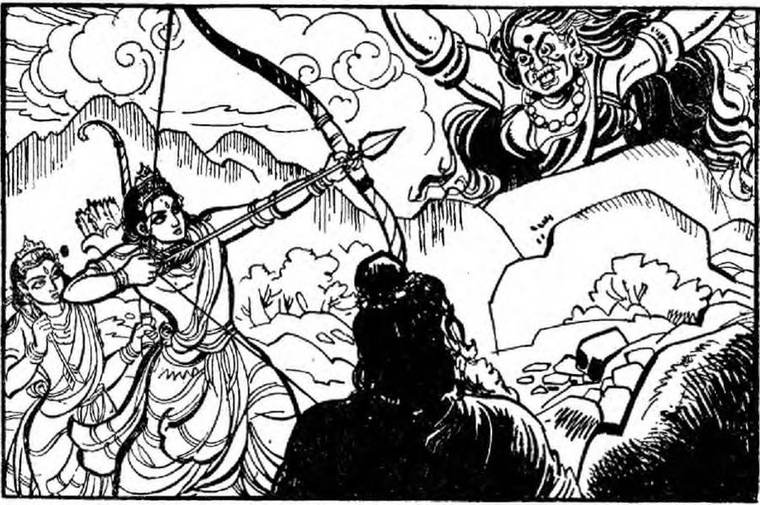
Rāma’s arrow finds Tāṭakā

The story

On the banks of the Sarayū Viśvāmitra teaches the princes two mantras, Balā and Atibalā, that free them from hunger, thirst and fatigue. At dawn he wakes them with the words that every temple still sings: “Kausalyā’s noble son, Rāma, the dawn is breaking; rise, tiger among men, the day’s sacred duties wait.”

They reach a forest laid waste by Tāṭakā, a yakṣī turned man-eater by a curse. Rāma hesitates — she is a woman. Viśvāmitra explains that protecting the innocent is a prince’s dharma, and that a tyrant is not spared for her sex. Rāma twangs his bow and, when she attacks, kills her. Pleased, the sage gives him the celestial weapons (astras).

At Siddhāśrama the princes guard the sacrifice for six days and nights without sleep. On the last day Mārīca and Subāhu swoop down. Rāma kills Subāhu, but with the mānava-astra he only hurls Mārīca a hundred leagues into the sea — a mercy that will return, as a golden deer, years later.

Verses

Bāla Kāṇḍa 1.23.2Viśvāmitra waking Rāma

Kausalyā suprajā Rāma — the first dawn-song

कौसल्या सुप्रजा राम पूर्वा सन्ध्या प्रवर्तते ।
उत्तिष्ठ नरशार्दूल कर्तव्यं दैवमाह्निकम् ॥
kausalyā suprajā rāma pūrvā sandhyā pravartate |
uttiṣṭha nara-śārdūla kartavyaṃ daivam āhnikam ||
Word by word
kausalyā-suprajāO worthy son of Kausalyā
rāmaRāma
pūrvā sandhyāthe eastern twilight, dawn
pravartateis beginning
uttiṣṭhaarise
nara-śārdūlaO tiger among men
kartavyamto be done
daivam āhnikamthe daily sacred duties

MeaningO Rāma, worthy son of Kausalyā, the dawn is breaking. Arise, tiger among men — the day’s sacred duties are waiting.

ContextThese words, spoken by the guru on the bank of the Sarayū, open the Venkaṭeśa Suprabhātam sung in temples every morning. Even God, born as a man, is woken by his teacher and reminded of his duties.

Philosophical aspectEvery morning is an awakening: from sleep into duty, from the small self into purpose. “Uttiṣṭha” — the same call as the Kaṭha Upaniṣad’s “uttiṣṭhata jāgrata” — arise, awake.

The deeper message

The first lesson of the forest is that dharma is discernment, not sentiment. Rāma’s reluctance to strike a woman is noble; the guru’s teaching is nobler — what must be protected is the innocent, and what must be removed is the destroyer, whatever form it wears.

The six sleepless nights are tapas: power is given (the astras) only after discipline is shown. And sparing Mārīca shows that from the start Rāma’s force is measured — he uses the least that will do.

Inner meaning

Tāṭakā is tamas — the gross, devouring inertia that lays waste to the forest of the mind; it is the first enemy any seeker must face.

Rāma here — which quality, and exactly where

  • Valour His first battle (1.26) — the boy whose bowstring alone terrifies Tāṭakā.
  • Compassion He spares Mārīca with a weapon that only throws him away (1.30).
  • The disciple He questions, then obeys: “At my father’s command and to honour your word, I will do it” (1.26.2–5).
Stories on the Road Bhagīratha and the descent of Gaṅgā sargas 32–44

The story

Walking towards Mithilā, Viśvāmitra fills the road with stories — each one about the land they are crossing or the family Rāma belongs to. The greatest is the descent of the Gaṅgā. Sixty thousand sons of King Sagara, searching for the sacrificial horse, insult the sage Kapila and are burnt to ashes. Only the heavenly river can purify them.

Generation after generation of Rāma’s ancestors performs austerities: Aṃśumān, Dilīpa — and finally Bhagīratha, who does tapas for a thousand years. Gaṅgā agrees to come, but her fall would shatter the earth; Śiva catches her in his matted hair and lets her down in gentle streams. Bhagīratha leads her across the land to the ashes of his ancestors, and they are freed.

The deeper message

“A Bhagīratha effort” is a proverb because one man finished what four generations began. Great goals are relay races; we inherit both the debts and the efforts of those before us. Rāma hears this as a young man so that he knows what kind of family he belongs to.

The Gaṅgā is grace: it comes from above, but it must be called down by effort, and it needs a Śiva — a steady, meditative mind — to receive it without destruction.

Inner meaning

Knowledge descending from the infinite is too powerful for the unprepared intellect; it must first be held in contemplation (Śiva’s hair) before it can flow into life.

Rāma here — which quality, and exactly where

  • The disciple Rāma listens and asks questions at every halt — the curious, attentive student (1.35–44).
Ahalyā Set Free A fall, a long penance, and the touch of grace sargas 48–49 · 1 picture
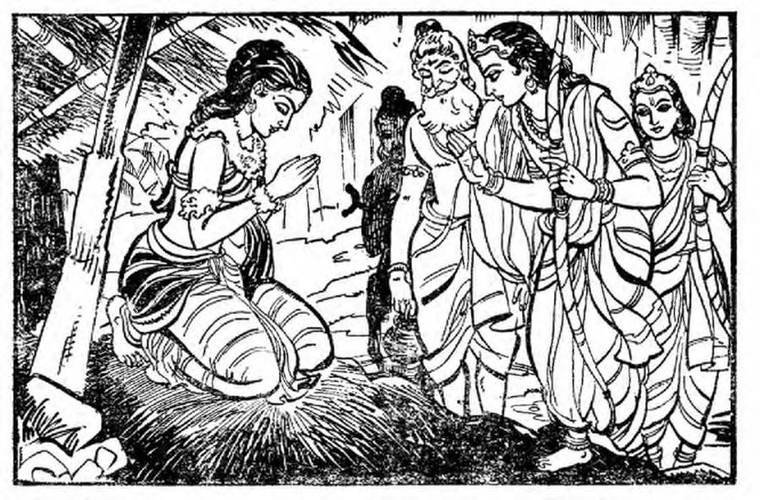
Ahalyā, freed, bows before Rāma

The story

Near Mithilā the party passes a silent, deserted hermitage. Viśvāmitra tells its story. It was the home of the sage Gautama and his wife Ahalyā. Indra, infatuated, came to her in Gautama’s form; in Vālmīki, she recognised him and yet yielded. Gautama cursed her to live there unseen, fasting on air, lying in ashes, until Rāma would come.

Rāma enters. Ahalyā, purified by her long penance, shines forth like a flame seen through smoke. Rāma and Lakṣmaṇa touch her feet. She receives them as honoured guests; Gautama returns and the couple are reunited.

(In later tellings — the Adhyātma Rāmāyaṇa and Tulasīdāsa — she has become a stone and is freed by the touch of Rāma’s foot.)

The deeper message

Vālmīki does not hide Ahalyā’s fault, and neither does he let it define her. Her penance is real and long; Rāma does not forgive her from above — he bows at her feet. The fallen are restored not by being pardoned but by being honoured again.

It is the first of many meetings in which Rāma brings people back to themselves: Ahalyā, Guha, Śabarī, Sugrīva, Vibhīṣaṇa.

Inner meaning

The mind that has fallen into desire becomes “stone” — insensitive, cut off. Long discipline prepares it, but it is the touch of the Self that awakens it.

Rāma here — which quality, and exactly where

  • Compassion He touches the feet of a woman the world had abandoned (1.49.17–19).
  • Humility The prince bows to her as a younger person to an elder.
Viśvāmitra’s Own Story From angry king to brahmarṣi sargas 51–65 · 1 verse

The story

At Mithilā, Śatānanda, son of Ahalyā, tells the princes who their teacher really is. Viśvāmitra was once King Kauśika. Visiting Vasiṣṭha’s hermitage, he coveted the wish-fulfilling cow Śabalā and tried to take her by force. The sage’s brahma-daṇḍa — a mere staff — swallowed every weapon the king hurled. “Fie on the might of a warrior,” Kauśika cried; “the power of the spirit alone is power.”

He renounced his kingdom to become a brahmarṣi. Again and again he fell: anger led him to create a new heaven for Triśaṅku; the nymph Menakā cost him ten years; in rage he cursed Rambhā and lost his merit again. Each fall he recognised, and each time he began again — until he conquered anger, desire and speech itself. Finally Vasiṣṭha himself greeted him as “brahmarṣi”.

Verses

Bāla Kāṇḍa 1.56.23Viśvāmitra (Kauśika), defeated by Vasiṣṭha

“Fie on a warrior’s strength”

धिग्बलं क्षत्रियबलं ब्रह्मतेजोबलं बलम् ।
एकेन ब्रह्मदण्डेन सर्वास्त्राणि हतानि मे ॥
dhig balaṃ kṣatriya-balaṃ brahma-tejo-balaṃ balam |
ekena brahma-daṇḍena sarvāstrāṇi hatāni me ||
Word by word
dhikfie on
balam kṣatriya-balamstrength — a warrior’s strength
brahma-tejaḥ-balamthe strength of spiritual radiance
balamis (true) strength
ekenaby a single
brahma-daṇḍenastaff of a brāhmaṇa
sarva-astrāṇiall weapons
hatāni meof mine are destroyed

MeaningFie on strength — on a warrior’s strength! The strength of spiritual radiance is strength. By one sage’s staff all my weapons have been destroyed.

ContextKing Kauśika’s cry after every divine weapon he hurled at Vasiṣṭha was swallowed by the sage’s staff. It is the turning point of his life: he renounces his kingdom to become a brahmarṣi.

Philosophical aspectOuter power cannot touch inner power. The verse is a seeker’s awakening: the moment one sees that the only strength worth having is the strength of the spirit — and resolves to win it.

The deeper message

This is the story of the seeker. Kauśika does not become a sage by one great renunciation but by a hundred small recoveries. The obstacles are always the same three — desire, anger, and pride — and the cure is self-honesty and starting again.

It is told to Rāma at this exact moment because a student needs to know that his teacher, too, struggled. The guru’s authority comes from victory over himself.

Inner meaning

Kṣatra (power) and brahma (spirit): every one of us is born a Kauśika and may become a Viśvāmitra.

Śiva’s Bow and the Wedding of Sītā The test no king could pass sargas 66–73 · 1 verse · 2 pictures
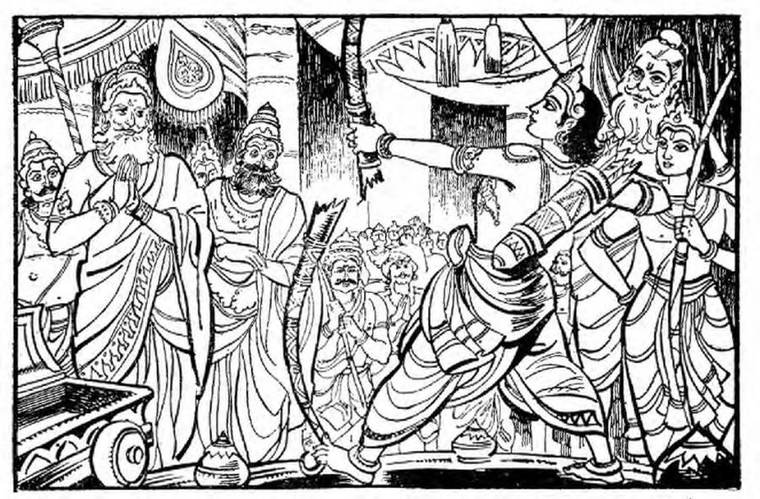
Rāma breaks the bow of Śiva
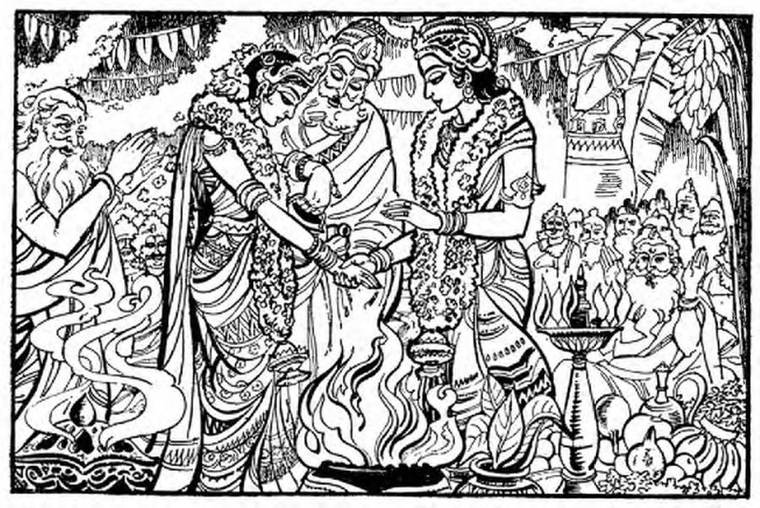
The wedding of Rāma and Sītā

The story

King Janaka tells the story of Sītā: ploughing the sacrificial field, he found a baby girl in the furrow (sītā) — a daughter of the Earth. He vowed to give her only to one who could string the great bow of Śiva kept in his house. Kings had come and failed; the bow is carried in on an eight-wheeled cart by five thousand men.

At Viśvāmitra’s nod Rāma lifts it as if in play, strings it, and draws it — and the bow snaps in the middle with a sound like thunder. Janaka, overjoyed, sends for Daśaratha. In a single ceremony the four brothers marry: Rāma and Sītā, Lakṣmaṇa and Ūrmilā (Janaka’s daughter), Bharata and Māṇḍavī, Śatrughna and Śrutakīrti (daughters of Kuśadhvaja).

Placing Sītā’s hand in Rāma’s, Janaka speaks the verse that every Hindu wedding remembers: “This is my daughter Sītā; she will walk with you in dharma. Take her hand in yours; she will follow you always, like your own shadow.”

Verses

Bāla Kāṇḍa 1.73.26–27Janaka to Rāma

Saha-dharma-carī — Janaka gives Sītā

इयं सीता मम सुता सहधर्मचरी तव ।
प्रतीच्छ चैनाम् भद्रं ते पाणिं गृह्णीष्व पाणिना ॥
पतिव्रता महाभागा छायेवानुगता सदा ॥
iyaṃ sītā mama sutā saha-dharma-carī tava |
pratīccha cainām bhadraṃ te pāṇiṃ gṛhṇīṣva pāṇinā ||
pativratā mahā-bhāgā chāyevānugatā sadā ||
Word by word
iyam sītāthis Sītā
mama sutāmy daughter
saha-dharma-carīone who walks with you in dharma
tavayours
pratīccha ca enāmaccept her
bhadram temay good befall you
pāṇim gṛhṇīṣvatake her hand
pāṇināwith your hand
pati-vratādevoted to her husband
mahā-bhāgāgreatly blessed
chāyā ivalike a shadow
anugatā sadāever following

MeaningThis is my daughter Sītā, your partner in dharma. Accept her — may it go well with you — take her hand in yours. Devoted and blessed, she will follow you always, like your shadow.

ContextSpoken as Janaka places Sītā’s hand in Rāma’s. These verses are recited at weddings to this day. “Like a shadow” is fulfilled literally: Sītā insists on following Rāma into exile.

Philosophical aspectMarriage as a shared spiritual path. The shadow cannot be separated from the body; the jīva that truly loves the Lord follows wherever He goes.

The deeper message

The bow no one could lift is the ego’s pride: the kings who came to win Sītā came to prove themselves. Rāma lifts it only when his guru asks, and without effort — the strength that does not belong to the ego is effortless.

Janaka’s words define marriage in the epic: saha-dharma-cāriṇī, “one who walks with you in dharma”. It is not possession but partnership in a shared ideal, and Sītā will prove it more than Rāma.

Inner meaning

Sītā, born of the earth, is the world — prakṛti — and Rāma the Spirit. Spirit wedded to the world: this is creation, and its whole story is the Rāmāyaṇa.

Rāma here — which quality, and exactly where

  • Humility He waits for his guru’s word before even touching the bow (1.67.13–15).
  • The husband Receives Sītā as saha-dharma-cāriṇī — his partner in dharma (1.73.26).
Paraśurāma Humbled The old avatāra meets the new sargas 74–77 · 1 picture
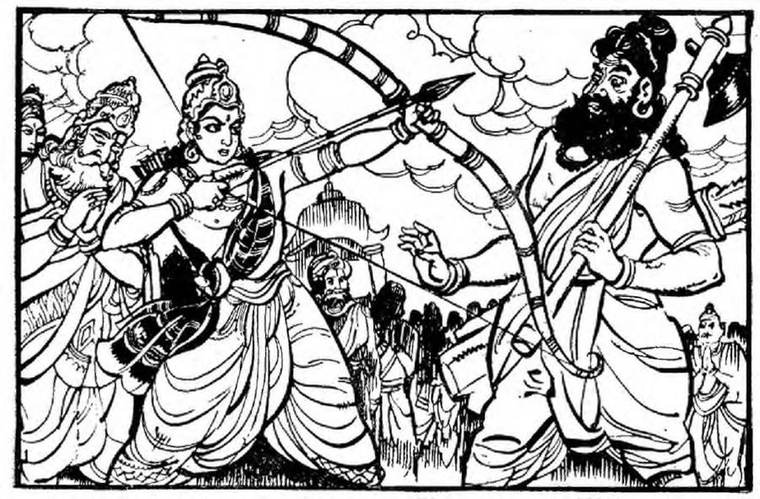
Rāma strings Paraśurāma’s bow

The story

On the road home the sky darkens and Paraśurāma appears — the brāhmaṇa warrior who had emptied the earth of kings twenty-one times. Enraged that Śiva’s bow was broken, he thrusts at Rāma the bow of Viṣṇu: “String this, and I will fight you.” Daśaratha pleads in terror.

Rāma calmly takes the bow, strings it and sets an arrow. “You are a brāhmaṇa and Viśvāmitra’s kin; I will not kill you. But this arrow cannot go in vain — shall I destroy your power of movement, or the worlds you have won by tapas?” Paraśurāma recognises who stands before him. He gives up his worlds, honours Rāma, and walks away to the mountains.

The deeper message

Power that has served its purpose must yield. Paraśurāma — power used to punish — hands over to Rāma — power used to protect. Rāma is courteous and firm at once: he does not insult the elder, but he does not give way to a bully.

His first words are a refusal to harm a brāhmaṇa; his second, a refusal to waste an arrow. Restraint and resolve, together.

Inner meaning

Anger, even righteous anger that once had a purpose, must surrender to the calm strength of the Self.

Rāma here — which quality, and exactly where

  • Anger on a leash Provoked and insulted before his father, he remains courteous (1.76.1–5).
  • Valour He strings Viṣṇu’s bow effortlessly and takes away Paraśurāma’s worlds.

Study companion — Bāla Kāṇḍa

prathamaḥ kāṇḍaḥ

Bāla Kāṇḍa — The Book of Childhood

77 sargas · From the birth of the poem to the wedding at Mithilā

Three frames nested: the poem's own origin (sargas 1–4), the births and boyhood of the princes (5–18), and Viśvāmitra's journey — a moving school in which every stop teaches through a story, ending in the marriage that joins the epic's two protagonists. Nearly half the kāṇḍa is upākhyāna — inset legends — making it a miniature purāṇa; the reading skill it teaches is to ask of every inset story: why is Rāma being told this, here?

❖ Golden boxes moments that define Rāma as Maryādā Puruṣottama Green boxes where Kamban’s Tamil Rāmāyaṇam tells it differently Verse cards ślokas worth memorising

The Birth of the Poem — Nārada, the Krauñca Birds, Lava-Kuśasargas 1–4StoryVerse

Sarga 1: Vālmīki's sixteen-guṇa question and Nārada's answer — the saṁkṣepa-rāmāyaṇa, the whole epic in a hundred verses (studied above in the Framework). Sarga 2: the krauñca birds. Sarga 3: Vālmīki, granted yogic sight, sees the entire story "like a fruit in the palm." Sarga 4: the finished poem is taught to two matchless young singers in his āśrama — Lava and Kuśa, whom the first-time reader does not yet know are Rāma's sons. The epic thus begins at its own end: the frame will close in the Uttara when the boys sing this very poem before their father.

Krauñca-vadha — grief becomes metre

By the Tamasā, Vālmīki watches a pair of krauñca birds in love. A hunter's arrow kills the male; the hen's wailing pierces the sage, and a curse bursts from him in perfect metre — śoka become śloka. Brahmā appears and commissions the grief itself: compose Rāma's story in this metre, and it will live as long as mountains stand and rivers flow.

Bāla Kāṇḍa 2.15 — the first śloka
मा निषाद प्रतिष्ठां त्वमगमः शाश्वतीः समाः ।
यत्क्रौञ्चमिथुनादेकमवधीः काममोहितम् ॥
mā niṣāda pratiṣṭhāṁ tvam agamaḥ śāśvatīḥ samāḥ |
yat krauñca-mithunād ekam avadhīḥ kāma-mohitam ||
mā — never
niṣāda — O hunter
pratiṣṭhām agamaḥ — may you attain standing / repose
śāśvatīḥ samāḥ — for everlasting years
yat — since
krauñca-mithunāt — from the pair of krauñca birds
ekam — the one
avadhīḥ — you slew
kāma-mohitam — while lost in love

The commentators' double reading: with mā as Mā (Lakṣmī), mā-niṣāda = "abode of Lakṣmī" — Viṣṇu — and the curse becomes benediction: "O Lord, be glorified forever, for You slew the one of the (rākṣasa) pair who was maddened by desire." Curse and blessing, grief and glory in one utterance: the seed-syllable of the epic.

Ayodhyā, Ṛśyaśṛṅga & the Putrakāmeṣṭisargas 5–14StoryKamba

Sargas 5–7 paint Kosala and its capital as dharma made urban planning — moats, mango groves, truthful citizens, ministers who read faces. The shadow: Daśaratha, sixty thousand years old by epic count, is sonless. Sumantra recalls a prophecy: sons will come through Ṛśyaśṛṅga.

Ṛśyaśṛṅga — the innocent who ended a drought

Sargas 9–11: the sage's son raised so purely in the forest that he has never seen a woman. When Aṅga kingdom's sins bring drought, courtesans are sent to charm the boy — who takes them for radiant ascetics — and his mere arrival in Aṅga brings rain. King Romapāda gives him Śāntā (in this tradition, Daśaratha's daughter given in adoption) in marriage. The innocent rain-bringer now presides over Daśaratha's rites: the aśvamedha (sargas 13–14, described with ritual precision) and then the putreṣṭi.

The heavenly frame

Sargas 15–16: during the rite the devas petition Viṣṇu — Rāvaṇa, invulnerable to gods, gandharvas, yakṣas and rākṣasas by Brahmā's boon, has in his contempt omitted men and animals. Viṣṇu chooses birth as Daśaratha's four sons. From the sacrificial fire rises a colossal being with a golden vessel of pāyasa: half to Kausalyā, and quarters divided so that Sumitrā receives two shares — hence Rāma, Bharata, and the twins Lakṣmaṇa-Śatrughna, with Lakṣmaṇa attaching himself to Rāma and Śatrughna to Bharata "from the breast."

Kamba Rāmāyaṇam differs

Kambar frames Rāma explicitly as the avatāra of Tirumāl from his opening cantos — characters perceive and address the divinity throughout. Vālmīki's Rāma will insist to the end that he is "a man, son of Daśaratha"; his divinity is structural (the boon's loophole) but experientially veiled. Keep this axis in mind at every Kamba note below — most differences flow from it.

Viśvāmitra's Claim & the Slaying of Tāṭakāsargas 18–30Story❖ MaryādāDharma

Sarga 18: the births, the naming (Vasiṣṭha: Rāma, "he in whom all delight"), the boyhood — Rāma walking ahead, Lakṣmaṇa his outer breath (bahiḥ prāṇaḥ), refusing even sleep and food unless Rāma shares it. Sargas 19–22: Viśvāmitra arrives like a thunderclap demanding the sixteen-year-old for ten days of yajña-protection. Daśaratha offers armies, offers himself, refuses his child — and is nearly cursed before Vasiṣṭha counsels surrender: this sage knows what this boy is. The princes leave on foot behind the ṛṣi.

The road as curriculum

Balā and Atibalā conferred at the Sarayū confluence (no hunger, thirst or fatigue — the vidyās that make the exile survivable, given fourteen years early). Kāma's body-loss legend at Kāmāśrama; the confluence-crossing; the terrible forest that was once two flourishing kingdoms — every landscape has a story, and each story is chosen for what the boy is about to need.

Tāṭakā-vadha

Sargas 24–26: the yakṣiṇī Tāṭakā — Suketu's daughter, crushed into monstrosity by Agastya's curse after her husband Sunda's death — devastates the land. Viśvāmitra commands her death. Rāma hesitates: a woman? The sage cites precedent and principle: protection of the many is the kṣatriya's first duty, and the guardian's hand may not be squeamish. Rāma first tries maiming; when dusk (rākṣasa hour) nears, he kills. Indra and the gods applaud; Viśvāmitra, next morning, transmits the entire arsenal of divine astras (sargas 27–28) — and, unasked, the mantras for their withdrawal (upasaṁhāra).

Maryādā Puruṣottama — obedience above scruple, weapons with brakes

Two foundations are laid here. First: the disciple's dharma — Rāma's private moral instinct (never harm a woman) yields to the guru's command grounded in a wider dharma (protect the innocent), establishing that maryādā means submitting one's own conscience to legitimately constituted authority, the hardest discipline of all. Second: Rāma receives the power to end worlds together with the discipline to sheathe it — the astras come with their recall mantras. Strength on a leash, from day one.

Siddhāśrama & the yajña defended

Sargas 29–30: Siddhāśrama, sanctified as Viṣṇu's Vāmana-site (the dwarf who measured the cosmos — told to the boy who is that Viṣṇu, unknowing). Six days of vigil; on the last, Mārīca and Subāhu rain blood on the altar. Rāma's response is exact, not symmetrical: Subāhu, the mere brute, is killed with the āgneyāstra; Mārīca is struck with the blunt mānavāstra and hurled a hundred yojanas into the sea — alive. That calibrated mercy will return with interest: the spared Mārīca becomes the golden deer, and also the epic's great witness (rāmo vigrahavān dharmaḥ).

The Road to Mithilā — Gaṅgā's Descent & the Inset Legendssargas 31–46Story

Viśvāmitra now leads the princes to Janaka's yajña at Mithilā, and the road becomes a river of stories: Kuśa's line and Kuśanābha's hundred daughters (who chose disfigurement by the wind-god over dishonour, and were healed by marriage to Brahmadatta); the birth of Gādhi, Viśvāmitra's father; the legend of Gaṅgā and her sister Umā; the birth of Kārttikeya.

Gaṅgā-avataraṇa — sixty thousand sons and one river

Sargas 38–44: King Sagara's sixty thousand sons, digging the earth for the stolen sacrificial horse, insult the meditating Kapila and are burnt to ash by his glance. Generations labour for their redemption until Bhagīratha's tapas persuades Gaṅgā to descend — and Śiva to catch her fall in his matted hair, lest the earth shatter. She follows Bhagīratha's chariot to the sea and down to the ashes; the sons rise to heaven. The parable given to Rāma before Mithilā: a single descendant's unrelenting effort can redeem an entire ruined lineage — a template for what Rāma's own descent is to accomplish for the world.

The churning, and Diti's broken embryo

Sarga 45: at Viśālā, the churning of the ocean — amṛta, Dhanvantari, the apsaras, Lakṣmī — and Diti's tapas for a son to kill Indra, ended when Indra enters her womb and cuts the embryo into the forty-nine Maruts ("mā ruda" — do not weep). The pattern of these insets: cosmic order maintained through drastic, morally jagged interventions — the world Rāma is being prepared to repair by cleaner means.

Ahalyā's Deliverancesargas 48–49StoryKamba

At a deserted āśrama outside Mithilā, Viśvāmitra tells of Gautama's wife Ahalyā, seduced by Indra wearing her husband's form (Vālmīki adds the unsettling half-line that she recognized the disguise — devarāja-kutūhalāt, curiosity about the king of gods). Gautama's double curse: Indra loses his testicles (restored with a ram's — the gods need their general); Ahalyā becomes invisible, living on air in ash, unseen by all beings, until Rāma's arrival. The princes reverently touch her feet; she and Gautama are reunited; the gods rain flowers.

Kamba Rāmāyaṇam differs

In Kambar — as in most later pan-Indian telling — Ahalyā is turned to stone, restored by the dust of Rāma's feet. Kambar's theology: insentient matter quickens at the Lord's mere contact; grace requires nothing of the recipient. Vālmīki's version keeps Ahalyā a conscious penitent whose long unseen tapas earns the deliverance that Rāma's arrival occasions. Grace crowning effort, versus grace replacing it — the two Rāmāyaṇas in one episode.

Viśvāmitra's Own Story — the King Who Became Brahmarṣisargas 51–65 (narrated by Śatānanda)StoryPhilosophy

In Mithilā, the priest Śatānanda (Ahalyā's son) rejoices at his mother's redemption and narrates to Rāma the colossal biography of his guide — the longest inset of the kāṇḍa, and its philosophical heart.

The arc in stations

King Viśvāmitra covets Vasiṣṭha's wish-cow Śabalā; his hundred armies and hundred sons are annihilated by her yogic legions — kṣātra brute force loses to brahma-tejas. Millennia of tapas win him weapons; the weapons break on Vasiṣṭha's staff. He creates a rival heaven for the outcaste Triśaṅku (who hangs head-down in the southern sky still — willpower can build, but not legitimize). He loses everything to Menakā's beauty; masters desire only to fall to anger at Rambhā (cursing her to stone — spending in one syllable the tapas of centuries). Finally: thousands of years of breathless trance until desire and anger are not suppressed but extinct — and it is Vasiṣṭha himself who pronounces him Brahmarṣi.

Why Rāma hears this now

On the eve of winning Sītā, Rāma is shown the anatomy of self-conquest: that force cannot take what only surrender receives; that tapas leaks through the twin holes of kāma and krodha; and that the title one fights for is real only when conferred by the rival one fought. The maryādā ideal Rāma will embody is here displayed in its costliest possible acquisition — what Rāma has by nature, Viśvāmitra clawed from nature over ten thousand years. The teacher's whole life is the lesson.

The Bow, the Wedding & Paraśurāmasargas 66–77StoryKamba❖ Maryādā

Sarga 66: Janaka tells the bow's history — Śiva's own, left in Devarāta's line after the Dakṣa-yajña fury — and Sītā's: risen from the furrow (sītā) as he ploughed the yajña ground, ayonijā, and declared vīrya-śulkā: her bride-price is valour alone. Kings who failed besieged Mithilā for a year in spite. Sarga 67: five thousand men wheel the bow in on an eight-wheeled iron case; Rāma strings it and it breaks with a crash that fells every man but four. Daśaratha is summoned; sargas 70–73 settle the four marriages — Sītā to Rāma, Ūrmilā to Lakṣmaṇa, and Janaka's nieces Māṇḍavī and Śrutakīrti to Bharata and Śatrughna — solemnized around the fire with Janaka's words: iyaṁ sītā mama sutā saha-dharma-carī tava, "this is Sītā, my daughter, your companion in dharma."

Paraśurāma at the pass

Sargas 74–76: the wedding party's road home is blocked by omens and then by Paraśurāma, axe on shoulder, the annihilator of twenty-one generations of kṣatriyas, carrying the Vaiṣṇava bow (twin to the broken Śaiva one): "String this, and I will grant you single combat." Rāma — courteous to a brāhmaṇa, immovable as a kṣatriya — takes the bow, strings and draws it in a motion, and asks where the inescapable arrow should fall. Paraśurāma, his tejas already draining into Rāma, yields his accumulated worlds as the target and recognizes the Lord of his own vanished mission. One avatāra's era closes as the next opens; Rāma the ideal householder-hero succeeds the celibate scourge.

Maryādā Puruṣottama — power that never postures

Note what Rāma does not do at either bow: no boast before stringing Śiva's bow (he asks Viśvāmitra's permission merely to touch it), and no harm to Paraśurāma when annihilation is in his hand — the arrow is spent on the sage's tapas-worlds, sparing his person and his pride's minimum. Vālmīki's formula for the ideal man: maximum capability, minimum display, zero cruelty in victory.

Kamba Rāmāyaṇam differs — the celebrated first sight

Kambar's most loved invention: before the bow ceremony, Rāma walking through Mithilā's streets meets Sītā's eyes at her palace window — aṇṇalum nōkkiṉāṉ, avaḷum nōkkiṉāḷ, "he looked, and she looked" — and both spend the night in longing without knowing each other's names. Vālmīki has no prior meeting: Sītā is won sight-unseen by the vow of valour. Kambar, heir to Tamil akam poetics, will not join the divine couple by contract alone; and since they are Viṣṇu and Lakṣmī eternally united, recognition properly precedes introduction. The bow merely ratifies what the eyes accomplished.

Verses follow the Gita Press (southern) numbering, checked against valmikiramayan.net; other editions may differ by a few verses, and the critical edition omits some popular verses (marked). Stories are retold in brief from Vālmīki, with C. Rajagopalachari and Kamala Subramaniam for further reading; later additions (Tulasīdāsa, Kamban, folk tradition) are marked as such. The symbolic readings are offered for reflection — one way among several of hearing the story. Drawings: Vipin K. Das, from Children’s Illustrated Ramayanam, retold by Vishnu B (2011).