Who should enquire, what Brahman is, how it is known, and where it is taught. The four sūtras that hold the whole work, word by word, with Śaṅkara’s preface on superimposition and the readings of the other schools.
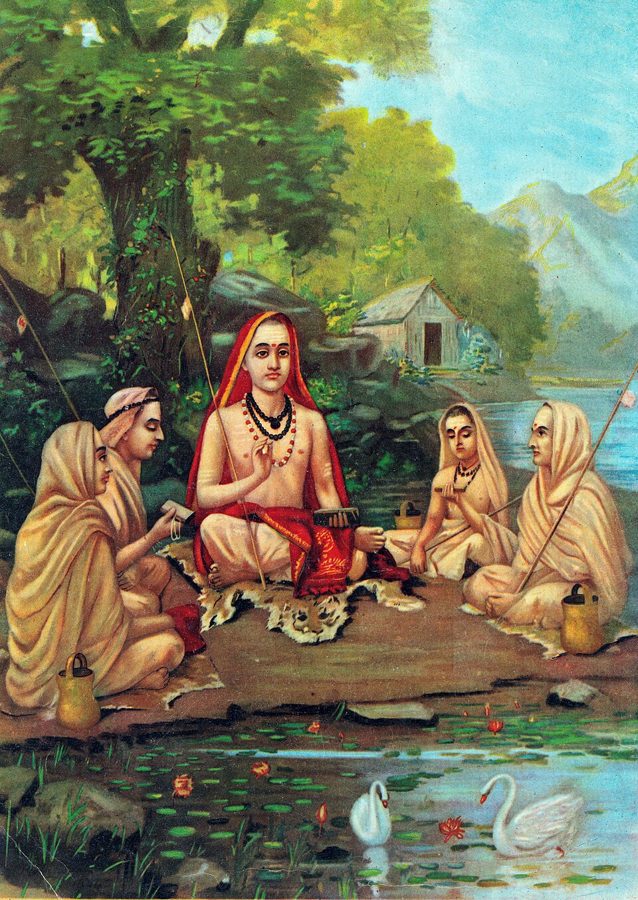
Ādi Śaṅkarācārya with his disciples — the commentator whose reading these pages follow (Raja Ravi Varma, c. 1904; public domain, via Wikimedia Commons)
Why four sūtras carry the whole work
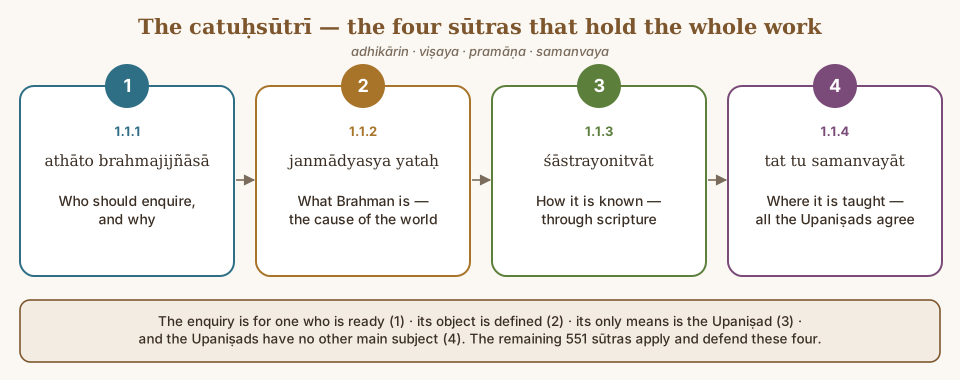
The catuḥsūtrī: who enquires, what Brahman is, how it is known, where it is taught (diagram drawn for this page)
The tradition treats the first four sūtras as a complete statement of Vedānta, and the other 551 as its application. Read together they answer
the four questions any teaching must settle before it begins — the anubandha-catuṣṭaya: who is fit for it (adhikārin), what it is about
(viṣaya), what it gives (prayojana) and how its subject is related to the text (sambandha). The first sūtra names the qualified seeker and the
goal; the second defines the subject; the third names the only means of knowing it; the fourth shows that the Upaniṣads, all of them, are about it.
So much was packed into these four that commentaries on them alone fill volumes — Śaṅkara’s bhāṣya on the first four sūtras is a quarter of his whole
commentary on the first pāda, and the sub-commentaries (Padmapāda’s Pañcapādikā, Vācaspati’s Bhāmatī) devote most of their length to them.
Before the first sūtra: adhyāsa
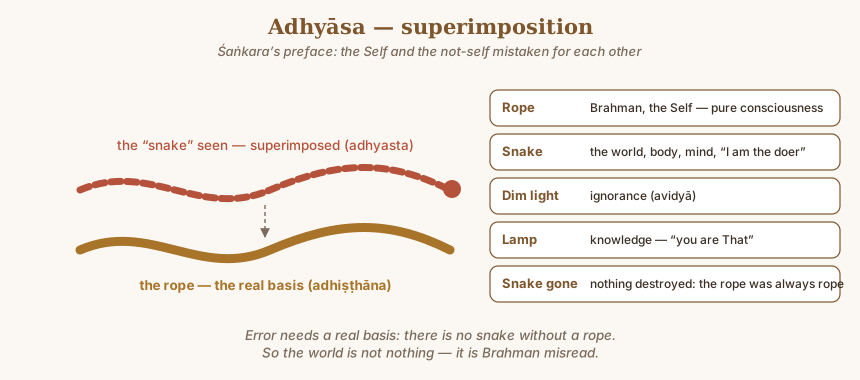
Superimposition — the snake seen on the rope (diagram drawn for this page)
Śaṅkara begins not with the sūtra but with a preface on superimposition (adhyāsa). The subject (“I”, consciousness) and the object
(“this”, the body, mind and world) are as opposite as light and darkness, yet everyone mixes them up: “I am fat”, “I am tired”, “this is mine”. Superimposition
is “the appearance, in the form of memory, of something previously seen, in some other thing” — as a rope is seen as a snake, or one moon as two.
This mixing is beginningless and natural, and every activity — perception, ritual, scripture itself as a guide to action — takes place within it.
Its removal by knowledge is called vidyā; the Upaniṣads are begun “to destroy this cause of evil and to attain the knowledge of the unity of the
Self”. The whole Brahma Sūtra, read this way, is the systematic undoing of one confusion.
Sūtra 1 — the fourfold fitness
“Now” (atha) means “after a definite preparation”, and Śaṅkara names it — the sādhana-catuṣṭaya:
viveka — discrimination between the lasting and the passing;
vairāgya — dispassion towards enjoying the fruits of action here and hereafter;
śamādi-ṣaṭka-sampatti — the six treasures: calm of mind (śama), control of the senses (dama), withdrawal (uparati), forbearance (titikṣā), faith
(śraddhā) and collectedness (samādhāna);
mumukṣutva — the longing to be free.
With these, the enquiry can begin even without a previous study of ritual; without them, it does not really begin even after it. “Therefore”
(ataḥ): because the Veda itself teaches that what is gained by action perishes (“as here the world gained by work perishes, so there the world gained
by merit perishes”, Chāndogya 8.1.6), while “the knower of Brahman attains the highest” (Taittirīya 2.1).
athanow — after a definite preparation has been completed
ataḥtherefore — because of that preparation, and because works give only perishable results
brahmaBrahman, the infinite reality
jijñāsāthe desire to know; hence a sustained enquiry undertaken to know it
MeaningNow, therefore, the enquiry into Brahman (is to be undertaken).
ExplanationThe opening word atha does not mean “after ritual” or “after studying the Pūrva-mīmāṃsā”, says Śaṅkara, but “after acquiring the fourfold fitness”: discrimination of the lasting from the passing, dispassion towards rewards here and hereafter, the six inner disciplines beginning with calm and self-control, and a real longing for freedom. Ataḥ, “therefore”, gives the reason: the Veda itself shows that whatever is gained by action ends, while knowledge of Brahman brings the highest good. A “desire to know” is named rather than knowledge because one cannot command knowledge; one can only enquire until it dawns.
Philosophical aspectThe whole system rests on this sūtra’s claim that liberation is a matter of knowing, not doing. Brahman is not something to be produced, reached or purified; it is to be known, and since it is one’s own Self it is already present — what is missing is only the clear understanding. Śaṅkara prefaces this sūtra with his famous adhyāsa-bhāṣya: the mixing-up of the Self and the not-self is the root of all suffering, and the enquiry exists to undo it.
Other schoolsRāmānuja takes atha as “after the enquiry into ritual (karma-vicāra)”: the two Mīmāṃsās are one continuous śāstra, and knowledge of works shows their limits. Madhva reads atha as auspicious and also as “after fitness”, and stresses that the enquiry is into Viṣṇu, the Brahman of all the Vedas.
Sūtra 2 — two kinds of definition
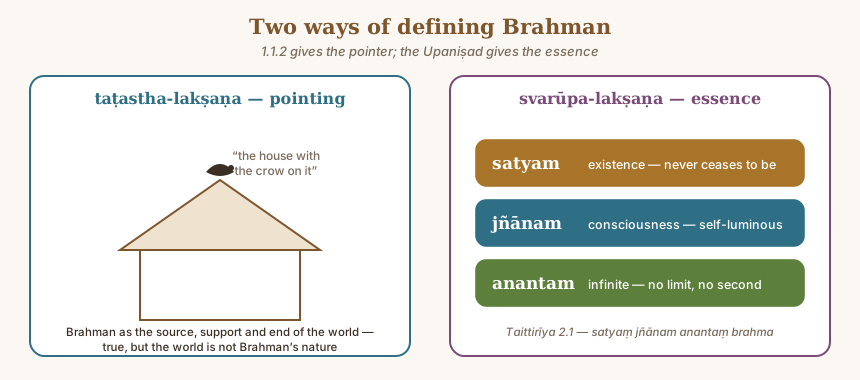
The pointing definition of 1.1.2 and the essential definition of the Taittirīya (diagram drawn for this page)
A thing can be defined by its essential nature (svarūpa-lakṣaṇa) or by an incidental mark that points to it
(taṭastha-lakṣaṇa) — the house “with the crow on the roof”. 1.1.2 is of the second kind: Brahman is that from which the world comes, in which it lives,
into which it returns. The Upaniṣad gives the first kind: satyaṃ jñānam anantaṃ brahma, existence, consciousness, infinitude.
Why use a pointer at all? Because the seeker begins in the world. The world is the most obvious fact we have; by tracing it to its cause we are pointed
to a reality that is not itself a thing in the world — and then the essential definition can be understood. The order of the sūtras is the order of teaching.
janma-ādibirth and the rest — origin, sustenance and dissolution
asyaof this (world), seen and experienced
yataḥfrom which (proceed)
Meaning(Brahman is that) from which the origin, sustenance and dissolution of this (world) proceed.
ExplanationThe sūtra points to Taittirīya Upaniṣad 3.1, where Varuṇa tells his son Bhṛgu: “That from which these beings are born, by which they live, and into which they return — seek to know that; that is Brahman.” A world so ordered — with countless agents, places, times and causes fitting together — cannot come from an unconscious source or from chance; it must come from an all-knowing and all-powerful cause. But the sūtra does not ask us to infer Brahman: it is pointing to what the Upaniṣad declares.
Philosophical aspectThis is the taṭastha-lakṣaṇa, a definition “standing at the edge”: like pointing out a house by the crow sitting on its roof, it indicates Brahman through the world, which is not part of Brahman’s nature. The essential definition (svarūpa-lakṣaṇa) is satyaṃ jñānam anantaṃ brahma — existence, consciousness, infinitude. Being the cause, Brahman is both the material and the efficient cause, as 1.4.23 will prove.
Other schoolsFor Rāmānuja and Madhva the definition is not merely “pointing”: creating, sustaining and dissolving the world are real glories of Brahman (Nārāyaṇa / Viṣṇu), and the sūtra describes a God who truly possesses them.
Sūtra 3 — why scripture?
Brahman cannot be perceived: it has no form, colour or sound, and is the perceiver itself. It cannot be inferred: inference needs an
observed link between a sign and the thing signified (smoke and fire), and Brahman, being one without a second, has never been observed in any such link.
The world shows that there is a cause; it does not show that the cause is conscious, one, and one’s own Self. Only the Upaniṣad can teach that.
This is not a rejection of reasoning. The second adhyāya is reasoning from beginning to end. But reason works on what the scripture teaches — removing
doubts, showing consistency, answering objections — rather than reaching the truth by itself (2.1.11). The other reading of the sūtra — Brahman as the source
of the Veda — completes the circle: the means of knowing Brahman comes from Brahman.
yonisource, womb; or the means of knowing (pramāṇa)
tvātbecause of being
MeaningBecause (Brahman) is the source of the scripture — and because scripture is the means of knowing it.
ExplanationŚaṅkara gives two readings. First: Brahman is the source of the vast Veda, which illumines all things like a lamp; the author of such a body of knowledge must be omniscient. Second: the scripture is the yoni, the valid means, through which alone Brahman is known. Perception cannot reach it, since it is not an object; inference cannot establish it, for inference needs an observed link between sign and thing, and Brahman is one without a second. Reason has a role, but it supports the meaning of the Upaniṣads; it does not replace them.
Philosophical aspectVedānta here takes a stand in epistemology. The Self is self-evident but its nature as Brahman is not; that identity is something no other pramāṇa could reveal. Hence the teaching is called śabda-pramāṇa: words used by a teacher, rightly understood, can remove ignorance about what is already one’s own Self.
Other schoolsAll the schools agree that Brahman is known from śāstra; Madhva stresses the second reading so that no reasoning independent of the Veda can establish God.
Sūtra 4 — the harmony, and the six marks of purport
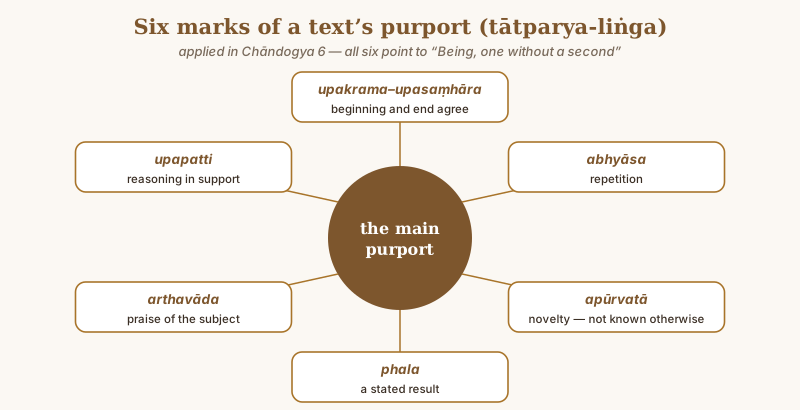
The six marks by which the main purport of a passage is settled (diagram drawn for this page)
How do we know what a text is about? The Mīmāṃsā tradition gives six marks, and Vedānta applies them to the Upaniṣads. In Chāndogya 6, for
example: it begins and ends with Being (“In the beginning there was only Being” … “All this has that for its Self”); the teaching “you are That” is
repeated nine times; the subject is new — known from no other source; a result is stated (“he waits only till the body falls”);
there is praise (“by which the unheard becomes heard”); and reasoning supports it (clay, gold, iron).
The Mīmāṃsaka objects that scripture only commands. Bādarāyaṇa’s tu (“but”) rejects this: knowledge of a thing that exists depends on the thing,
not on anyone’s will; it cannot be commanded. Mokṣa is not a result of action — that would make it perishable — but the nature of the Self, revealed when
ignorance is removed. This is the hinge on which the Brahma Sūtra turns: tat tu samanvayāt.
tubut, indeed — removing the doubt raised by the ritualist
samanvayātbecause of the harmony — all the Vedānta texts agree, connected as their main purport
MeaningBut that (Brahman is known from the Upaniṣads), because it is their uniform purport.
ExplanationThe Mīmāṃsaka objects: the Veda exists to command action, so passages describing an existing thing can only praise or support some act — knowledge of Brahman must serve a meditation or ritual. Bādarāyaṇa answers with tu: when the Upaniṣads are read with the six marks of purport (beginning and end, repetition, novelty, result, praise and reasoning), they are seen to aim at Brahman, the Self, as their main subject. Knowledge of an existing thing depends on the thing, not on the knower’s will, so it cannot be enjoined. And its fruit — freedom — is immediate, not produced later.
Philosophical aspectŚaṅkara’s long commentary here is the heart of Advaita: liberation (mokṣa) is eternal, so it cannot be a product of action; it is the very nature of the Self, revealed when ignorance is removed. “You are That” is not a command to meditate but a statement of fact. The rest of the Brahma Sūtra applies this one sūtra to text after text.
Other schoolsRāmānuja accepts that Brahman is the purport but holds that the knowledge which liberates is a steady loving meditation (dhyāna, upāsanā) culminating in direct vision, and so it can be enjoined. Madhva also makes knowledge an enjoined meditation on Viṣṇu, rewarded by his grace.
How the schools read the four
Śaṅkara (Advaita)
Rāmānuja (Viśiṣṭādvaita)
Madhva (Dvaita)
“Now” (1.1.1)
after the fourfold fitness
after the enquiry into ritual (Pūrva-mīmāṃsā)
after fitness — and an auspicious opening
Brahman (1.1.2)
pointed to by the world; in essence without qualities
the Lord with infinite auspicious qualities, the real cause
Viṣṇu, the independent efficient cause
Scripture (1.1.3)
the only means of knowing Brahman
the only means; reason cannot prove God
the only means; the Veda is authorless and eternal
Harmony (1.1.4)
knowledge of identity liberates by itself
loving meditation, culminating in vision, liberates by grace
Sūtra text: the Sanskrit of the Brahma Sūtra on sa.wikisource (वेदान्तदर्शनम्), checked against the text printed with
Śaṅkara’s bhāṣya; numbering and the division into 191 adhikaraṇas follow Śaṅkara (as in Swami Gambhirananda’s and Swami Vireswarananda’s translations).
Transliteration is generated from the Devanāgarī. Word meanings, translations, explanations and diagrams are written for this page; they follow Śaṅkara’s
reading, with the readings of Rāmānuja and Madhva noted where they differ.
Online Classes
Know More About Classes
Fill in your details and we’ll reach out with class schedule, fees, and more.
✓
Thank you!
We’ve received your enquiry and will get back to you within 24 hours.