🔔 Online Vedanta Classes Now Enrolling — Know More →

Research › Brahma Sūtra › Adhyāya II · Avirodha

अविरोधाध्यायः

Adhyāya II — Avirodha

Non-contradiction. No reasoning, smṛti or rival system overturns that teaching. 47 topics, 157 sūtras — 37 of them opened word by word.

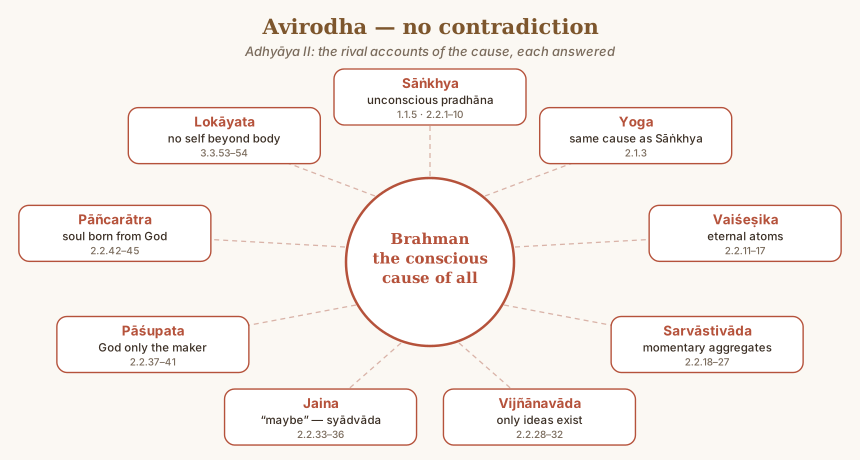
Adhyāya II: the rival accounts of the cause, with the sūtras that answer each
Adhyāya II: the rival accounts of the cause, with the sūtras that answer each (diagram drawn for this page)

The Avirodha adhyāya — non-contradiction

Once the purport of the Upaniṣads is fixed, it must be defended. The second adhyāya answers every kind of objection: from other smṛtis (Sāṅkhya and Yoga, which claimed the authority of sages), from reasoning (“the world is too unlike Brahman to come from it”, “a partless Brahman cannot change”, “why would a perfect being create?”, “is God cruel?”), and from the rival philosophies of the day.

Pāda 1 is defensive; pāda 2 goes on the attack. Sāṅkhya’s unconscious cause cannot explain order; the Vaiśeṣika atoms cannot start moving; the Buddhist schools — the realists with their momentary aggregates, the idealists for whom only ideas exist — are shown to lack a continuous witness or to contradict experience; the Jaina “maybe” cannot yield certain knowledge; a God who is only the maker of a separate matter is a limited God. Pādas 3 and 4 reconcile the Upaniṣads among themselves on creation, on the individual soul and on the senses and life-force.

Two of the most important passages of the work are here. 2.1.14 (tad-ananyatvam) states the theory of causation on which Advaita rests — the effect is not other than the cause, as pots are only clay with names. And 2.3.43–53 discuss the soul as a “part” of the Lord, a reflection, an agent — the sūtras the schools read most differently.

At a glance

4pādas47adhikaraṇas157sūtras37studied word by word

  1. Pāda 1 · Smṛti- and tarka-virodha Answering objections from smṛti and from reasoning — 37 sūtras, 13 adhikaraṇas
  2. Pāda 2 · Para-mata-khaṇḍana The refutation of the rival schools — 45 sūtras, 8 adhikaraṇas
  3. Pāda 3 · Sṛṣṭi-krama & jīva-svarūpa The order of creation, and the nature of the individual soul — 53 sūtras, 17 adhikaraṇas
  4. Pāda 4 · Prāṇa-utpatti The origin and status of the vital and sensory functions — 22 sūtras, 9 adhikaraṇas

The main questions

Each opens the full argument — passage, doubt, prior view and conclusion — on the overview.

The sūtras, pāda by pāda

Every sūtra of the adhyāya, grouped by adhikaraṇa (topic). The 37 key sūtras are opened word by word; the others are given in Devanāgarī and transliteration. The question and conclusion of each topic come from the overview.

Pāda 1 · Smṛti- and tarka-virodhaAnswering objections from smṛti and from reasoning 37 sūtras · 13 adhikaraṇas · 14 studied word by word
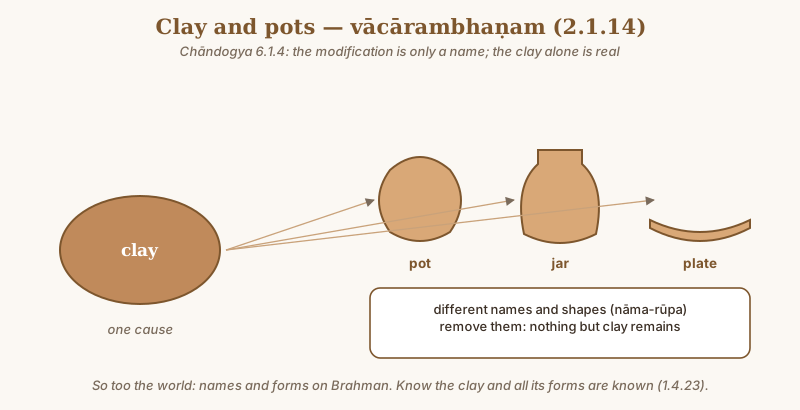
Clay and its products — the effect is not other than the cause (2.1.14)
Clay and its products — the effect is not other than the cause (2.1.14) (diagram drawn for this page)

The objections here are not about texts but about coherence: an insentient world cannot come from a conscious cause; a partless Brahman cannot transform; a perfect being has no motive to create; a just God would not make an unequal world. Each is answered, and along the way the ārambhaṇa-adhikaraṇa states the non-difference of effect and cause.

Unaided reasoning has no resting place — every argument admits a counter-argument.

1

Smṛti-adhikaraṇa

2.1.1–2 · 2 sūtras · 1 studied word by word
all five limbs ›

The passageThe authority of Kapila's Sāṅkhya smṛti.

The questionDoes the authority of a revered smṛti override the plain sense of śruti?

ConclusionSmṛti is authoritative only in what does not conflict with śruti, from which it derives its own standing. Where it conflicts, it is set aside. And the smṛtis are not unanimous: Manu, the Gītā and the Mokṣadharma teach a conscious cause. The Kapila praised in śruti need not be the author of the Sāṅkhya.

2.1.2
इतरेषां चानुपलब्धेः
itareṣāṃ cānupalabdheḥ
2

Yogapratyukti-adhikaraṇa

2.1.3 · 1 sūtra · 1 studied word by word
all five limbs ›

The passageThe authority of the Yoga smṛti.

The questionDoes the same objection and the same answer apply to Yoga?

ConclusionThe same refutation applies to Yoga's metaphysics. Its disciplines — restraint, posture, concentration — are not rejected; what is rejected is its account of the world's cause as an independent insentient principle alongside a plurality of puruṣas.

3

Na-vilakṣaṇatva-adhikaraṇa

2.1.4–11 · 8 sūtras · 3 studied word by word
all five limbs ›

The passageThe unlikeness of cause and effect.

The questionCan an insentient, impure and changeful world arise from a conscious, pure and changeless Brahman?

ConclusionUnlikeness does not prevent causation — hair and nails come from a conscious man, and living creatures from inert matter. The effect is non-different from the cause and has no being apart from it, so the question of resemblance between two things does not arise. Above all, mere reasoning is apratiṣṭhita , without a resting place: any argument admits a counter-argument, and matters beyond the senses are not to be settled by it.

2.1.5
अभिमानिव्यपदेशस्तु विशेषानुगतिभ्याम्
abhimānivyapadeśastu viśeṣānugatibhyām
2.1.7
असदिति चेन्न प्रतिषेधमात्रत्वात्
asaditi cenna pratiṣedhamātratvāt
2.1.8
अपीतौ तद्वत्प्रसङ्गादसमञ्जसम्
apītau tadvatprasaṅgādasamañjasam
2.1.9
न तु दृष्टान्तभावात्
na tu dṛṣṭāntabhāvāt
2.1.10
स्वपक्षदोषाच्च
svapakṣadoṣācca
4

Śiṣṭāparigraha-adhikaraṇa

2.1.12 · 1 sūtra
all five limbs ›

The passageThe appeal to the authority of respected thinkers.

The questionDoes the acceptance of Sāṅkhya by learned and respected people lend it weight?

ConclusionIt is not accepted by those who follow the Veda, and that is the relevant authority here. Moreover the rival schools contradict one another as much as they contradict Vedānta, so appeal to reputation settles nothing.

2.1.12
एतेन शिष्टापरिग्रहा अपि व्याख्याताः
etena śiṣṭāparigrahā api vyākhyātāḥ
5

Bhoktrāpatti-adhikaraṇa

2.1.13 · 1 sūtra · 1 studied word by word
all five limbs ›

The passageThe distinction of enjoyer and enjoyed.

The questionIf the world is non-different from Brahman and the soul is Brahman, does the distinction between enjoyer and enjoyed collapse?

ConclusionNon-difference at the level of substance does not abolish distinction at the level of practice — as the sea is not different from its waves and foam, which nevertheless remain distinguishable. The distinction is real within its own order.

6

Ārambhaṇa-adhikaraṇa

2.1.14–20 · 7 sūtras · 1 studied word by word
all five limbs ›

The passageChāndogya 6.1.4 — vācārambhaṇaṁ vikāro nāmadheyaṁ mṛttiketyeva satyam : ‘the modification is a name, a matter of speech; the clay alone is real’.

The questionIs the effect a genuinely new thing, or non-different from its cause?

ConclusionThe effect is non-different from the cause ( ananyatva ). The clay alone is real; pot, jar and plate are names taken hold of by speech. Difference of function does not establish difference of substance, and the śruti's promise that knowing one thing all is known requires exactly this.

2.1.15
भावे चोपलब्धेः
bhāve copalabdheḥ
2.1.16
सत्त्वाच्चावरस्य
sattvāccāvarasya
2.1.17
असद्व्यपदेशान्नेति चेन्न धर्मान्तरेण वाक्यशेषात्
asadvyapadeśānneti cenna dharmāntareṇa vākyaśeṣāt
2.1.18
युक्तेः शब्दान्तराच्च
yukteḥ śabdāntarācca
2.1.19
पटवच्च
paṭavacca
2.1.20
यथा च प्राणादि
yathā ca prāṇādi
7

Itaravyapadeśa-adhikaraṇa

2.1.21–23 · 3 sūtras
all five limbs ›

The passageThe Lord's responsibility for the soul's condition.

The questionIf the creator is the soul's own self, why would it make a world in which it suffers?

ConclusionThe ruler and the ruled remain distinct in the empirical order, as the same substance appears as sea and as wave. The soul's identity with Brahman does not make the soul the agent of creation; creation belongs to Brahman under its own aspect, not to the soul under its adjuncts.

2.1.21
इतरव्यपदेशाद्धिताकरणादिदोषप्रसक्तिः
itaravyapadeśāddhitākaraṇādidoṣaprasaktiḥ
2.1.22
अधिकं तु भेदनिर्देशात्
adhikaṃ tu bhedanirdeśāt
2.1.23
अश्मादिवच्च तदनुपपत्तिः
aśmādivacca tadanupapattiḥ
8

Upasaṁhāradarśana-adhikaraṇa

2.1.24–25 · 2 sūtras · 1 studied word by word
all five limbs ›

The passageThe absence of materials and instruments.

The questionBrahman has no hands, no tools, no separate material. How then can it produce anything?

ConclusionMilk turns to curd without instruments; gods and yogins are said to produce forms by their own nature alone. Creation from Brahman is of that kind, and the analogy of ordinary craftsmanship does not govern the unique case.

2.1.25
देवादिवदपि लोके
devādivadapi loke
9

Kṛtsnaprasakti-adhikaraṇa

2.1.26–29 · 4 sūtras · 3 studied word by word
all five limbs ›

The passageThe transformation of a partless whole.

The questionIf Brahman is without parts, does creation consume it entirely, leaving nothing over?

ConclusionThe creation proceeds from māyā, not by real division or exhaustion of Brahman — as a magician is untouched by the magic he displays, and a dreamer by the dream. Scripture is authoritative here, and it asserts both creation and immutability.

2.1.29
स्वपक्षदोषाच्च
svapakṣadoṣācca
10

Sarvopetā-adhikaraṇa

2.1.30–31 · 2 sūtras
all five limbs ›

The passageThe powers required for creatorship.

The questionCan a Brahman said to be without organs possess the powers that creation demands?

ConclusionŚruti ascribes all powers to Brahman — ‘he grasps without hands, moves without feet, sees without eyes’. The denial of organs denies material instruments, not capability; and the powers ascribed are its own, not borrowed.

2.1.30
सर्वोपेता च तद्दर्शनात्
sarvopetā ca taddarśanāt
2.1.31
विकरणत्वान्नेति चेत्तदुक्तम्
vikaraṇatvānneti cettaduktam
11

Prayojanavattva-adhikaraṇa

2.1.32–33 · 2 sūtras · 1 studied word by word
all five limbs ›

The passageThe motive for creation.

The questionWhy would a being lacking nothing create anything at all?

ConclusionCreation is līlā , sport: it proceeds without motive, as a king plays or as breathing goes on. Nor is the objection decisive against scripture, which reports the fact whether or not a motive can be assigned.

2.1.32
न प्रयोजनवत्त्वात्
na prayojanavattvāt
12

Vaiṣamya-nairghṛṇya-adhikaraṇa

2.1.34–36 · 3 sūtras · 2 studied word by word
all five limbs ›

The passageThe problem of inequality and suffering.

The questionIs the Lord then partial and cruel, since creatures are born unequal and some to great misery?

ConclusionCreation proceeds with regard to the merit and demerit of beings, as rain falls impartially while different seeds yield different plants. And the objection of a first arbitrary allotment does not arise, because saṁsāra is beginningless — there is no first birth at which the Lord acted without regard to prior karma.

2.1.36
उपपद्यते चाप्युपलभ्यते च
upapadyate cāpyupalabhyate ca
13

Sarvadharmopapatti-adhikaraṇa

2.1.37 · 1 sūtra
all five limbs ›

The passageThe conclusion of the pāda.

The questionAre all the attributes needed for creatorship actually established in Brahman?

ConclusionOmniscience, omnipotence and the rest are established by śruti and are not contradicted by anything shown. All the characteristics required of the world's cause are found in Brahman and in nothing else.

2.1.37
सर्वधर्मोपपत्तेश्च
sarvadharmopapatteśca
Pāda 2 · Para-mata-khaṇḍanaThe refutation of the rival schools 45 sūtras · 8 adhikaraṇas · 9 studied word by word
Adhyāya II: the rival accounts of the cause, with the sūtras that answer each
Adhyāya II: the rival accounts of the cause, with the sūtras that answer each (diagram drawn for this page)

The most polemical pāda in the work, and the one that most clearly shows Vedānta arguing on its opponents' own ground rather than by appeal to scripture. Sāṅkhya, Vaiśeṣika atomism, Sarvāstivāda, Vijñānavāda, Jaina anekāntavāda, the Pāśupatas and the Pāñcarātrins are each taken up and dismantled on grounds of internal inconsistency.

Here scripture is set aside and the rivals are met with argument alone.

1

Racanānupapatti-adhikaraṇa

2.2.1–10 · 10 sūtras · 2 studied word by word
all five limbs ›

The passageSāṅkhya's pradhāna, met on its own ground.

The questionCan an unguided insentient principle produce an ordered world?

ConclusionThe analogies fail: milk flows under the cow's own vitality and under the Lord's governance. The guṇas in equilibrium have no reason to become disturbed, and no principle within pradhāna can initiate the disturbance. The puruṣa of Sāṅkhya is by definition inactive and cannot supply it. An ordered world requires a directing intelligence.

2.2.2
प्रवृत्तेश्च
pravṛtteśca
2.2.3
पयोऽम्बुवच्चेत्तत्रापि
payo'mbuvaccettatrāpi
2.2.4
व्यतिरेकानवस्थितेश्चानपेक्षत्वात्
vyatirekānavasthiteścānapekṣatvāt
2.2.5
अन्यत्राभावाच्च न तृणादिवत्
anyatrābhāvācca na tṛṇādivat
2.2.6
अभ्युपगमेऽप्यर्थाभावात्
abhyupagame'pyarthābhāvāt
2.2.8
अङ्गित्वानुपपत्तेश्च
aṅgitvānupapatteśca
2.2.9
अन्यथानुमितौ च ज्ञशक्तिवियोगात्
anyathānumitau ca jñaśaktiviyogāt
2.2.10
विप्रतिषेधाच्चासमञ्जसम्
vipratiṣedhāccāsamañjasam
2

Mahaddīrgha-adhikaraṇa

2.2.11 · 1 sūtra
all five limbs ›

The passageThe Vaiśeṣika account of magnitude.

The questionCan extended magnitude arise from partless atoms?

ConclusionMagnitude in the effect must be traced to magnitude in the cause. Partless atoms have none, and number alone cannot generate extension. The atomic account of ‘great’ and ‘long’ fails at its first step.

2.2.11
महद्दीर्घवद्वा ह्रस्वपरिमण्डलाभ्याम्
mahaddīrghavadvā hrasvaparimaṇḍalābhyām
3

Paramāṇu-jagad-akāraṇatva-adhikaraṇa

2.2.12–17 · 6 sūtras · 1 studied word by word
all five limbs ›

The passageAtomism as a theory of the world's material cause.

The questionAre atoms the material cause of the world?

ConclusionThe initial motion of the atoms cannot be accounted for: adṛṣṭa is insentient and cannot direct, and if motion is intrinsic the atoms would be eternally active, making dissolution impossible, while if it is not, they would be eternally inert and creation impossible. Conjunction requires parts, which partless atoms lack. And atoms of different sizes cannot be maintained without contradiction.

2.2.13
समवायाभ्युपगमाच्च साम्यादनवस्थितेः
samavāyābhyupagamācca sāmyādanavasthiteḥ
2.2.14
नित्यमेव च भावात्
nityameva ca bhāvāt
2.2.15
रूपादिमत्त्वाच्च विपर्ययो दर्शनात्
rūpādimattvācca viparyayo darśanāt
2.2.16
उभयथा च दोषात्
ubhayathā ca doṣāt
2.2.17
अपरिग्रहाच्चात्यन्तमनपेक्षा
aparigrahāccātyantamanapekṣā
4

Samudāya-adhikaraṇa

2.2.18–27 · 10 sūtras · 1 studied word by word
all five limbs ›

The passageThe Buddhist realists — Sarvāstivāda and Sautrāntika — and the doctrine of momentariness.

The questionCan a world be built from momentary aggregates with no permanent substrate?

ConclusionNothing is available to effect the aggregation: not the momentary factors themselves, which perish before they can combine, and not a permanent principle, which the doctrine denies. Momentariness destroys causality, since the cause is gone before the effect arises; it destroys recognition and memory, since the rememberer is not the experiencer; and it makes bondage and release unintelligible, since no one persists to be bound or freed.

2.2.19
इतरेतरप्रत्ययत्वादिति चेन्नोत्पत्तिमात्रनिमित्तत्वात्
itaretarapratyayatvāditi cennotpattimātranimittatvāt
2.2.20
उत्तरोत्पादे च पूर्वनिरोधात्
uttarotpāde ca pūrvanirodhāt
2.2.21
असति प्रतिज्ञोपरोधो यौगपद्यमन्यथा
asati pratijñoparodho yaugapadyamanyathā
2.2.22
प्रतिसंख्याप्रतिसंख्यानिरोधाप्राप्तिरविच्छेदात्
pratisaṃkhyāpratisaṃkhyānirodhāprāptiravicchedāt
2.2.23
उभयथा च दोषात्
ubhayathā ca doṣāt
2.2.24
आकाशे चाविशेषात्
ākāśe cāviśeṣāt
2.2.25
अनुस्मृतेश्च
anusmṛteśca
2.2.26
नासतोऽदृष्टत्वात्
nāsato'dṛṣṭatvāt
2.2.27
उदासीनानामपि चैवं सिद्धिः
udāsīnānāmapi caivaṃ siddhiḥ
5

Nābhāva-adhikaraṇa

2.2.28–32 · 5 sūtras · 2 studied word by word
all five limbs ›

The passageVijñānavāda — the doctrine of consciousness only.

The questionIs the external world merely a modification of consciousness?

ConclusionPerception presents its object as external and given, not as constructed; to say otherwise is to contradict the very experience appealed to. Waking and dream are disanalogous, since dream is sublated on waking while waking is not. And momentary consciousness cannot account for the residual impressions the doctrine requires, since there is nothing that persists to hold them.

2.2.30
न भावोऽनुपलब्धेः
na bhāvo'nupalabdheḥ
2.2.31
क्षणिकत्वाच्च
kṣaṇikatvācca
2.2.32
सर्वथानुपपत्तेश्च
sarvathānupapatteśca
6

Ekasminnasambhava-adhikaraṇa

2.2.33–36 · 4 sūtras · 1 studied word by word
all five limbs ›

The passageJaina anekāntavāda and the sevenfold predication.

The questionCan mutually contradictory attributes belong to one and the same thing?

ConclusionContradictory properties cannot coexist in one substrate; and a doctrine which affirms and denies indifferently yields no determinate knowledge, so it cannot even assert itself. The Jaina account of the soul as of the size of the body is also untenable, since bodies vary and the soul would have to grow and shrink, becoming impermanent.

2.2.34
एवं चात्माकार्त्स्न्यम्
evaṃ cātmākārtsnyam
2.2.35
न च पर्यायादप्यविरोधो विकारादिभ्यः
na ca paryāyādapyavirodho vikārādibhyaḥ
2.2.36
अन्त्यावस्थितेश्चोभयनित्यत्वादविशेषः
antyāvasthiteścobhayanityatvādaviśeṣaḥ
7

Patyur-adhikaraṇa

2.2.37–41 · 5 sūtras · 1 studied word by word
all five limbs ›

The passageThe Pāśupata and Seśvara-Sāṅkhya position: a Lord who is efficient cause only.

The questionCan the Lord be merely the efficient cause, governing a material principle distinct from himself?

ConclusionThe relation between a Lord who is neither the material nor within it and the material he governs cannot be specified — not conjunction, since both are partless or all-pervading, and not inherence. Such a Lord would be moved by motives and hence not self-sufficient, or would create arbitrarily and hence be unjust. And the position contradicts śruti's ‘one without a second’.

2.2.38
सम्बन्धानुपपत्तेश्च
sambandhānupapatteśca
2.2.39
अधिष्ठानानुपपत्तेश्च
adhiṣṭhānānupapatteśca
2.2.40
करणवच्चेन्न भोगादिभ्यः
karaṇavaccenna bhogādibhyaḥ
2.2.41
अन्तवत्त्वमसर्वज्ञता वा
antavattvamasarvajñatā vā
8

Utpattyasambhava-adhikaraṇa

2.2.42–45 · 4 sūtras · 1 studied word by word
all five limbs ›

The passageThe Pāñcarātra or Bhāgavata doctrine of the four vyūhas.

The questionCan Saṅkarṣaṇa — that is, the individual soul — be produced from Vāsudeva?

ConclusionThe soul cannot originate: it is unoriginated, as the third pāda will establish. If it did, it would be perishable and release would be impossible. The devotional core of the school is not rejected — that Vāsudeva is the supreme reality, and that worship of him is a means — but the derivation of souls and instruments in that sequence cannot stand.

2.2.43
न च कर्तुः करणम्
na ca kartuḥ karaṇam
2.2.44
विज्ञानादिभावे वा तदप्रतिषेधः
vijñānādibhāve vā tadapratiṣedhaḥ
2.2.45
विप्रतिषेधाच्च
vipratiṣedhācca
Pāda 3 · Sṛṣṭi-krama & jīva-svarūpaThe order of creation, and the nature of the individual soul 53 sūtras · 17 adhikaraṇas · 11 studied word by word
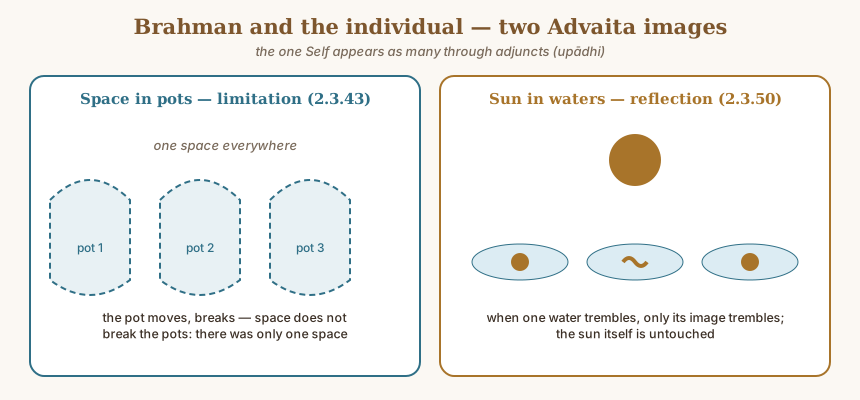
Space in pots and the sun in waters: how the one Self appears as many
Space in pots and the sun in waters: how the one Self appears as many (diagram drawn for this page)

The first half establishes the sequence in which the elements arise from Brahman and dissolve back. The second half turns to the soul: it is unoriginated, essentially consciousness, an agent only through its adjuncts, and a 'part' of Brahman in a carefully qualified sense. The dispute over its size in sūtras 19–32 is the sharpest fault-line between Śaṅkara and Rāmānuja anywhere in the text.

The soul is not made, and its bondage belongs to what it has been mistaken for.

1

Viyat-adhikaraṇa

2.3.1–7 · 7 sūtras · 2 studied word by word
all five limbs ›

The passageTaittirīya 2.1 — ‘from that self sprang ākāśa’ — against Chāndogya 6.2, which begins with fire.

The questionDoes ākāśa originate, or is it beginningless?

ConclusionThe Taittirīya states its origin explicitly, and an omission in one text does not contradict an assertion in another. Everything other than Brahman has an origin; ‘eternal’ as applied to ākāśa is relative to the grosser elements.

2.3.2
अस्ति तु
asti tu
2.3.3
गौण्यसम्भवात्
gauṇyasambhavāt
2.3.4
शब्दाच्च
śabdācca
2.3.5
स्याच्चैकस्य ब्रह्मशब्दवत्
syāccaikasya brahmaśabdavat
2.3.6
प्रतिज्ञाहानिरव्यतिरेकाच्छब्देभ्यः
pratijñāhāniravyatirekācchabdebhyaḥ
2

Mātariśva-adhikaraṇa

2.3.8 · 1 sūtra
all five limbs ›

The passageThe origin of air.

The questionDoes air likewise originate?

ConclusionAir originates from ākāśa, as the same passage states in sequence. The reasoning follows exactly that of the preceding adhikaraṇa.

2.3.8
एतेन मातरिश्वा व्याख्यातः
etena mātariśvā vyākhyātaḥ
3

Asambhava-adhikaraṇa

2.3.9 · 1 sūtra · 1 studied word by word
all five limbs ›

The passageThe status of Brahman in the causal series.

The questionDoes Brahman itself have an origin?

ConclusionBrahman has no origin, there being nothing prior to it from which it could arise. The series terminates, and it terminates in what is by definition uncaused.

4

Tejas-adhikaraṇa

2.3.10 · 1 sūtra
all five limbs ›

The passageThe origin of fire.

The questionFrom what does fire arise?

ConclusionFire arises from air, following the stated sequence; passages that seem to derive it directly from Brahman are speaking of the ultimate source through the intermediate stages.

2.3.10
तेजोऽतस्तथा ह्याह
tejo'tastathā hyāha
5

Ap-adhikaraṇa

2.3.11 · 1 sūtra
all five limbs ›

The passageThe origin of water.

The questionFrom what does water arise?

ConclusionWater arises from fire, as the Chāndogya states.

2.3.11
आपः
āpaḥ
6

Pṛthivī-adhikaraṇa

2.3.12 · 1 sūtra
all five limbs ›

The passageChāndogya 6.2.4 — ‘from water, food’.

The questionDoes ‘food’ here mean rice and barley, or the element earth?

ConclusionEarth, since the element is what the sequence requires, and since earth is elsewhere characterised by the qualities of food. The word is used for the element by extension.

2.3.12
पृथिव्यधिकाररूपशब्दान्तरेभ्यः
pṛthivyadhikārarūpaśabdāntarebhyaḥ
7

Tadabhidhyāna-adhikaraṇa

2.3.13 · 1 sūtra
all five limbs ›

The passageThe elements are said to ‘think’ before producing their successors.

The questionIs the creative agency in each element its own?

ConclusionThe thinking belongs to Brahman presiding within each element. Insentient elements do not deliberate; the language ascribes to them what belongs to the one who has entered them.

2.3.13
तदभिध्यानादेव तु तल्लिङ्गात्सः
tadabhidhyānādeva tu talliṅgātsaḥ
8

Viparyaya-adhikaraṇa

2.3.14 · 1 sūtra
all five limbs ›

The passageThe order of dissolution.

The questionIn what order do the elements resolve?

ConclusionIn the reverse of the order of origination — earth into water, water into fire, and so on — which follows necessarily from the order of production.

2.3.14
विपर्ययेण तु क्रमोऽत उपपद्यते च
viparyayeṇa tu kramo'ta upapadyate ca
9

Antarāvijñāna-adhikaraṇa

2.3.15 · 1 sūtra
all five limbs ›

The passageThe place of mind and the senses in the causal order.

The questionAre mind and the senses outside the elemental sequence, since some texts name them separately?

ConclusionThey are included in the same order, being products of the elements. Their separate mention is for emphasis, not for exclusion.

2.3.15
अन्तरा विज्ञानमनसी क्रमेण तल्लिङ्गादिति चेन्नाविशेषात्
antarā vijñānamanasī krameṇa talliṅgāditi cennāviśeṣāt
10

Carācara-vyapāśraya-adhikaraṇa

2.3.16 · 1 sūtra
all five limbs ›

The passageStatements that the soul is born and dies.

The questionDo birth and death belong to the soul?

ConclusionBirth and death belong to the body. They are ascribed to the soul in a secondary sense, because of its connection with a body that is born and dies.

2.3.16
चराचरव्यपाश्रयस्तु स्यात्तद्व्यपदेशो भाक्तस्तद्भावभावित्वात्
carācaravyapāśrayastu syāttadvyapadeśo bhāktastadbhāvabhāvitvāt
11

Ātman-adhikaraṇa

2.3.17 · 1 sūtra · 1 studied word by word
all five limbs ›

The passageThe origin of the individual soul.

The questionDoes the soul originate?

ConclusionThe soul has no origin. Scripture nowhere states its production, speaks of it as eternal, and describes it as unborn. Its apparent birth is the birth of the adjuncts with which it is associated.

12

Jña-adhikaraṇa

2.3.18 · 1 sūtra · 1 studied word by word
all five limbs ›

The passageThe soul's relation to consciousness.

The questionIs consciousness the soul's essential nature, or an adventitious quality it acquires?

ConclusionThe soul is consciousness itself, not a substance possessing it. A soul that were unconscious in release would be indistinguishable from a stone, and no one would seek such a state. The apparent absence of consciousness in deep sleep is the absence of objects, not of the light by which they would be known.

13

Utkrānti-gati-adhikaraṇa

2.3.19–32 · 14 sūtras · 1 studied word by word
all five limbs ›

The passagePassages describing the soul as departing, going and returning, and as of the size of the point of a goad.

The questionIs the individual soul atomic in size, or all-pervading?

ConclusionOn Śaṅkara's reading these descriptions belong to the internal organ, the soul's adjunct, and are transferred to the soul by association. The soul is in truth vibhu , all-pervading and identical with Brahman; its apparent size, motion and location are borrowed from what it has been mistaken for.

2.3.19
उत्क्रान्तिगत्यागतीनाम्
utkrāntigatyāgatīnām
2.3.20
स्वात्मना चोत्तरयोः
svātmanā cottarayoḥ
2.3.21
नाणुरतच्छ्रुतेरिति चेन्नेतराधिकारात्
nāṇuratacchruteriti cennetarādhikārāt
2.3.22
स्वशब्दोन्मानाभ्यां च
svaśabdonmānābhyāṃ ca
2.3.23
अविरोधश्चन्दनवत्
avirodhaścandanavat
2.3.24
अवस्थितिवैशेष्यादिति चेन्नाभ्युपगमाद्धृदि हि
avasthitivaiśeṣyāditi cennābhyupagamāddhṛdi hi
2.3.25
गुणाद्वा लोकवत्
guṇādvā lokavat
2.3.26
व्यतिरेको गन्धवत्
vyatireko gandhavat
2.3.27
तथा च दर्शयति
tathā ca darśayati
2.3.28
पृथगुपदेशात्
pṛthagupadeśāt
2.3.30
यावदात्मभावित्वाच्च न दोषस्तद्दर्शनात्
yāvadātmabhāvitvācca na doṣastaddarśanāt
2.3.31
पुंस्त्वादिवत्त्वस्य सतोऽभिव्यक्तियोगात्
puṃstvādivattvasya sato'bhivyaktiyogāt
2.3.32
नित्योपलब्ध्यनुपलब्धिप्रसङ्गोऽन्यतरनियमो वान्यथा
nityopalabdhyanupalabdhiprasaṅgo'nyataraniyamo vānyathā
14

Kartṛ-adhikaraṇa

2.3.33–39 · 7 sūtras · 1 studied word by word
all five limbs ›

The passageThe soul as agent.

The questionIs the soul an agent, or is agency wholly foreign to it?

ConclusionThe soul is an agent — scripture enjoins actions upon it and promises fruits, which would be meaningless otherwise. But its agency is not essential: it belongs to the soul through its adjuncts, as a carpenter acts with tools and rests without them.

2.3.34
विहारोपदेशात्
vihāropadeśāt
2.3.35
उपादानात्
upādānāt
2.3.36
व्यपदेशाच्च क्रियायां न चेन्निर्देशविपर्ययः
vyapadeśācca kriyāyāṃ na cennirdeśaviparyayaḥ
2.3.37
उपलब्धिवदनियमः
upalabdhivadaniyamaḥ
2.3.38
शक्तिविपर्ययात्
śaktiviparyayāt
2.3.39
समाध्यभावाच्च
samādhyabhāvācca
15

Takṣa-adhikaraṇa

2.3.40 · 1 sūtra · 1 studied word by word
all five limbs ›

The passageThe carpenter analogy.

The questionIf agency is not essential to the soul, how does it come and go?

ConclusionAs a carpenter is an agent while holding his tools and not while laying them down, so the soul is an agent through the upādhis and free of agency without them. Agency is therefore neither intrinsic nor impossible.

16

Parāyatta-adhikaraṇa

2.3.41–42 · 2 sūtras · 1 studied word by word
all five limbs ›

The passageThe Lord and the soul's action.

The questionIf the soul acts, is it independent — and if it is dependent on the Lord, is the Lord responsible for its deeds?

ConclusionThe soul's agency is dependent on the Lord, but the Lord acts with regard to the soul's own past effort and accumulated karma, as rain enables each seed to grow according to its own nature. Responsibility is therefore preserved on both sides.

2.3.42
कृतप्रयत्नापेक्षस्तु विहितप्रतिषिद्धावैयर्थ्यादिभ्यः
kṛtaprayatnāpekṣastu vihitapratiṣiddhāvaiyarthyādibhyaḥ
17

Aṁśa-adhikaraṇa

2.3.43–53 · 11 sūtras · 2 studied word by word
all five limbs ›

The passageThe relation of the soul to Brahman.

The questionIs the soul identical with Brahman, or different from it, or a part of it?

ConclusionThe soul is a ‘part’ (aṁśa) — but since Brahman is partless, part here means as a reflection or a delimited portion of space is a part: not a fragment broken off but the same thing appearing as limited. This is why scripture uses the language of both difference and non-difference. The Lord is not affected by the soul's pleasure and pain, as the sun is not wetted by the water in which it is reflected.

2.3.44
मन्त्रवर्णाच्च
mantravarṇācca
2.3.45
अपि च स्मर्यते
api ca smaryate
2.3.46
प्रकाशादिवन्नैवं परः
prakāśādivannaivaṃ paraḥ
2.3.47
स्मरन्ति च
smaranti ca
2.3.48
अनुज्ञापरिहारौ देहसम्बन्धाज्ज्योतिरादिवत्
anujñāparihārau dehasambandhājjyotirādivat
2.3.49
असंततेश्चाव्यतिकरः
asaṃtateścāvyatikaraḥ
2.3.51
अदृष्टानियमात्
adṛṣṭāniyamāt
2.3.52
अभिसंध्यादिष्वपि चैवम्
abhisaṃdhyādiṣvapi caivam
2.3.53
प्रदेशादिति चेन्नान्तर्भावात्
pradeśāditi cennāntarbhāvāt
Pāda 4 · Prāṇa-utpattiThe origin and status of the vital and sensory functions 22 sūtras · 9 adhikaraṇas · 3 studied word by word

A technical pāda completing the cosmology: the eleven organs and the chief prāṇa also originate from Brahman, the chief prāṇa is a principle distinct both from air and from the sense-functions, and the presiding deities do not displace the soul as enjoyer.

Nothing in the psychophysical apparatus is self-existent.

1

Prāṇotpatti-adhikaraṇa

2.4.1–4 · 4 sūtras · 1 studied word by word
all five limbs ›

The passageThe origin of the vital and sensory functions.

The questionDo the prāṇas originate, or are they beginningless?

ConclusionThey originate from Brahman, as scripture states. Passages that seem to presuppose them describe the state before their differentiation, not their eternality.

2.4.2
गौण्यसम्भवात्
gauṇyasambhavāt
2.4.3
तत्प्राक्श्रुतेश्च
tatprākśruteśca
2.4.4
तत्पूर्वकत्वाद्वाचः
tatpūrvakatvādvācaḥ
2

Saptagati-adhikaraṇa

2.4.5–6 · 2 sūtras
all five limbs ›

The passageThe number of the prāṇas.

The questionHow many organs are there?

ConclusionEleven: the five organs of knowledge, the five of action, and the mind — as other passages enumerate. The figure seven is contextual.

2.4.5
सप्त गतेर्विशेषितत्वाच्च
sapta gaterviśeṣitatvācca
2.4.6
हस्तादयस्तु स्थितेऽतो नैवम्
hastādayastu sthite'to naivam
3

Prāṇāṇutva-adhikaraṇa

2.4.7 · 1 sūtra
all five limbs ›

The passageThe size of the sense-organs.

The questionAre the organs all-pervading or minute?

ConclusionThey are minute (aṇu) and subtle, since they depart with the soul at death, which the all-pervading could not do. Their reach is a function, not an extension.

2.4.7
अणवश्च
aṇavaśca
4

Prāṇa-śreṣṭhya-adhikaraṇa

2.4.8 · 1 sūtra · 1 studied word by word
all five limbs ›

The passageThe chief prāṇa.

The questionDoes the chief vital force also originate?

ConclusionIt too originates from Brahman. ‘Eldest’ marks its priority among the products, not exemption from production.

5

Vāyukriyā-adhikaraṇa

2.4.9–12 · 4 sūtras
all five limbs ›

The passageThe nature of the chief prāṇa.

The questionIs the chief prāṇa simply air, or a collective function of the organs, or a distinct principle?

ConclusionIt is neither: not mere air, because it is a distinct function under a distinct name; and not the organs' collective activity, because it operates in deep sleep when they do not, and because scripture treats it as a separate principle. It is a fifth mode of the elemental air, dependent on the soul.

2.4.9
न वायुक्रिये पृथगुपदेशात्
na vāyukriye pṛthagupadeśāt
2.4.10
चक्षुरादिवत्तु तत्सहशिष्ट्यादिभ्यः
cakṣurādivattu tatsahaśiṣṭyādibhyaḥ
2.4.11
अकरणत्वाच्च न दोषस्तथा हि दर्शयति
akaraṇatvācca na doṣastathā hi darśayati
2.4.12
पञ्चवृत्तिर्मनोवद्व्यपदिश्यते
pañcavṛttirmanovadvyapadiśyate
6

Śreṣṭhāṇutva-adhikaraṇa

2.4.13 · 1 sūtra
all five limbs ›

The passageThe size of the chief prāṇa.

The questionIs the chief prāṇa all-pervading?

ConclusionIt too is subtle and limited, since it departs with the soul. Its pervasion is of the body only.

2.4.13
अणुश्च
aṇuśca
7

Jyotirādi-adhikaraṇa

2.4.14–16 · 3 sūtras
all five limbs ›

The passageThe deities presiding over the organs.

The questionIf fire, sun and the rest preside over speech, sight and the other organs, who is the enjoyer?

ConclusionThe deities preside, but the organs serve the soul, and the soul is the enjoyer. The deities are concerned with the cosmic functions, not with the individual's experience.

2.4.14
ज्योतिराद्यधिष्ठानं तु तदामननात्
jyotirādyadhiṣṭhānaṃ tu tadāmananāt
2.4.15
प्राणवता शब्दात्
prāṇavatā śabdāt
2.4.16
तस्य च नित्यत्वात्
tasya ca nityatvāt
8

Indriya-adhikaraṇa

2.4.17–19 · 3 sūtras
all five limbs ›

The passageThe status of the organs.

The questionAre the sense-organs merely modes of the chief prāṇa?

ConclusionThey are distinct principles, since they are separately enumerated and have distinct objects and distinct presiding deities. The common name marks their common dependence, not their identity.

2.4.17
त इन्द्रियाणि तद्व्यपदेशादन्यत्र श्रेष्ठात्
ta indriyāṇi tadvyapadeśādanyatra śreṣṭhāt
2.4.18
भेदश्रुतेः
bhedaśruteḥ
2.4.19
वैलक्षण्याच्च
vailakṣaṇyācca
9

Saṁjñāmūrti-klṛpti-adhikaraṇa

2.4.20–22 · 3 sūtras · 1 studied word by word
all five limbs ›

The passageChāndogya 6.3 — ‘let me evolve names and forms’.

The questionWho evolves names and forms — the individual soul that entered, or the Lord?

ConclusionThe Lord, who enters as the living self and does the evolving; the soul is the medium, not the agent. Likewise the tripartite composition of the elements, and the derivation of flesh, blood and mind from food, water and fire, are the Lord's doing.

2.4.21
मांसादि भौमं यथाशब्दमितरयोश्च
māṃsādi bhaumaṃ yathāśabdamitarayośca
2.4.22
वैशेष्यात्तु तद्वादस्तद्वादः
vaiśeṣyāttu tadvādastadvādaḥ

Sūtra text: the Sanskrit of the Brahma Sūtra on sa.wikisource (वेदान्तदर्शनम्), checked against the text printed with Śaṅkara’s bhāṣya; numbering and the division into 191 adhikaraṇas follow Śaṅkara (as in Swami Gambhirananda’s and Swami Vireswarananda’s translations). Transliteration is generated from the Devanāgarī. Word meanings, translations, explanations and diagrams are written for this page; they follow Śaṅkara’s reading, with the readings of Rāmānuja and Madhva noted where they differ.