The passageThe two sets of texts: those ascribing form and attributes to Brahman, and those denying them.
The questionDoes Brahman have form and qualities, or not?
ConclusionBrahman is in truth formless and without attributes. The passages ascribing form are for the sake of meditation; the negating passages — neti neti — state the reality. Not even a shadow of imperfection touches Brahman, and where texts appear to admit one, the reference is to Brahman as conditioned by adjuncts.
Brahman does not have two natures
न स्थानतोऽपि परस्योभयलिङ्गं सर्वत्र हि
na sthānato'pi parasyobhayaliṅgaṃ sarvatra hi
Word by word
nanot
sthānataḥ apieven from place (adjuncts)
parasyaof the supreme (Brahman)
ubhaya-liṅgamtwofold characteristic (with and without attributes)
sarvatraeverywhere (in scripture)
hifor (it is taught as without attributes)
MeaningNot even on account of the place (adjuncts) can there be a twofold characteristic of the supreme (Brahman), for everywhere (it is taught as without distinctions).
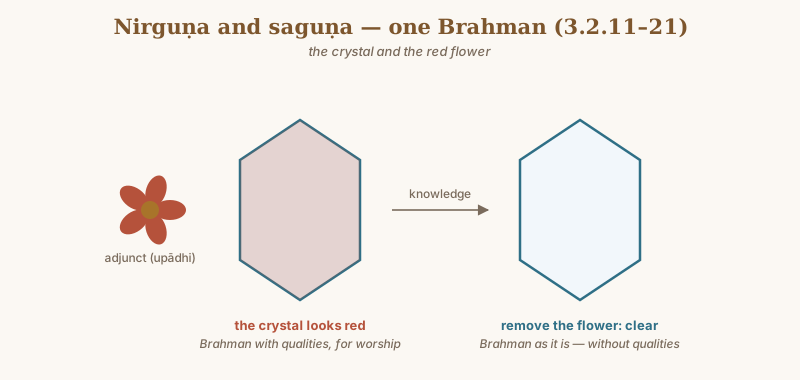
ExplanationThe Upaniṣads sometimes describe Brahman with qualities (“all-scented, all-tasting”) and sometimes without (“soundless, touchless, formless”). Does it have both natures? No — something cannot be by nature both qualified and unqualified. Through its adjuncts Brahman appears with qualities, but in itself it is without them, as a crystal is not red though a red flower is near it.
Philosophical aspectThe distinction of nirguṇa and saguṇa Brahman rests on this adhikaraṇa (3.2.11–21). Saguṇa Brahman is not a different Brahman but the same reality seen through the world-adjunct, for worship and meditation.
Other schoolsRāmānuja reads the same sūtra the other way: Brahman, everywhere, has the twofold mark of freedom from all defects and possession of all auspicious qualities.
3.2.12न भेदादिति चेन्न प्रत्येकमतद्वचनात्
na bhedāditi cenna pratyekamatadvacanāt
Brahman is formless
अरूपवदेव हि तत्प्रधानत्वात्
arūpavad eva hi tatpradhānatvāt
Word by word
arūpavat evaformless indeed
hifor
tat-pradhānatvātbecause that (formlessness) is the main teaching
Meaning(Brahman is) indeed formless, for that is the main purport (of the texts).
ExplanationTexts like “not gross, not subtle, not short, not long” (Bṛhadāraṇyaka 3.8.8) and “that which is without sound, touch, form” (Kaṭha 1.3.15) aim directly at Brahman’s nature. Texts describing form serve meditation and are secondary.
Philosophical aspectThe highest reality is beyond all form; forms are means for approaching it, not its nature.
Like light taking the shape of what it lights
प्रकाशवच्चावैयर्थ्यात्
prakāśavac cāvaiyarthyāt
Word by word
prakāśa-vatlike light
caand
avaiyarthyātbecause (the texts of form) are not meaningless
MeaningAnd like light (Brahman appears with form), so that (those texts) are not meaningless.
ExplanationSunlight is formless, but it appears straight or bent according to what it falls on. So formless Brahman appears with form through adjuncts, and the descriptions of form are useful for meditation.
Philosophical aspectNothing in scripture is wasted: descriptions of form are true of Brahman as it appears and are a support for the mind that is not yet ready for the formless.
3.2.16आह च तन्मात्रम्
āha ca tanmātram
Scripture and smṛti teach by negation
दर्शयति चाथो अपि स्मर्यते
darśayati cātho api smaryate
Word by word
darśayati(scripture) shows
caand
atha u apimoreover also
smaryate(it is) stated in smṛti
Meaning(Scripture) shows (that Brahman is without attributes), and so too does smṛti.
ExplanationScripture teaches Brahman by negating all distinctions: Bāhva, asked by Bāṣkali about Brahman, remained silent; asked again, he said, “I am telling you, but you do not understand: this Self is silence.” The Gītā says “it is called neither being nor non-being” (13.12).
Philosophical aspectThe highest teaching is silence or negation — not because Brahman is nothing, but because it is the subject, which no description of objects can reach.
Like the sun reflected in many waters
अत एव चोपमा सूर्यकादिवत्
ata eva copamā sūryakādivat
Word by word
ataḥ evafor this very reason
caand
upamāthe comparison
sūryaka-ādi-vatlike the images of the sun and so on (in water)
MeaningFor this very reason the comparison (is used), like that of the reflections of the sun.
ExplanationBecause Brahman is one and appears as many through adjuncts, scripture compares it to the sun reflected in many vessels of water: one sun, many images, each trembling with its water while the sun is untouched.
Philosophical aspectThe reflection image explains how the one Self appears in many bodies without being divided or affected by their changes.
3.2.19अम्बुवदग्रहणात्तु न तथात्वम्
ambuvadagrahaṇāttu na tathātvam
3.2.20वृद्धिह्रासभाक्त्वमन्तर्भावादुभयसामञ्जस्यादेवम्
vṛddhihrāsabhāktvamantarbhāvādubhayasāmañjasyādevam