🔔 Online Vedanta Classes Now Enrolling — Know More →

Research › Brahma Sūtra › Adhyāya IV · Phala

फलाध्यायः

Adhyāya IV — Phala

The fruit. Knowledge ends karma; the departure, the path and the liberated state. 38 topics, 78 sūtras — 31 of them opened word by word.

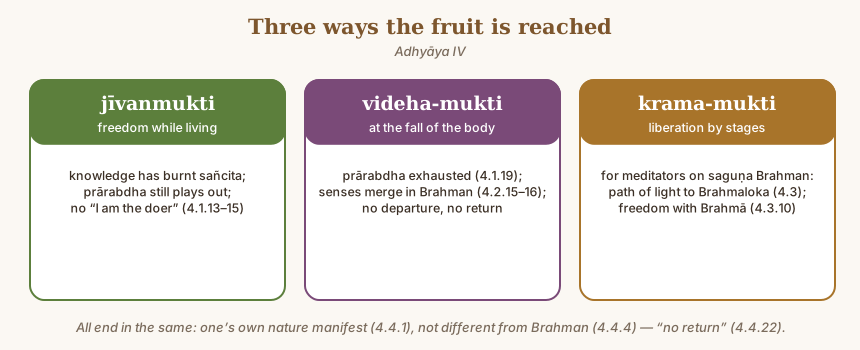
Adhyāya IV: liberation while living, at death, and by stages
Adhyāya IV: liberation while living, at death, and by stages (diagram drawn for this page)

The Phala adhyāya — the fruit

The last adhyāya is the fruit. It begins with the practice that ripens into it — repeated hearing and meditation, knowing Brahman as one’s own Self, posture and place — and then states the great result: on knowing Brahman, past karma is burnt and future karma does not cling; only the karma that has already begun this life runs on, like an arrow already shot. This is the basis of jīvanmukti, freedom while living.

Pādas 2 and 3 describe departure at death and the path of light (devayāna) by which meditators on the qualified Brahman go to Brahmaloka, never to return, and attain the highest at the end of the cosmic cycle. The knower of the attributeless Brahman, however, goes nowhere: “his prāṇas do not depart; being Brahman, he goes to Brahman.” Pāda 4 describes the liberated state — one’s own nature manifest, not separate from Brahman — reconciles three ancient teachers’ views of it, and ends with the words “no return”, said twice.

At a glance

4pādas38adhikaraṇas78sūtras31studied word by word

  1. Pāda 1 · Āvṛtti & karma-kṣaya The practice of meditation, and the fate of accumulated karma — 19 sūtras, 14 adhikaraṇas
  2. Pāda 2 · Utkrānti What happens at the moment of death — 21 sūtras, 11 adhikaraṇas
  3. Pāda 3 · Devayāna The path of light, and where it leads — 16 sūtras, 6 adhikaraṇas
  4. Pāda 4 · Mukti-svarūpa The nature of the liberated state, and the end of return — 22 sūtras, 7 adhikaraṇas

The main questions

Each opens the full argument — passage, doubt, prior view and conclusion — on the overview.

The sūtras, pāda by pāda

Every sūtra of the adhyāya, grouped by adhikaraṇa (topic). The 31 key sūtras are opened word by word; the others are given in Devanāgarī and transliteration. The question and conclusion of each topic come from the overview.

Pāda 1 · Āvṛtti & karma-kṣayaThe practice of meditation, and the fate of accumulated karma 19 sūtras · 14 adhikaraṇas · 11 studied word by word
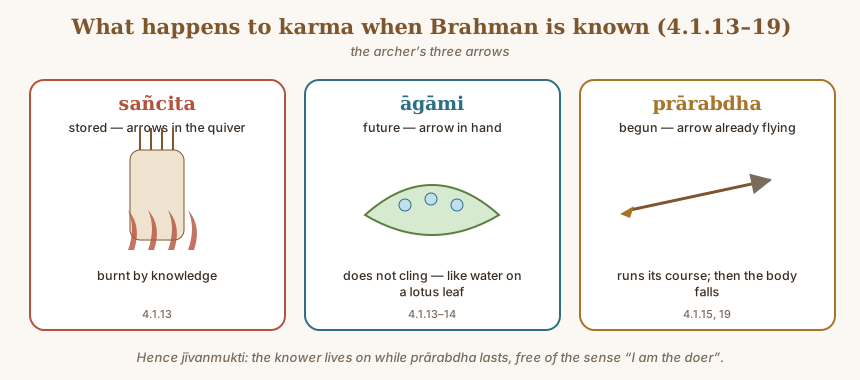
Stored, future and begun karma when Brahman is known
Stored, future and begun karma when Brahman is known (diagram drawn for this page)

Practical rules first — repetition until realisation, the self-regarding attitude, the direction of superimposition in symbol-meditations, the seated posture — and then the great concession: knowledge destroys karma not yet begun to fructify, while prārabdha runs its course.

The arrow already released must complete its flight; that is why the knower still has a body.

1

Āvṛtti-adhikaraṇa

4.1.1–2 · 2 sūtras · 1 studied word by word
all five limbs ›

The passageThe practice of hearing, reflection and meditation.

The questionIs the instruction to be received once, or repeated?

ConclusionRepetition is required until realisation. Śravaṇa, manana and nididhyāsana are to be continued, since the point is not the comprehension of a sentence but the removal of a deep-seated misidentification. The one exception is the person in whom knowledge arises immediately on hearing — for whom repetition would be pointless.

4.1.2
लिङ्गाच्च
liṅgācca
2

Ātmatvopāsana-adhikaraṇa

4.1.3 · 1 sūtra · 1 studied word by word
all five limbs ›

The passageThe attitude in which Brahman is to be meditated on.

The questionShould Brahman be meditated on as other than oneself, or as oneself?

ConclusionAs one's own Self. Scripture instructs ‘I am Brahman’, ‘Thou art That’, and does not correct the identification afterwards. Meditation that preserves otherness cannot end in the knowledge that removes it.

3

Pratīka-adhikaraṇa

4.1.4 · 1 sūtra · 1 studied word by word
all five limbs ›

The passageMeditations on a symbol — the mind as Brahman, the sun as Brahman.

The questionIn symbol-meditation, should one regard the symbol as oneself?

ConclusionIt should not. The self is not to be superimposed on a symbol, since the symbol is not the Self and such a meditation would produce a false rather than a true identification.

4

Brahmadṛṣṭi-adhikaraṇa

4.1.5 · 1 sūtra · 1 studied word by word
all five limbs ›

The passageThe direction of superimposition.

The questionIn ‘the mind is Brahman’, is the mind to be seen as Brahman, or Brahman as the mind?

ConclusionThe symbol is to be viewed as Brahman, not Brahman as the symbol — as a servant is treated as the king and not the king as the servant. The superior term is superimposed on the inferior, never the reverse.

5

Ādityādimati-adhikaraṇa

4.1.6 · 1 sūtra
all five limbs ›

The passageMeditations on ritual members — ‘he who sings the Udgītha is the sun’.

The questionWhich is to be seen in which?

ConclusionThe deity is to be seen in the ritual member, on the same principle as before.

4.1.6
आदित्यादिमतयश्चाङ्ग उपपत्तेः
ādityādimatayaścāṅga upapatteḥ
6

Āsīna-adhikaraṇa

4.1.7–10 · 4 sūtras · 1 studied word by word
all five limbs ›

The passageThe posture for meditation.

The questionMust meditation be practised in any particular bodily attitude?

ConclusionIt is to be practised seated. Concentration of mind is not possible while lying down, which invites sleep, nor while walking or standing, which occupy attention. Scripture and smṛti both describe the meditator as seated.

4.1.8
ध्यानाच्च
dhyānācca
4.1.9
अचलत्वं चापेक्ष्य
acalatvaṃ cāpekṣya
4.1.10
स्मरन्ति च
smaranti ca
7

Ekāgratā-adhikaraṇa

4.1.11 · 1 sūtra · 1 studied word by word
all five limbs ›

The passagePlace and time.

The questionAre any particular place, time or direction required?

ConclusionAny place is suitable where the mind becomes concentrated — that alone is the criterion. Smṛti recommends quiet and level ground, but as an aid to concentration, not as a rule.

8

Āprāyaṇa-adhikaraṇa

4.1.12 · 1 sūtra · 1 studied word by word
all five limbs ›

The passageThe duration of the practice.

The questionHow long is meditation to be continued?

ConclusionUntil death, for the meditator on the qualified Brahman, since the state of mind at the end determines what is attained. For the knower of the unqualified, the question does not arise, since knowledge once arisen does not lapse.

9

Tadadhigama-adhikaraṇa

4.1.13 · 1 sūtra · 1 studied word by word
all five limbs ›

The passageThe effect of knowledge on accumulated sin.

The questionWhat becomes of the knower's past evil deeds?

ConclusionOn the rise of knowledge, past sins do not adhere and future ones do not cling — as water does not cling to a lotus leaf. Scripture states it plainly and repeatedly.

10

Itara-adhikaraṇa

4.1.14 · 1 sūtra · 1 studied word by word
all five limbs ›

The passageThe effect on accumulated merit.

The questionAnd what of the knower's good deeds?

ConclusionThey too fall away, by the same logic. Merit binds as surely as demerit, since both require a future embodiment in which to be enjoyed.

11

Anārabdha-kārya-adhikaraṇa

4.1.15 · 1 sūtra · 1 studied word by word
all five limbs ›

The passageThe limits of the destruction of karma.

The questionIs <i>all</i> karma destroyed by knowledge?

ConclusionOnly karma that has not yet begun to bear fruit is destroyed. The karma that has already begun — prārabdha — continues until exhausted, as a potter's wheel turns on after the potter's hand is withdrawn, and as an arrow already released completes its flight.

12

Agnihotrādi-adhikaraṇa

4.1.16 · 1 sūtra
all five limbs ›

The passageObligatory rites after knowledge.

The questionShould the knower continue to perform the daily obligatory observances?

ConclusionThe regular obligatory rites are still to be performed by one who remains in the ritual order, since they generate no bondage when performed without desire and since scripture nowhere cancels them.

4.1.16
अग्निहोत्रादि तु तत्कार्यायैव तद्दर्शनात्
agnihotrādi tu tatkāryāyaiva taddarśanāt
13

Vidyā-sādhanatva-adhikaraṇa

4.1.17 · 1 sūtra
all five limbs ›

The passageThe value of such rites.

The questionIf they are not binding, what purpose do they serve?

ConclusionThey conduce to the rise and stability of knowledge, being a means of purification. Their fruit is not a world attained but a mind made fit.

4.1.17
अतोऽन्यापि ह्येकेषामुभयोः
ato'nyāpi hyekeṣāmubhayoḥ
14

Itara-kṣapaṇa-adhikaraṇa

4.1.18–19 · 2 sūtras · 1 studied word by word
all five limbs ›

The passageThe exhaustion of the remainder.

The questionHow does the residual karma finally end?

ConclusionIt is worn out by being lived through in the present body; when it is exhausted, the knower attains Brahman. Scripture: ‘for him there is delay only so long as he is not released; then he attains’.

4.1.18
यदेव विद्ययेति हि
yadeva vidyayeti hi
Pāda 2 · UtkrāntiWhat happens at the moment of death 21 sūtras · 11 adhikaraṇas · 6 studied word by word

The dissolution of speech into mind, mind into prāṇa, prāṇa into the soul, and the soul with prāṇa into the subtle elements. The decisive distinction comes at sūtras 7–14: for the knower of the highest Brahman there is no departure at all, because there is nowhere to go.

For the knower of nirguṇa Brahman, the prāṇas do not depart — they are resolved on the spot.

1

Vāk-adhikaraṇa

4.2.1–2 · 2 sūtras · 1 studied word by word
all five limbs ›

The passageChāndogya 6.8.6 and Bṛhadāraṇyaka 4.4.2 — the sequence of dissolution at death.

The questionInto what does speech merge at the moment of death?

ConclusionInto mind. The organ's function is withdrawn into the mind, not into the deity, since the texts describe a progressive interiorisation. The deity's connection ceases only later.

4.2.2
अत एव च सर्वाण्यनु
ata eva ca sarvāṇyanu
2

Manas-adhikaraṇa

4.2.3 · 1 sūtra
all five limbs ›

The passageThe next stage.

The questionInto what does mind merge?

ConclusionInto prāṇa, as the texts state in sequence.

4.2.3
तन्मनः प्राण उत्तरात्
tanmanaḥ prāṇa uttarāt
3

Adhyakṣa-adhikaraṇa

4.2.4 · 1 sūtra
all five limbs ›

The passageThe resting-place of prāṇa.

The questionInto what does prāṇa merge?

ConclusionInto the soul, the ruler of the body, since the soul is what departs and the prāṇa accompanies it.

4.2.4
सोऽध्यक्षे तदुपगमादिभ्यः
so'dhyakṣe tadupagamādibhyaḥ
4

Bhūta-adhikaraṇa

4.2.5–6 · 2 sūtras
all five limbs ›

The passageThe soul with prāṇa.

The questionInto what does the soul with its prāṇa merge?

ConclusionInto the subtle elements, which form the vehicle of the departing soul — the same subtle body established in the third adhyāya. The gross body is left behind.

4.2.5
भूतेषु तच्छ्रुतेः
bhūteṣu tacchruteḥ
4.2.6
नैकस्मिन्दर्शयतो हि
naikasmindarśayato hi
5

Āsṛtyupakrama-adhikaraṇa

4.2.7–14 · 8 sūtras · 2 studied word by word
all five limbs ›

The passageThe difference between the knower of the qualified and of the unqualified Brahman.

The questionIs the process of departure the same for both?

ConclusionUp to the point of merging in the highest, the process is common. But for the knower of the unqualified Brahman there is no departure at all: his prāṇas do not go out. Since he is already Brahman and Brahman is not elsewhere, there is nowhere for him to go. His parts are simply resolved on the spot.

4.2.7
समाना चासृत्युपक्रमादमृतत्वं चानुपोष्य
samānā cāsṛtyupakramādamṛtatvaṃ cānupoṣya
4.2.8
तदापीतेः संसारव्यपदेशात्
tadāpīteḥ saṃsāravyapadeśāt
4.2.9
सूक्ष्मं प्रमाणतश्च तथोपलब्धेः
sūkṣmaṃ pramāṇataśca tathopalabdheḥ
4.2.10
नोपमर्देनातः
nopamardenātaḥ
4.2.11
अस्यैव चोपपत्तेरेष ऊष्मा
asyaiva copapattereṣa ūṣmā
4.2.14
स्मर्यते च
smaryate ca
6

Parasampatti-adhikaraṇa

4.2.15 · 1 sūtra · 1 studied word by word
all five limbs ›

The passageThe manner of the merging.

The questionDo the knower's parts merge distinctly or indistinctly?

ConclusionIndistinctly, since what is attained is the undifferentiated. The elements of his constitution are absorbed without remaining recoverable.

7

Avibhāga-adhikaraṇa

4.2.16 · 1 sūtra · 1 studied word by word
all five limbs ›

The passageThe state attained.

The questionWhat exactly does the knower attain?

ConclusionNon-separation ( avibhāga ) from Brahman. Not a location reached but a distinction ceasing.

8

Tadoko'gra-jvalana-adhikaraṇa

4.2.17 · 1 sūtra · 1 studied word by word
all five limbs ›

The passageThe lighting of the tip of the heart.

The questionDoes the soul of the saguṇa meditator depart by a particular route?

ConclusionThe top of the heart is lit, and the soul departs through the nāḍī leading upward from it, by the Lord's favour, the way being shown by that light.

9

Raśmyanusāra-adhikaraṇa

4.2.18 · 1 sūtra
all five limbs ›

The passageThe rays of the sun.

The questionBy what does the departing soul travel?

ConclusionIt follows the rays. The nāḍīs and the rays are connected at all times, by night as well as by day, so the route is always open.

4.2.18
रश्म्यनुसारी
raśmyanusārī
10

Niśa-adhikaraṇa

4.2.19 · 1 sūtra
all five limbs ›

The passageDying at night.

The questionIs one who dies at night disadvantaged?

ConclusionIt is not. The result of knowledge does not fail on account of the time of death; the praise of certain times belongs to the ritual order and cannot override the promise made to the knower.

4.2.19
निशि नेति चेन्न सम्बन्धस्य यावद्देहभावित्वाद्दर्शयति च
niśi neti cenna sambandhasya yāvaddehabhāvitvāddarśayati ca
11

Dakṣiṇāyana-adhikaraṇa

4.2.20–21 · 2 sūtras
all five limbs ›

The passageDying in the sun's southern course.

The questionAnd one who dies in the six months of the southern course?

ConclusionIt does not affect the knower's result. Bhīṣma's waiting is explained by family custom and by the boon he held; and smṛti's statements about the two courses apply to those following the ritual path, not to the knower.

4.2.20
अतश्चायनेऽपि दक्षिणे
ataścāyane'pi dakṣiṇe
4.2.21
योगिनः प्रति च स्मर्यते स्मार्ते चैते
yoginaḥ prati ca smaryate smārte caite
Pāda 3 · DevayānaThe path of light, and where it leads 16 sūtras · 6 adhikaraṇas · 4 studied word by word
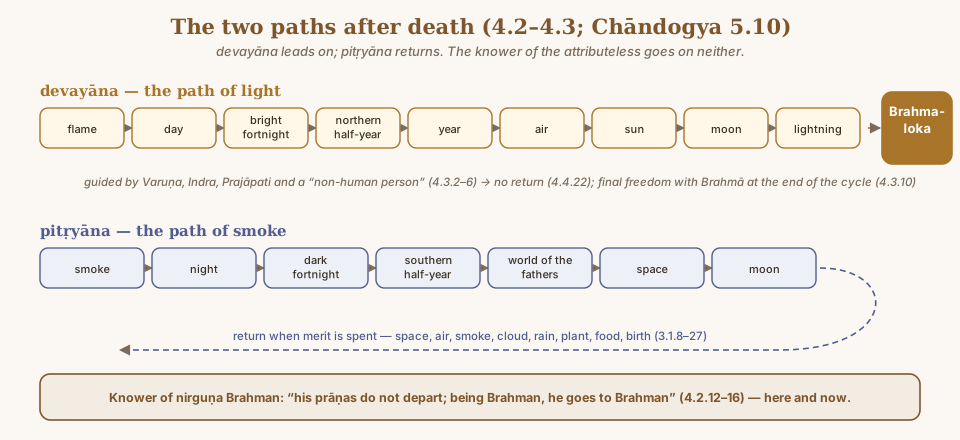
The path of light and the path of smoke
The path of light and the path of smoke (diagram drawn for this page)

The stages of the arcirādi-mārga are enumerated and identified as conducting deities rather than as landmarks or enjoyments. Then the disputed question: does the path lead to the effected Brahman or the highest? Bādari, Jaimini and Bādarāyaṇa each answer differently.

The path is for the saguṇa meditator. The knower of nirguṇa Brahman travels nowhere.

1

Arcirādi-adhikaraṇa

4.3.1 · 1 sūtra · 1 studied word by word
all five limbs ›

The passageThe path of light — Chāndogya 4.15.5, 5.10.1, Bṛhadāraṇyaka 6.2.15.

The questionThe texts name the stages of the northward path differently. Which enumeration holds?

ConclusionIt is one path, and the varying lists are to be combined into a single sequence: flame, day, the bright fortnight, the six months of the northern course, the year, the sun, the moon, lightning, and beyond.

2

Vāyu-adhikaraṇa

4.3.2 · 1 sūtra
all five limbs ›

The passageThe place of air in the sequence.

The questionWhere does the stage of air belong?

ConclusionIt follows the year, on the strength of the text that names it there, and is inserted accordingly.

4.3.2
वायुमब्दादविशेषविशेषाभ्याम्
vāyumabdādaviśeṣaviśeṣābhyām
3

Varuṇa-adhikaraṇa

4.3.3 · 1 sūtra
all five limbs ›

The passageLightning, Varuṇa, Indra, Prajāpati.

The questionWhere do these belong?

ConclusionVaruṇa and the rest come after lightning, on the strength of their mention in that connection.

4.3.3
तडितोऽधि वरुणः सम्बन्धात्
taḍito'dhi varuṇaḥ sambandhāt
4

Ātivāhika-adhikaraṇa

4.3.4–6 · 3 sūtras
all five limbs ›

The passageThe status of the stages.

The questionAre the stages of the path landmarks, or enjoyments, or something else?

ConclusionThey are conducting deities ( ātivāhika ) who lead the soul onward, since the soul, being unconscious of the route, cannot travel unaided. The stages are not places passed but powers that carry.

4.3.4
आतिवाहिकास्तल्लिङ्गात्
ātivāhikāstalliṅgāt
4.3.5
उभयव्यामोहात्तत्सिद्धेः
ubhayavyāmohāttatsiddheḥ
4.3.6
वैद्युतेनैव ततस्तच्छ्रुतेः
vaidyutenaiva tatastacchruteḥ
5

Kārya-adhikaraṇa

4.3.7–14 · 8 sūtras · 2 studied word by word
all five limbs ›

The passageThe destination of the path.

The questionTo which Brahman does the path of light lead — the effected Brahman of Hiraṇyagarbha, or the highest?

ConclusionJaimini holds it leads to the highest, since ‘Brahman’ in its primary sense is the highest and the fruit promised is the highest. Bādarāyaṇa settles it: the path belongs to the meditator on the qualified Brahman, who reaches the world of Brahman and attains release at the dissolution of that world — krama-mukti , liberation by stages.

4.3.8
विशेषितत्वाच्च
viśeṣitatvācca
4.3.9
सामीप्यात्तु तद्व्यपदेशः
sāmīpyāttu tadvyapadeśaḥ
4.3.11
स्मृतेश्च
smṛteśca
4.3.12
परं जैमिनिर्मुख्यत्वात्
paraṃ jaiminirmukhyatvāt
4.3.13
दर्शनाच्च
darśanācca
4.3.14
न च कार्ये प्रतिपत्त्यभिसंधिः
na ca kārye pratipattyabhisaṃdhiḥ
6

Apratīkālambana-adhikaraṇa

4.3.15–16 · 2 sūtras · 1 studied word by word
all five limbs ›

The passageThose who meditate on symbols.

The questionDo symbol-meditators also travel the path of light?

ConclusionThey do not. The path is for those whose support is Brahman itself; those who meditate on a symbol attain results proportionate to the symbol. The conductor leads only those whose object was Brahman.

4.3.16
विशेषं च दर्शयति
viśeṣaṃ ca darśayati
Pāda 4 · Mukti-svarūpaThe nature of the liberated state, and the end of return 22 sūtras · 7 adhikaraṇas · 10 studied word by word
Adhyāya IV: liberation while living, at death, and by stages
Adhyāya IV: liberation while living, at death, and by stages (diagram drawn for this page)

The final pāda describes the released soul: its own nature made manifest rather than a new state acquired, non-separation from Brahman, freedom of will and of embodiment, and — in the last adhikaraṇa — lordship over everything except the cosmic functions. The work ends on the word anāvṛtti.

Not a journey completed, but a covering removed. And there is no return.

1

Sampadyāvirbhāva-adhikaraṇa

4.4.1–3 · 3 sūtras · 2 studied word by word
all five limbs ›

The passageChāndogya 8.12.3 — ‘rising from this body and reaching the highest light, he appears in his own form’.

The questionDoes the released soul acquire a new nature, or manifest what was already its own?

ConclusionIts own nature becomes manifest ( āvirbhāva ). Nothing is added. What was always the case ceases to be obscured — as the sun is not created when the cloud disperses.

4.4.3
आत्मा प्रकरणात्
ātmā prakaraṇāt
2

Avibhāga-adhikaraṇa

4.4.4 · 1 sūtra · 1 studied word by word
all five limbs ›

The passageThe mode of the released soul's existence.

The questionIn what relation does the released soul stand to Brahman?

ConclusionAs non-separate. The texts speak of it as merging like rivers in the sea, losing name and form.

3

Brahma-adhikaraṇa

4.4.5–7 · 3 sūtras · 3 studied word by word
all five limbs ›

The passageThe characteristics of the released.

The questionWhat is the nature of the liberated soul?

ConclusionAuḍulomi holds it is pure consciousness alone ( caitanya ), the attributes being expressions of that. Bādarāyaṇa accepts both: the attributes are true from the standpoint of the texts that state them, and consciousness alone is true in the primary sense.

4

Saṅkalpa-adhikaraṇa

4.4.8–9 · 2 sūtras · 1 studied word by word
all five limbs ›

The passageThe fulfilment of desire in the released state.

The questionHow do the released obtain what they wish?

ConclusionBy mere will. The texts describe the fathers rising up at the thought of them; no instrument intervenes between wish and fulfilment.

4.4.9
अत एव चानन्याधिपतिः
ata eva cānanyādhipatiḥ
5

Abhāva-adhikaraṇa

4.4.10–14 · 5 sūtras
all five limbs ›

The passageEmbodiment after release.

The questionDo the released possess bodies?

ConclusionJaimini holds they do, since the texts describe them as eating, sporting and taking multiple forms. Bādarāyaṇa reconciles: either, at will — bodiless, or embodied as they choose, since the texts support both and will is unimpeded.

4.4.10
अभावं बादरिराह ह्येवम्
abhāvaṃ bādarirāha hyevam
4.4.11
भावं जैमिनिर्विकल्पामननात्
bhāvaṃ jaiminirvikalpāmananāt
4.4.12
द्वादशाहवदुभयविधं बादरायणोऽतः
dvādaśāhavadubhayavidhaṃ bādarāyaṇo'taḥ
4.4.13
तन्वभावे संध्यवदुपपत्तेः
tanvabhāve saṃdhyavadupapatteḥ
4.4.14
भावे जाग्रद्वत्
bhāve jāgradvat
6

Pradīpa-adhikaraṇa

4.4.15–16 · 2 sūtras
all five limbs ›

The passageMultiple bodies.

The questionIf the released one assumes many bodies, is the soul divided among them?

ConclusionAs one lamp's light fills many places, the released soul animates the bodies it assumes without division, being independent of them and merely willing them.

4.4.15
प्रदीपवदावेशस्तथा हि दर्शयति
pradīpavadāveśastathā hi darśayati
4.4.16
स्वाप्ययसम्पत्त्योरन्यतरापेक्षमाविष्कृतं हि
svāpyayasampattyoranyatarāpekṣamāviṣkṛtaṃ hi
7

Jagad-vyāpāra-adhikaraṇa

4.4.17–22 · 6 sūtras · 3 studied word by word
all five limbs ›

The passageThe scope of the released soul's lordship.

The questionDo the released possess unlimited lordship, including the power to create, sustain and dissolve worlds?

ConclusionThey obtain all enjoyment and all freedom, but not the cosmic functions of creation, maintenance and dissolution, which belong to the Lord alone. Two creators would produce conflict, and the texts that describe the highest lordship speak of the Lord. The work closes on anāvṛttiḥ śabdāt — there is no return, on the authority of scripture.

4.4.18
प्रत्यक्षोपदेशादिति चेन्नाधिकारिकमण्डलस्थोक्तेः
pratyakṣopadeśāditi cennādhikārikamaṇḍalasthokteḥ
4.4.19
विकारावर्ति च तथा हि स्थितिमाह
vikārāvarti ca tathā hi sthitimāha
4.4.20
दर्शयतश्चैवं प्रत्यक्षानुमाने
darśayataścaivaṃ pratyakṣānumāne

Sūtra text: the Sanskrit of the Brahma Sūtra on sa.wikisource (वेदान्तदर्शनम्), checked against the text printed with Śaṅkara’s bhāṣya; numbering and the division into 191 adhikaraṇas follow Śaṅkara (as in Swami Gambhirananda’s and Swami Vireswarananda’s translations). Transliteration is generated from the Devanāgarī. Word meanings, translations, explanations and diagrams are written for this page; they follow Śaṅkara’s reading, with the readings of Rāmānuja and Madhva noted where they differ.