🔔 Online Vedanta Classes Now Enrolling — Know More →

Research › Brahma Sūtra › Adhyāya I · Samanvaya

समन्वयाध्यायः

Adhyāya I — Samanvaya

Harmony. All the Upaniṣads have one subject — Brahman. 39 topics, 134 sūtras — 31 of them opened word by word.

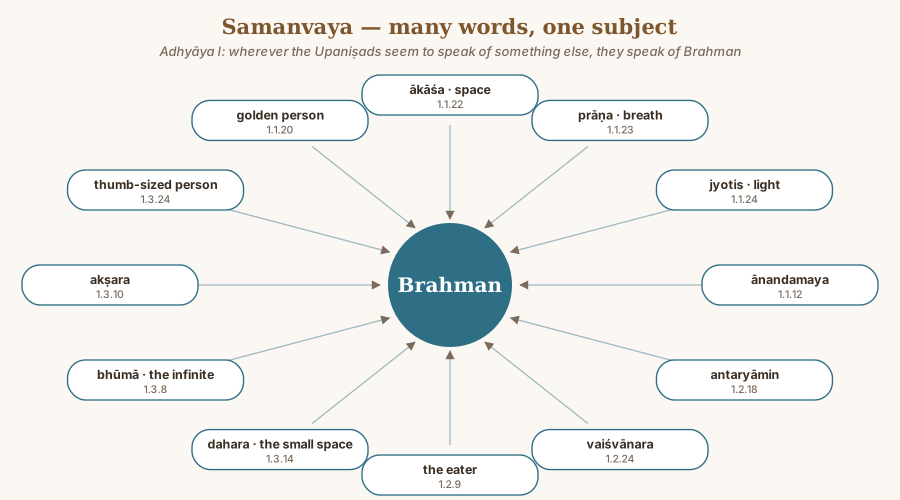
Adhyāya I: twelve Upaniṣadic words shown to mean Brahman
Adhyāya I: twelve Upaniṣadic words shown to mean Brahman (diagram drawn for this page)

The Samanvaya adhyāya — harmony

The first adhyāya settles what the Upaniṣads are about. Their language is bewilderingly varied: space, breath, light, a golden person in the sun, a person the size of a thumb, a small space in the heart, an “eater” whose food is the world. Bādarāyaṇa takes these one by one and shows, by the marks each passage gives, that the subject is always Brahman — the conscious cause of the world and the Self of all.

The chapter opens with the catuḥsūtrī, the four sūtras that frame the whole work: the enquiry, the definition, the means of knowledge, and the harmony of all texts. The remaining sūtras apply that harmony. Pāda 1 takes passages where Brahman’s marks are plain; pādas 2 and 3, those where they are less clear (pāda 2 mostly about meditations, pāda 3 mostly about knowledge); pāda 4, the words that the Sāṅkhya school claimed for its unconscious primal matter, pradhāna.

The method is worth learning for itself. A word in scripture is understood by its context — what comes before and after — and by its marks (liṅga): freedom from evil, being the Self of all, being the source and end of all beings, bestowing liberation. Where such marks are present, the passage speaks of Brahman, whatever name it uses.

At a glance

4pādas39adhikaraṇas134sūtras31studied word by word

  1. Pāda 1 · Spaṣṭa-brahma-liṅga Passages in which the marks of Brahman are plain — 31 sūtras, 11 adhikaraṇas
  2. Pāda 2 · Aspaṣṭa-brahma-liṅga I Doubtful passages: the mind-made, the eater, the two in the cave — 32 sūtras, 7 adhikaraṇas
  3. Pāda 3 · Aspaṣṭa-brahma-liṅga II Further doubtful passages, and the question of who may inquire — 43 sūtras, 13 adhikaraṇas
  4. Pāda 4 · Pradhāna-nirākaraṇa Removing Sāṅkhya's claim on scripture, and Brahman as material cause — 28 sūtras, 8 adhikaraṇas
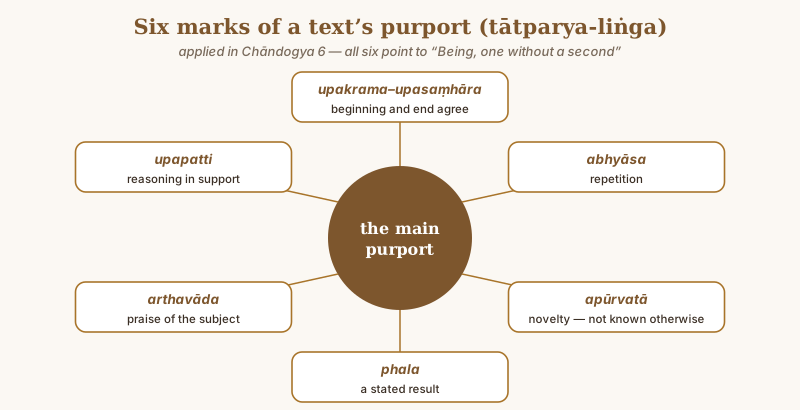
The six marks by which the main purport of a passage is settled
The six marks by which the main purport of a passage is settled (diagram drawn for this page)

The main questions

Each opens the full argument — passage, doubt, prior view and conclusion — on the overview.

The sūtras, pāda by pāda

Every sūtra of the adhyāya, grouped by adhikaraṇa (topic). The 31 key sūtras are opened word by word; the others are given in Devanāgarī and transliteration. The question and conclusion of each topic come from the overview.

Pāda 1 · Spaṣṭa-brahma-liṅgaPassages in which the marks of Brahman are plain 31 sūtras · 11 adhikaraṇas · 11 studied word by word
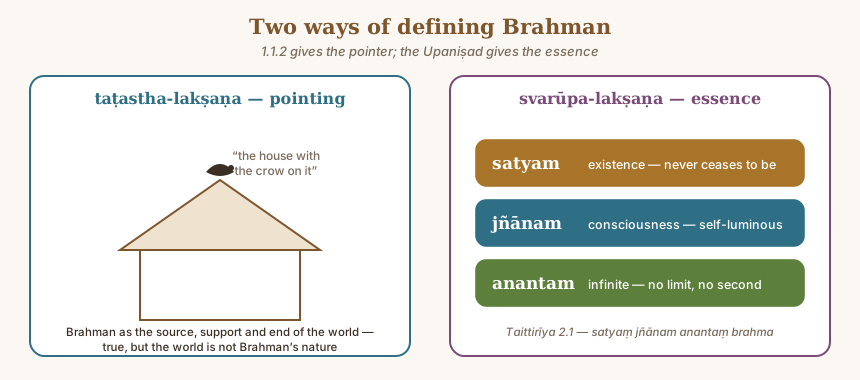
The pointing definition of 1.1.2 and the essential definition of the Taittirīya
The pointing definition of 1.1.2 and the essential definition of the Taittirīya (diagram drawn for this page)

The famous catuḥsūtrī opens the work — the inquiry, the definition, the means of knowing, and the claim of uniform purport — and the rest of the pāda applies that claim to texts where Brahman's marks are already evident: the blissful self, the person in the sun, ākāśa, prāṇa, the light beyond heaven.

Establish the subject first; the passages then read themselves.

1

Jijñāsā-adhikaraṇa

1.1.1 · 1 sūtra · 1 studied word by word
all five limbs ›

The passageathāto brahmajijñāsā — the opening aphorism itself.

The questionWhat does the word ‘now’ depend on — and who is fit to begin this inquiry at all?

Conclusion‘Atha’ denotes immediate consecution upon the fourfold discipline — viveka (discrimination of the eternal from the non-eternal), vairāgya (indifference to fruits here and hereafter), the six treasures beginning with śama and dama, and mumukṣutva (the longing for release). It does not denote consecution upon karma, because Brahman is an already-accomplished reality and knowledge of it does not depend on prior action.

2

Janmādi-adhikaraṇa

1.1.2 · 1 sūtra · 1 studied word by word
all five limbs ›

The passagejanmādyasya yataḥ , glossed by Taittirīya 3.1 — Varuṇa's instruction to Bhṛgu.

The questionHow can Brahman, being without attributes, be defined at all?

ConclusionBrahman is given a taṭastha-lakṣaṇa — an accidental or pointing definition — as that from which the origin, sustenance and dissolution of this world proceed. This is not an inference from effect to cause; it is a pointer to a specific śruti passage. The svarūpa-lakṣaṇa, the essential definition, is given elsewhere: satyaṁ jñānam anantaṁ brahma .

3

Śāstrayonitva-adhikaraṇa

1.1.3 · 1 sūtra · 1 studied word by word
all five limbs ›

The passageśāstrayonitvāt — Brahman as the source of scripture.

The questionBy what means of knowledge is Brahman known?

ConclusionBrahman is not an object of the senses, and inference requires a known invariable concomitance, which cannot be had for what is unique and secondless. Śruti alone is the pramāṇa here. The sūtra also carries a second sense: since scripture, that vast body of knowledge, issued from Brahman, Brahman must be omniscient.

4

Samanvaya-adhikaraṇa

1.1.4 · 1 sūtra · 1 studied word by word
all five limbs ›

The passagetat tu samanvayāt — the fourth and pivotal sūtra of the catuḥsūtrī.

The questionScripture is authoritative for injunctions. What authority can it have for statements about an already-existing thing?

ConclusionBrahman is the samanvaya — the uniform and principal purport — of all Vedāntic texts, determined by the six marks (upakrama-upasaṁhāra, abhyāsa, apūrvatā, phala, arthavāda, upapatti). Knowledge of an existent thing is vastu-tantra, dependent on the object and not on the knower's will; hence it is not an act. And mokṣa, being eternal, cannot be the product of any act — it is the removal of ignorance.

5

Īkṣati-adhikaraṇa

1.1.5–11 · 7 sūtras · 1 studied word by word
all five limbs ›

The passageChāndogya 6.2.3 — tad aikṣata bahu syāṁ prajāyeya , ‘It saw: may I be many.’

The questionIs the world's cause the conscious Brahman, or Sāṅkhya's insentient pradhāna?

ConclusionSeven distinct reasons are given: seeing is ascribed to the cause; the word ‘ātman’ is applied to it; liberation is promised to one devoted to it; there is no later instruction to discard it; the soul is said to merge into it in sleep; all Vedānta texts agree in this; and śruti names the Lord outright. Insentient matter cannot will, and figurative reading is uncalled for when the primary sense is available.

1.1.6
गौणश्चेन्नात्मशब्दात्
gauṇaścennātmaśabdāt
1.1.7
तन्निष्ठस्य मोक्षोपदेशात्
tanniṣṭhasya mokṣopadeśāt
1.1.8
हेयत्वावचनाच्च
heyatvāvacanācca
1.1.9
स्वाप्ययात्
svāpyayāt
1.1.10
गतिसामान्यात्
gatisāmānyāt
1.1.11
श्रुतत्वाच्च
śrutatvācca
6

Ānandamaya-adhikaraṇa

1.1.12–19 · 8 sūtras · 1 studied word by word
all five limbs ›

The passageTaittirīya 2.5 — the ānandamaya self, innermost of the five sheaths.

The questionIs the ‘self made of bliss’ the individual soul, or Brahman?

ConclusionThe suffix ‑maya here denotes abundance (prācurya), as in ‘the sacrifice abounding in food’. Bliss is repeatedly predicated of Brahman; Brahman is declared the cause of all bliss; the mantra portion and the brāhmaṇa portion must be read as teaching one thing; and difference is stated between the one who attains bliss and the bliss attained.

1.1.13
विकारशब्दान्नेति चेन्न प्राचुर्यात्
vikāraśabdānneti cenna prācuryāt
1.1.14
तद्धेतुव्यपदेशाच्च
taddhetuvyapadeśācca
1.1.15
मान्त्रवर्णिकमेव च गीयते
māntravarṇikameva ca gīyate
1.1.16
नेतरोऽनुपपत्तेः
netaro'nupapatteḥ
1.1.17
भेदव्यपदेशाच्च
bhedavyapadeśācca
1.1.18
कामाच्च नानुमानापेक्षा
kāmācca nānumānāpekṣā
1.1.19
अस्मिन्नस्य च तद्योगं शास्ति
asminnasya ca tadyogaṃ śāsti
7

Antara-adhikaraṇa

1.1.20–21 · 2 sūtras · 1 studied word by word
all five limbs ›

The passageChāndogya 1.6–7 — the golden person seen within the sun, and the person seen within the eye.

The questionIs this some exalted individual soul who has risen high by knowledge and merit, or the Supreme Lord?

ConclusionFreedom from all evil ( apahatapāpmā ) and being the very Self of Ṛk and Sāman are predicated, and these belong to the Lord alone. The Bṛhadāraṇyaka's antaryāmin passage explicitly distinguishes the one within the sun from the soul whose body the sun is. Form, locus and limited lordship are assumed for the sake of meditation.

1.1.21
भेदव्यपदेशाच्चान्यः
bhedavyapadeśāccānyaḥ
8

Ākāśa-adhikaraṇa

1.1.22 · 1 sūtra · 1 studied word by word
all five limbs ›

The passageChāndogya 1.9 — ākāśa as the origin and end of all beings.

The questionDoes ‘ākāśa’ here mean elemental space, or Brahman?

Conclusion‘All these beings take their origin from ākāśa alone’, ‘greater than these’, ‘their final resort’ — these are said of Brahman throughout the Upaniṣads and cannot be said of an element which itself has an origin. The word is elsewhere used of Brahman: kaṁ brahma khaṁ brahma .

9

Prāṇa-adhikaraṇa

1.1.23 · 1 sūtra · 1 studied word by word
all five limbs ›

The passageChāndogya 1.11 — prāṇa as the deity of the prastāva.

The questionDoes ‘prāṇa’ here mean the vital breath, or Brahman?

ConclusionThe passage says all beings merge into prāṇa and arise from it — not the senses of one sleeper, but all beings. That fits Brahman alone. The word is used of Brahman elsewhere: prāṇasya prāṇaḥ , ‘the breath of the breath’.

10

Jyotiścaraṇa-adhikaraṇa

1.1.24–27 · 4 sūtras · 1 studied word by word
all five limbs ›

The passageChāndogya 3.13.7 — ‘the light that shines above this heaven’.

The questionIs this the physical light of the sun, or Brahman?

ConclusionThe immediately preceding passage assigns four quarters (pāda) to this same entity, three of which are immortal in heaven — a description of Brahman. The section following is the Śāṇḍilya-vidyā, which is explicitly about Brahman; to read physical light in between would be to drop the topic under discussion and introduce a new one. Objections from the Gāyatrī metre and from the difference of case-endings ( divi , ‘in heaven’, versus divaḥ , ‘above heaven’) are answered.

1.1.25
छन्दोऽभिधानान्नेति चेन्न तथा चेतोऽर्पणनिगदात्तथा हि दर्शनम्
chando'bhidhānānneti cenna tathā ceto'rpaṇanigadāttathā hi darśanam
1.1.26
भूतादिपादव्यपदेशोपपत्तेश्चैवम्
bhūtādipādavyapadeśopapatteścaivam
1.1.27
उपदेशभेदान्नेति चेन्नोभयस्मिन्नप्यविरोधात्
upadeśabhedānneti cennobhayasminnapyavirodhāt
11

Pratardana-adhikaraṇa

1.1.28–31 · 4 sūtras · 1 studied word by word
all five limbs ›

The passageKauṣītaki 3 — Indra's instruction to Pratardana: ‘Know me only.’

The questionDoes ‘prāṇa’ in this dialogue mean breath, or the god Indra, or the individual soul, or Brahman?

ConclusionThe prāṇa here is called prajñātman , and blissful, undecaying and immortal — all of which fit only Brahman. Indra speaks from realised identity, as the sage Vāmadeva did when he said ‘I was Manu and the sun’. And a single passage cannot be taken to enjoin three different meditations at once.

1.1.28
प्राणस्तथानुगमात्
prāṇastathānugamāt
1.1.29
न वक्तुरात्मोपदेशादिति चेदध्यात्मसम्बन्धभूमा ह्यस्मिन्
na vakturātmopadeśāditi cedadhyātmasambandhabhūmā hyasmin
1.1.31
जीवमुख्यप्राणलिङ्गान्नेति चेन्नोपासात्रैविध्यादाश्रितत्वादिह तद्योगात्
jīvamukhyaprāṇaliṅgānneti cennopāsātraividhyādāśritatvādiha tadyogāt
Pāda 2 · Aspaṣṭa-brahma-liṅga IDoubtful passages: the mind-made, the eater, the two in the cave 32 sūtras · 7 adhikaraṇas · 6 studied word by word

Here the marks are less obvious and the doubt is usually the same: does this text speak of the individual soul, or of Brahman? The pāda settles seven such cases, culminating in Vaiśvānara, where a cosmic body is shown to be Brahman presented for meditation.

Smallness, location and form are concessions to the meditator, not limitations on Brahman.

1

Sarvatra-prasiddhi-adhikaraṇa

1.2.1–8 · 8 sūtras · 1 studied word by word
all five limbs ›

The passageChāndogya 3.14, the Śāṇḍilya-vidyā — ‘he who consists of mind, whose body is prāṇa’.

The questionIs the being to be meditated on here the individual soul, or Brahman?

ConclusionThe section opens sarvaṁ khalv idaṁ brahma , so Brahman is the announced subject and must not be abandoned midway. Manomaya is used of Brahman in other Upaniṣads. Smallness and mental attributes are assumed for the sake of upāsanā, and the passage distinguishes the meditator from the object attained.

1.2.2
विवक्षितगुणोपपत्तेश्च
vivakṣitaguṇopapatteśca
1.2.3
अनुपपत्तेस्तु न शारीरः
anupapattestu na śārīraḥ
1.2.4
कर्मकर्तृव्यपदेशाच्च
karmakartṛvyapadeśācca
1.2.5
शब्दविशेषात्
śabdaviśeṣāt
1.2.6
स्मृतेश्च
smṛteśca
1.2.7
अर्भकौकस्त्वात्तद्व्यपदेशाच्च नेति चेन्न निचाय्यत्वादेवं व्योमवच्च
arbhakaukastvāttadvyapadeśācca neti cenna nicāyyatvādevaṃ vyomavacca
1.2.8
सम्भोगप्राप्तिरिति चेन्न वैशेष्यात्
sambhogaprāptiriti cenna vaiśeṣyāt
2

Attṛ-adhikaraṇa

1.2.9–10 · 2 sūtras · 1 studied word by word
all five limbs ›

The passageKaṭha 1.2.25 — ‘for whom the brāhmaṇa and the kṣatriya are food, and death a condiment’.

The questionWho is this eater of all — fire, or the individual soul, or Brahman?

ConclusionDeath itself is the condiment, so the eater must be that in which even death is absorbed. Only Brahman, as the reabsorber of all at dissolution, answers to this.

1.2.10
प्रकरणाच्च
prakaraṇācca
3

Guhā-praviṣṭa-adhikaraṇa

1.2.11–12 · 2 sūtras · 1 studied word by word
all five limbs ›

The passageKaṭha 1.3.1 — ‘two drink the fruit of works, entered into the cave; shadow and light’.

The questionWho are the two — the intellect and the soul, or the soul and Brahman?

ConclusionThe soul and the Supreme. Both are called drinkers because they are found together; the contrast of shadow and light marks the difference; and the qualities stated afterwards belong to Brahman.

1.2.12
विशेषणाच्च
viśeṣaṇācca
4

Antara-adhikaraṇa

1.2.13–17 · 5 sūtras
all five limbs ›

The passageChāndogya 4.15.1 — ‘the person seen within the eye’.

The questionIs this the reflected image in the pupil, or the presiding deity of the eye, or the soul, or Brahman?

ConclusionImmortality, fearlessness, the name saṁyadvāma, and the statement that the path of light leads to him — none of these belong to a reflection or to a deity. The residence in the eye is for meditation.

1.2.13
अन्तर उपपत्तेः
antara upapatteḥ
1.2.14
स्थानादिव्यपदेशाच्च
sthānādivyapadeśācca
1.2.15
सुखविशिष्टाभिधानादेव च
sukhaviśiṣṭābhidhānādeva ca
1.2.16
श्रुतोपनिषत्कगत्यभिधानाच्च
śrutopaniṣatkagatyabhidhānācca
1.2.17
अनवस्थितेरसम्भवाच्च नेतरः
anavasthiterasambhavācca netaraḥ
5

Antaryāmi-adhikaraṇa

1.2.18–20 · 3 sūtras · 1 studied word by word
all five limbs ›

The passageBṛhadāraṇyaka 3.7 — the inner controller of earth, water, sun, soul.

The questionWho is the antaryāmin who rules all from within?

ConclusionRuling, seeing and immortality are ascribed, which the insentient pradhāna cannot have; and the text says ‘whom the soul does not know, whose body the soul is’, distinguishing the controller from the soul. The Supreme, then, dwelling within all as their inner ruler.

1.2.19
न च स्मार्तमतद्धर्माभिलापात्
na ca smārtamataddharmābhilāpāt
1.2.20
शारीरश्चोभयेऽपि हि भेदेनैनमधीयते
śārīraścobhaye'pi hi bhedenainamadhīyate
6

Adṛśyatva-adhikaraṇa

1.2.21–23 · 3 sūtras · 1 studied word by word
all five limbs ›

The passageMuṇḍaka 1.1.6 — ‘the invisible, ungraspable, sourceless’.

The questionIs the invisible source of beings pradhāna, or the soul, or Brahman?

Conclusion‘All-knowing, all-perceiving’ is stated, and the divine formless puruṣa is described as higher than the imperishable — attributes of Brahman. The passage is offered as what is to be known for release, which the soul, being already the knower, does not require.

1.2.22
विशेषणभेदव्यपदेशाभ्यां च नेतरौ
viśeṣaṇabhedavyapadeśābhyāṃ ca netarau
1.2.23
रूपोपन्यासाच्च
rūpopanyāsācca
7

Vaiśvānara-adhikaraṇa

1.2.24–32 · 9 sūtras · 1 studied word by word
all five limbs ›

The passageChāndogya 5.11ff — the Vaiśvānara self, ‘whose head is the heavens, whose eye is the sun’.

The questionIs Vaiśvānara the gastric fire, or elemental fire, or the deity of fire, or the soul, or Brahman?

ConclusionThe world is described as the body of Vaiśvānara, which fits only the Supreme. Śaṅkara reads the cosmic form as an adjunct assumed for meditation, so that the highest Brahman is worshipped through the cosmic person. The views of Jaimini, Āśmarathya and Bādari are recorded in the course of the discussion.

1.2.25
स्मर्यमाणमनुमानं स्यादिति
smaryamāṇamanumānaṃ syāditi
1.2.26
शब्दादिभ्योऽन्तःप्रतिष्ठानाच्च नेति चेन्न तथा दृष्ट्युपदेशादसम्भवात्पुरुषमपि चैनमधीयते
śabdādibhyo'ntaḥpratiṣṭhānācca neti cenna tathā dṛṣṭyupadeśādasambhavātpuruṣamapi cainamadhīyate
1.2.27
अत एव न देवता भूतं च
ata eva na devatā bhūtaṃ ca
1.2.28
साक्षादप्यविरोधं जैमिनिः
sākṣādapyavirodhaṃ jaiminiḥ
1.2.29
अभिव्यक्तेरित्याश्मरथ्यः
abhivyakterityāśmarathyaḥ
1.2.30
अनुस्मृतेर्बादरिः
anusmṛterbādariḥ
1.2.31
सम्पत्तेरिति जैमिनिस्तथा हि दर्शयति
sampatteriti jaiministathā hi darśayati
1.2.32
आमनन्ति चैनमस्मिन्
āmananti cainamasmin
Pāda 3 · Aspaṣṭa-brahma-liṅga IIFurther doubtful passages, and the question of who may inquire 43 sūtras · 13 adhikaraṇas · 9 studied word by word

More contested texts — the abode of heaven and earth, the bhūman, the akṣara, the dahara-ākāśa — and then, in the middle of the pāda, two adhikaraṇas that leave textual exegesis behind and ask about competence: are the gods eligible for brahma-vidyā, and is the śūdra?

The question of what the text means and the question of who may hear it are asked in the same breath.

1

Dyubhvādi-adhikaraṇa

1.3.1–7 · 7 sūtras · 1 studied word by word
all five limbs ›

The passageMuṇḍaka 2.2.5 — ‘that in which heaven, earth and the interspace are woven’.

The questionIs this abode of all pradhāna, or air, or the soul, or Brahman?

ConclusionIt is called the self of all, the bridge of immortality, and what alone is to be known — none of which applies to an insentient support. The soul is excluded because the text distinguishes the knower from what is to be known.

1.3.2
मुक्तोपसृप्यव्यपदेशात्
muktopasṛpyavyapadeśāt
1.3.3
नानुमानमतच्छब्दात्
nānumānamatacchabdāt
1.3.4
प्राणभृच्च
prāṇabhṛcca
1.3.5
भेदव्यपदेशात्
bhedavyapadeśāt
1.3.6
प्रकरणात्
prakaraṇāt
1.3.7
स्थित्यदनाभ्यां च
sthityadanābhyāṃ ca
2

Bhūmā-adhikaraṇa

1.3.8–9 · 2 sūtras · 1 studied word by word
all five limbs ›

The passageChāndogya 7.23 — ‘the Infinite (bhūman) alone is bliss’.

The questionIs the bhūman the vital prāṇa, which the preceding section had reached, or Brahman?

Conclusion‘Where one sees nothing else, hears nothing else, understands nothing else — that is the Infinite.’ Absence of all otherness, immortality, and being one's own greatness are stated. The teaching does not stop at prāṇa but passes beyond it.

1.3.9
धर्मोपपत्तेश्च
dharmopapatteśca
3

Akṣara-adhikaraṇa

1.3.10–12 · 3 sūtras · 1 studied word by word
all five limbs ›

The passageBṛhadāraṇyaka 3.8 — Gārgī's question, and the akṣara on which ākāśa is woven.

The questionIs the imperishable pradhāna, or the soul, or Brahman?

ConclusionThe akṣara is said to be under whose government sun and moon stand apart, and rivers flow — and to be seerless yet the seer, unheard yet the hearer. Command over the cosmic order and being consciousness itself belong only to Brahman.

1.3.11
सा च प्रशासनात्
sā ca praśāsanāt
1.3.12
अन्यभावव्यावृत्तेश्च
anyabhāvavyāvṛtteśca
4

Īkṣatikarma-adhikaraṇa

1.3.13 · 1 sūtra
all five limbs ›

The passagePraśna 5.2 — the meditator on Oṁ ‘sees the highest person’.

The questionIs the person seen by meditation on Oṁ the lower Brahman (Hiraṇyagarbha) or the highest?

ConclusionThe text itself distinguishes the higher and lower Brahman and names the object of the seeing as the highest person, superior to the life-aggregate.

1.3.13
ईक्षतिकर्मव्यपदेशात्सः
īkṣatikarmavyapadeśātsaḥ
5

Dahara-adhikaraṇa

1.3.14–21 · 8 sūtras · 1 studied word by word
all five limbs ›

The passageChāndogya 8.1 — the small space (dahara-ākāśa) within the lotus of the heart.

The questionIs the small ether within the heart elemental space, or the individual soul, or Brahman?

Conclusion‘As large as this ākāśa is, so large is this space within the heart’ — and heaven and earth are said to be contained in it. The eight qualities beginning with freedom from evil are then stated, which belong to the Supreme; and the soul is mentioned separately in the same passage. Smallness refers to the place of meditation.

1.3.15
गतिशब्दाभ्यां तथा हि दृष्टं लिङ्गं च
gatiśabdābhyāṃ tathā hi dṛṣṭaṃ liṅgaṃ ca
1.3.16
धृतेश्च महिम्नोऽस्यास्मिन्नुपलब्धेः
dhṛteśca mahimno'syāsminnupalabdheḥ
1.3.17
प्रसिद्धेश्च
prasiddheśca
1.3.18
इतरपरामर्शात्स इति चेन्नासम्भवात्
itaraparāmarśātsa iti cennāsambhavāt
1.3.19
उत्तराच्चेदाविर्भूतस्वरूपस्तु
uttarāccedāvirbhūtasvarūpastu
1.3.20
अन्यार्थश्च परामर्शः
anyārthaśca parāmarśaḥ
1.3.21
अल्पश्रुतेरिति चेत्तदुक्तम्
alpaśruteriti cettaduktam
6

Anukṛti-adhikaraṇa

1.3.22–23 · 2 sūtras · 1 studied word by word
all five limbs ›

The passageMuṇḍaka 2.2.10 — ‘after him, shining, everything shines; by his light all this is lit’.

The questionIs the shining one a luminary, or the soul, or Brahman?

ConclusionNothing lends light to the sun; and the text says all else shines only after this one and by this one's light. That which is not itself lit and by which all is lit is Brahman.

1.3.23
अपि च स्मर्यते
api ca smaryate
7

Pramita-adhikaraṇa

1.3.24–25 · 2 sūtras · 1 studied word by word
all five limbs ›

The passageKaṭha 2.1.12 — ‘the person of the size of a thumb dwells in the middle of the self’.

The questionIs the thumb-sized person the individual soul, which is measurable, or Brahman?

ConclusionThe same passage calls him ‘lord of what has been and what will be’. The measure refers to the heart, the place of meditation, and to the human worshipper for whom the teaching is given.

1.3.25
हृद्यपेक्षया तु मनुष्याधिकारत्वात्
hṛdyapekṣayā tu manuṣyādhikāratvāt
8

Devatā-adhikaraṇa

1.3.26–33 · 8 sūtras · 1 studied word by word
all five limbs ›

The passageThe question of whether gods may seek brahma-vidyā.

The questionAre the gods competent for the knowledge of Brahman? And do they have bodies and desires at all?

ConclusionThe gods have form and desire, as narratives and mantras alike attest, and are therefore competent for vidyā. The eternality of the Veda is not disturbed, because what is eternal is the relation between the word-species and the thing-species, not between a word and a particular individual — a point argued through the case of Madhu-vidyā and the treatment of names like ‘Indra’.

1.3.27
विरोधः कर्मणीति चेन्नानेकप्रतिपत्तेर्दर्शनात्
virodhaḥ karmaṇīti cennānekapratipatterdarśanāt
1.3.28
शब्द इति चेन्नातः प्रभवात्प्रत्यक्षानुमानाभ्याम्
śabda iti cennātaḥ prabhavātpratyakṣānumānābhyām
1.3.29
अत एव च नित्यत्वम्
ata eva ca nityatvam
1.3.30
समाननामरूपत्वाच्चावृत्तावप्यविरोधो दर्शनात्स्मृतेश्च
samānanāmarūpatvāccāvṛttāvapyavirodho darśanātsmṛteśca
1.3.31
मध्वादिष्वसम्भवादनधिकारं जैमिनिः
madhvādiṣvasambhavādanadhikāraṃ jaiminiḥ
1.3.32
ज्योतिषि भावाच्च
jyotiṣi bhāvācca
1.3.33
भावं तु बादरायणोऽस्ति हि
bhāvaṃ tu bādarāyaṇo'sti hi
9

Apaśūdra-adhikaraṇa

1.3.34–38 · 5 sūtras · 1 studied word by word
all five limbs ›

The passageChāndogya 4.1–2 — Raikva addressing Jānaśruti as ‘śūdra’.

The questionIs a śūdra entitled to the knowledge of Brahman?

ConclusionŚaṅkara reads ‘śūdra’ here as a compound meaning ‘one who rushed into grief’, and holds that Jānaśruti was in fact a kṣatriya. Since the study of the Veda presupposes upanayana, which is not prescribed for the śūdra, formal Vedic study is not open, and with it the sūtra-based inquiry.

1.3.35
क्षत्रियत्वगतेश्चोत्तरत्र चैत्ररथेन लिङ्गात्
kṣatriyatvagateścottaratra caitrarathena liṅgāt
1.3.36
संस्कारपरामर्शात्तदभावाभिलापाच्च
saṃskāraparāmarśāttadabhāvābhilāpācca
1.3.37
तदभावनिर्धारणे च प्रवृत्तेः
tadabhāvanirdhāraṇe ca pravṛtteḥ
1.3.38
श्रवणाध्ययनार्थप्रतिषेधात्स्मृतेश्च
śravaṇādhyayanārthapratiṣedhātsmṛteśca
10

Kampana-adhikaraṇa

1.3.39 · 1 sūtra
all five limbs ›

The passageKaṭha 2.3.2 — ‘whatever is in the world trembles in prāṇa; it is a great terror, a raised thunderbolt’.

The questionIs this prāṇa the vital breath, or Brahman?

ConclusionImmortality is promised to those who know it, and the whole world is said to tremble in it as under a raised thunderbolt — the language of cosmic governance, not of respiration.

1.3.39
कम्पनात्
kampanāt
11

Jyotis-adhikaraṇa

1.3.40 · 1 sūtra
all five limbs ›

The passageChāndogya 8.12.3 — ‘this serene one, rising from this body, attains the highest light’.

The questionIs the highest light physical light, or Brahman?

ConclusionThe context is the attainment of one's own form by the released soul; what is attained is Brahman, described as light because it is self-luminous.

1.3.40
ज्योतिर्दर्शनात्
jyotirdarśanāt
12

Arthāntaratva-vyapadeśa-adhikaraṇa

1.3.41 · 1 sūtra
all five limbs ›

The passageChāndogya 8.14 — ‘ākāśa is the revealer of name and form; that within which they are is Brahman’.

The questionIs the revealer of names and forms Brahman, or the individual soul?

ConclusionThat which is stated to be other than name and form cannot itself be within them; the revealer is Brahman. The evolving of names and forms belongs to the Lord, with the soul as the medium of entry.

1.3.41
आकाशोऽर्थान्तरत्वादिव्यपदेशात्
ākāśo'rthāntaratvādivyapadeśāt
13

Suṣupti-adhikaraṇa

1.3.42–43 · 2 sūtras · 1 studied word by word
all five limbs ›

The passageBṛhadāraṇyaka 4.3.7 — ‘which is the self? — the person among the prāṇas, the light within the heart’.

The questionIs the self here the individual soul, or Brahman?

ConclusionThe same passage calls it the lord of all, the ruler of beings, untouched by good or evil action — the marks of the Supreme. It is described as within the heart because that is where it is to be sought.

1.3.43
पत्यादिशब्देभ्यः
patyādiśabdebhyaḥ
Pāda 4 · Pradhāna-nirākaraṇaRemoving Sāṅkhya's claim on scripture, and Brahman as material cause 28 sūtras · 8 adhikaraṇas · 5 studied word by word

Sāṅkhya had claimed scriptural sanction for pradhāna from three passages — the avyakta of the Kaṭha, the aja of the Śvetāśvatara, the enumerations of the Bṛhadāraṇyaka. Each is taken away. The pāda ends by establishing the position that separates Vedānta from every rival: Brahman is both the efficient and the material cause.

Brahman does not make the world out of something else. There is nothing else.

1

Ānumānika-adhikaraṇa

1.4.1–7 · 7 sūtras · 1 studied word by word
all five limbs ›

The passageKaṭha 1.3.10–11 — ‘higher than the senses are the objects, higher than the objects the mind… higher than mahat is the avyakta, higher than the avyakta the puruṣa’.

The questionDoes the ‘unmanifest’ of the Kaṭha refer to Sāṅkhya's pradhāna, giving that doctrine scriptural sanction?

ConclusionThe passage belongs to the chariot allegory, and the avyakta there is the subtle body, unmanifest because not perceptible. The terms occur in a different sense; and even where the words coincide, Sāṅkhya's pradhāna as an independent principle is nowhere established by śruti but only inferred, which is precisely what is at issue.

1.4.2
सूक्ष्मं तु तदर्हत्वात्
sūkṣmaṃ tu tadarhatvāt
1.4.3
तदधीनत्वादर्थवत्
tadadhīnatvādarthavat
1.4.4
ज्ञेयत्वावचनाच्च
jñeyatvāvacanācca
1.4.5
वदतीति चेन्न प्राज्ञो हि प्रकरणात्
vadatīti cenna prājño hi prakaraṇāt
1.4.6
त्रयाणामेव चैवमुपन्यासः प्रश्नश्च
trayāṇāmeva caivamupanyāsaḥ praśnaśca
1.4.7
महद्वच्च
mahadvacca
2

Camasa-adhikaraṇa

1.4.8–10 · 3 sūtras
all five limbs ›

The passageŚvetāśvatara 4.5 — ‘the unborn one, red, white and black’.

The questionIs the aja, the unborn female, Sāṅkhya's prakṛti with her three guṇas?

ConclusionThe colours may be read as the three elements — fire, water, earth — of the tripartite creation. And even if a causal power is meant, it is Brahman's own power, dependent on the Lord and having no standing apart from him, not an independent second principle.

1.4.8
चमसवदविशेषात्
camasavadaviśeṣāt
1.4.9
ज्योतिरुपक्रमा तु तथा ह्यधीयत एके
jyotirupakramā tu tathā hyadhīyata eke
1.4.10
कल्पनोपदेशाच्च मध्वादिवदविरोधः
kalpanopadeśācca madhvādivadavirodhaḥ
3

Saṅkhyopasaṅgraha-adhikaraṇa

1.4.11–13 · 3 sūtras
all five limbs ›

The passageBṛhadāraṇyaka 4.4.17 — ‘the five people of five, and the ākāśa’.

The questionDo the enumerations of principles in śruti confirm Sāṅkhya's twenty-five tattvas?

ConclusionThe items enumerated in the śruti passages are not Sāṅkhya's categories, and the totals do not in fact line up when the members are named. Coincidence of number establishes nothing.

1.4.11
न संख्योपसंग्रहादपि नानाभावादतिरेकाच्च
na saṃkhyopasaṃgrahādapi nānābhāvādatirekācca
1.4.12
प्राणादयो वाक्यशेषात्
prāṇādayo vākyaśeṣāt
1.4.13
ज्योतिषैकेषामसत्यन्ने
jyotiṣaikeṣāmasatyanne
4

Kāraṇatva-adhikaraṇa

1.4.14–15 · 2 sūtras · 1 studied word by word
all five limbs ›

The passageThe apparent disagreement among Upaniṣads on the order of creation.

The questionIf śruti is inconsistent about how the world came to be, can it be trusted about what the world came from?

ConclusionOn the causal principle there is no disagreement at all — every passage traces the world to a single conscious source. Differences in the order of secondary products are not differences about the cause, and where order matters it is uniform.

1.4.15
समाकर्षात्
samākarṣāt
5

Bālāki-adhikaraṇa

1.4.16–18 · 3 sūtras
all five limbs ›

The passageKauṣītaki 4 — Ajātaśatru's teaching to Bālāki, ‘the maker of these persons, whose work this is’.

The questionWho is the maker referred to — the vital prāṇa, or the individual soul, or Brahman?

ConclusionThe one whose work the whole is, is the Supreme. Bālāki's successive proposals of solar and lunar persons are each rejected before the true answer is given, which marks that answer as something beyond them.

1.4.16
जगद्वाचित्वात्
jagadvācitvāt
1.4.17
जीवमुख्यप्राणलिङ्गान्नेति चेत्तद्व्याख्यातम्
jīvamukhyaprāṇaliṅgānneti cettadvyākhyātam
1.4.18
अन्यार्थं तु जैमिनिः प्रश्नव्याख्यानाभ्यामपि चैवमेके
anyārthaṃ tu jaiminiḥ praśnavyākhyānābhyāmapi caivameke
6

Vākyānvaya-adhikaraṇa

1.4.19–22 · 4 sūtras
all five limbs ›

The passageBṛhadāraṇyaka 2.4 and 4.5 — Yājñavalkya to Maitreyī, ‘the Self is to be seen, heard, reflected on, meditated upon’.

The questionIs the Self here the individual soul, or the Supreme?

ConclusionThe Supreme, as shown by the promise that by knowing it all is known. Three older teachers are cited on how soul and Brahman relate: Āśmarathya, on whose view the relation is neither wholly identity nor difference; Auḍulomi, on whose view the soul becomes Brahman on purification; and Kāśakṛtsna, on whose view the Supreme itself abides as the soul without undergoing change.

1.4.19
वाक्यान्वयात्
vākyānvayāt
1.4.20
प्रतिज्ञासिद्धेर्लिङ्गमाश्मरथ्यः
pratijñāsiddherliṅgamāśmarathyaḥ
1.4.21
उत्क्रमिष्यत एवं भावादित्यौडुलोमिः
utkramiṣyata evaṃ bhāvādityauḍulomiḥ
1.4.22
अवस्थितेरिति काशकृत्स्नः
avasthiteriti kāśakṛtsnaḥ
7

Prakṛti-adhikaraṇa

1.4.23–27 · 5 sūtras · 2 studied word by word
all five limbs ›

The passageThe central claim of Vedāntic cosmology.

The questionIs Brahman only the efficient cause of the world, or also its material cause?

ConclusionBrahman is abhinna-nimitta-upādāna-kāraṇa , the material and efficient cause without difference. Śruti promises that by knowing one thing all is known, which requires material identity, not merely causal dependence; and it says the Lord ‘created himself by himself’ and ‘entered into’ what he had made.

1.4.24
अभिध्योपदेशाच्च
abhidhyopadeśācca
1.4.25
साक्षाच्चोभयाम्नानात्
sākṣāccobhayāmnānāt
1.4.27
योनिश्च हि गीयते
yoniśca hi gīyate
8

Sarvavyākhyāna-adhikaraṇa

1.4.28 · 1 sūtra · 1 studied word by word
all five limbs ›

The passageThe closing sūtra of the first adhyāya.

The questionHave the remaining rival theories of causation also been disposed of?

ConclusionBy the refutation of pradhāna — the most formidable of the rival causes, and the one with the strongest claim to scriptural support — all the others are refuted a fortiori. The same arguments apply with less effort.

Sūtra text: the Sanskrit of the Brahma Sūtra on sa.wikisource (वेदान्तदर्शनम्), checked against the text printed with Śaṅkara’s bhāṣya; numbering and the division into 191 adhikaraṇas follow Śaṅkara (as in Swami Gambhirananda’s and Swami Vireswarananda’s translations). Transliteration is generated from the Devanāgarī. Word meanings, translations, explanations and diagrams are written for this page; they follow Śaṅkara’s reading, with the readings of Rāmānuja and Madhva noted where they differ.