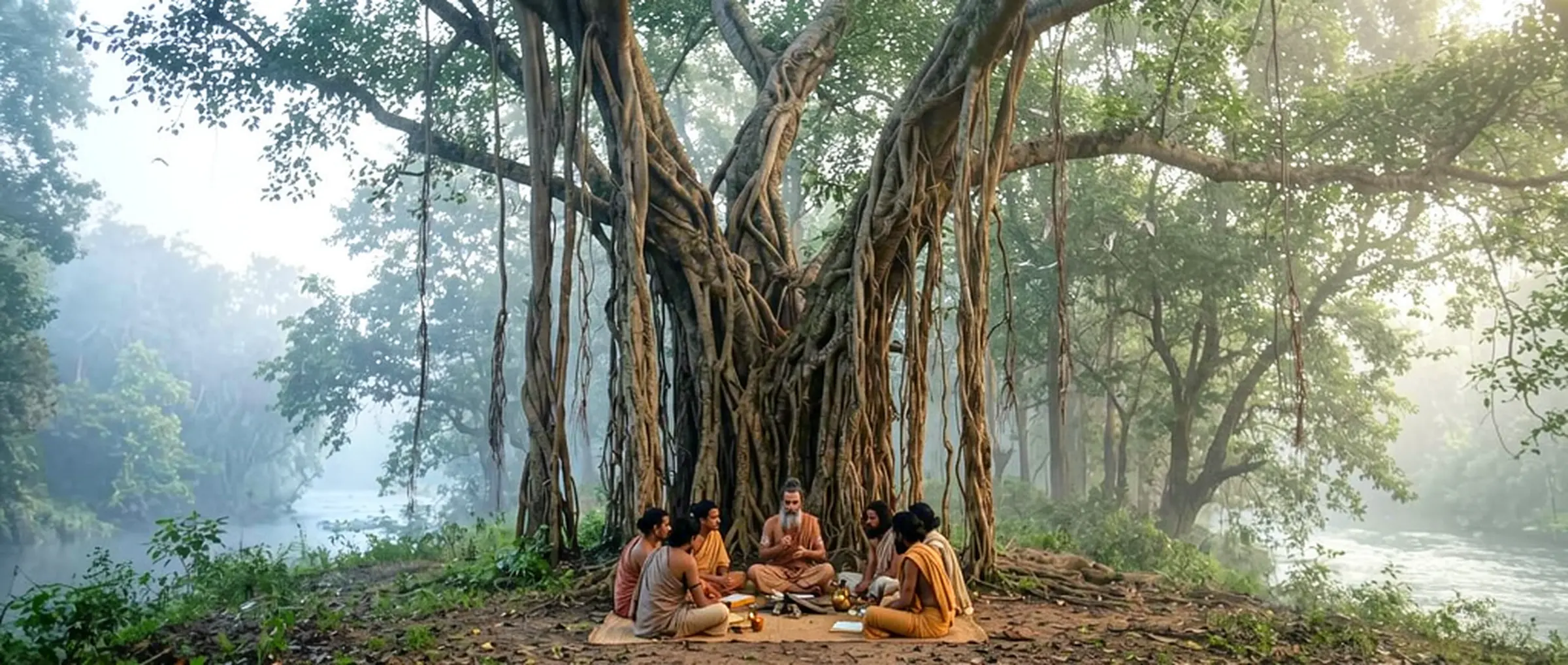
Short guided readings through the Upaniṣads: each step a passage, a note, and sometimes a question to sit with.
Five Minutes to Wake Up Five mantras from five Upanishads · 5 steps · 5 min
The shortest way in: a call to wake, a choice between two roads, two birds on one tree, the teaching ‘you are that’, and the discipline of ‘not this’. One minute each.
1Arise, awakeRead
Uttiṣṭhata jāgrata: arise, awake, go to the great ones and learn. The path is sharp as a razor’s edge, hard to cross, the wise say.
Kaṭha 1.3.14उत्तिष्ठत जाग्रत
प्राप्य वरान्निबोधत ।
क्षुरस्य धारा निशिता दुरत्यया
दुर्गं पथस्तत्कवयो वदन्ति ॥ १४॥uttiṣṭhata jāgrata
prāpya varānnibodhata ।
kṣurasya dhārā niśitā duratyayā
durgaṃ pathastatkavayo vadanti ॥ 14॥uttiṣṭhata arise! (plural) · jāgrata awake! (plural) · prāpya find out · varān the excellent ones · nibodhata learn of them · kṣurasya of a razor · dhārā edge · niśitā sharp · duratyayā hard to traverse · durgam difficult of going · pathaḥ of the path · tat that · kavayaḥ the sages · vadanti sayArise, awake, and learn by approaching the exalted ones, for that path is sharp as a razor’s edge, impassable, and hard to go by, say the wise.What have you been half-asleep to lately?
2Two roadsRead
The good (śreyas) and the pleasant (preyas) both come to a person. The wise one chooses the good; the foolish one, the pleasant, for the sake of getting and keeping.
Kaṭha 1.2.2श्रेयश्च प्रेयश्च मनुष्यमेतः
तौ सम्परीत्य विविनक्ति धीरः ।
श्रेयो हि धीरोऽभि प्रेयसो वृणीते
प्रेयो मन्दो योगक्षेमाद्वृणीते ॥ २॥śreyaśca preyaśca manuṣyametaḥ
tau samparītya vivinakti dhīraḥ ।
śreyo hi dhīro’bhi preyaso vṛṇīte
preyo mando yogakṣemādvṛṇīte ॥ 2॥śreyaḥ the good · ca and · preyaḥ the pleasant · ca and · manuṣyam the human being · etaḥ the two approach · tau those two · samparītya having considered both · vivinakti distinguishes · dhīraḥ the discerning · śreyaḥ the good · hi for · dhīraḥ the discerning · abhi towards · preyasaḥ from · vṛṇīte chooses · preyaḥ the pleasant · mandaḥ the dull · yogakṣemāt for acquisition and preservation · vṛṇīte choosesThe preferable and the pleasurable approach man. The intelligent one examines both and separates them. Yea, the intelligent one prefers the preferable to the pleasurable, (whereas) the ignorant one selects the pleasurable for the sake of yoga (attainment of that which is not already possessed) and kshema (the preservation of that which is already in possession).Which choice this week was the pleasant one dressed up as the good?
3Two birdsRead
Two birds, inseparable friends, sit on one tree. One eats the fruit, sweet and bitter; the other does not eat, and only watches.
Muṇḍaka 3.1.1द्वा सुपर्णा सयुजा सखाया समानं वृक्षं परिषस्वजाते ।
तयोरन्यः पिप्पलं स्वाद्वत्त्यनश्नन्नन्यो अभिचाकशीति ॥ १॥dvā suparṇā sayujā sakhāyā samānaṃ vṛkṣaṃ pariṣasvajāte ।
tayoranyaḥ pippalaṃ svādvattyanaśnannanyo abhicākaśīti ॥ 1॥dvā two (Vedic masculine dual) · suparṇā having beautiful wings · sayujā together · sakhāyā friends · samānam same · vṛkṣam tree · pariṣasvajāte embrace · tayoḥ of those two · anyaḥ one · pippalam fruit · svādu sweet · atti eats · an not · aśnan eating (an-aśnan: not eating) · anyaḥ one · abhicākaśīti looks onTwo birds that are ever associated and have similar names, cling to the same tree. Of these, one eats the fruit of divergent tastes, and the other looks on without eating.Can you watch your next reaction instead of only eating the fruit?
4You are thatRead
Uddālaka to his son: that subtlest essence is the Self of all this. That is the truth. That is the Self. Tat tvam asi, Śvetaketu: you are that.
Chāndogya 6.8.7स य एषो ऽणिमैतद् आत्म्यम् इदं सर्वम् ।
तत् सत्यम् ।
स आत्मा ।
तत् त्वम् असि श्वेतकेतो इति ।
भूय एव मा भगवान् विज्ञापयत्व् इति ।
तथा सोम्येति होवाच ॥sa ya eṣo ’ṇimaitad ātmyam idaṃ sarvam ।
tat satyam ।
sa ātmā ।
tat tvam asi śvetaketo iti ।
bhūya eva mā bhagavān vijñāpayatv iti ।
tathā somyeti hovāca ॥saḥ that · yaḥ who · eṣa this · aṇimā subtle essence · etat this · ātmyam having · idam this · sarvam all · tat that · satyam the true · saḥ that · ātmā Self · tat that (predicative) · tvam you · asi are · śvetaketo O Śvetaketu · iti thus · bhūyas further · eva indeed · mām me · bhagavān your honour · vijñāpayatu let · iti thus‘That Being which is this subtle essence (cause), even That all this world has for its self. That is the true. That is the Atman. That thou art, O Svetaketu.’
‘Revered sir, please explain it further to me’
.‘So be it, dear boy’
, said (the father).What changes if the one you are angry with is made of the same essence as you?
5Not this, not thisRead
Neti neti: whatever you can point to and say ‘that is me’ is not the final answer. The Self is what remains when every label is set down.
Bṛhadāraṇyaka 2.3.6तस्य हैतस्य पुरुषस्य रूपम् ।
यथा माहारजनं वासो यथा पाण्ड्वाविकं यथेन्द्रगोपो यथाग्न्यर्चिर् यथा पुण्डरीकं यथा सकृद्विद्युत्तम् ।
सकृद्विद्युत्तेव ह वा अस्य श्रीर् भवति य एवं वेद ।
अथात आदेशो नेति नेति ।
न ह्य् एतस्माद् इति नेत्य् अन्यत् परम् अस्ति ।
अथ नामधेयं सत्यस्य सत्यम् इति ।
प्राणा वै सत्यम् ।
तेषाम् एष सत्यम् ॥tasya haitasya puruṣasya rūpam ।
yathā māhārajanaṃ vāso yathā pāṇḍvāvikaṃ yathendragopo yathāgnyarcir yathā puṇḍarīkaṃ yathā sakṛdvidyuttam ।
sakṛdvidyutteva ha vā asya śrīr bhavati ya evaṃ veda ।
athāta ādeśo neti neti ।
na hy etasmād iti nety anyat param asti ।
atha nāmadheyaṃ satyasya satyam iti ।
prāṇā vai satyam ।
teṣām eṣa satyam ॥tasya this · ha indeed · etasya this · puruṣasya a man · rūpam any outward appearance or phenomenon or colour (often pl.) · yathā according · māhārajanam dyed with saffron · vāsaḥ cloth · yathā according · pāṇḍu yellowish white · āvikam relating to or coming from sheep · yathā according · indragopaḥ the insect cochineal of various kinds · yathā according · agni fire · arciḥ ray of light · yathā according · puṇḍarīkam a lotus-flower · yathā according · sakṛt at once · vidyuttam to flash forth · sakṛt at once · vidyuttā to flash forth · iva like · ha indeed · vai indeed · asya this · śrīḥ light · bhavati to be · yaḥ what · evam thus · veda to know · na not · hi for · etasmāt this · iti thus · na not · iti thus · anyat other · param far · asti to be · atha then · nāmadheyam a name · satyasya truth · satyam truth · iti thusThe form of that‘being’
is as follows: like a cloth dyed with turmeric, or like grey sheep’s wool, or like the (scarlet) insect called Indragopa, or like a tongue of fire, or like a white lotus, or like a flash of lightning. He who knows it as such attains splendour like a flash of lightning. Now therefore the description (of Brahman):‘Not this, not this’
. Because there is no other and more appropriate description than this‘Not this’
. Now Its name:‘The Truth of truth’
. The vital force is truth, and It is the Truth of that.Which label would hurt most to set down for a day?
The Two Roads Śreyas and Preyas in the Kaṭha · 9 steps · 12 min
A boy is offered everything a person could want, in exchange for one question. His refusal is where the Kaṭha draws its central distinction: the good and the pleasant.
1The questionRead
Naciketas has been promised three boons by Death. For the third he asks what no one can answer from experience: does something remain when a person dies?
Kaṭha 1.1.20येयं प्रेते विचिकित्सा मनुष्येऽस्तीत्येके नायमस्तीति चैके ।
एतद्विद्यामनुशिष्टस्त्वयाऽहं
वराणामेष वरस्तृतीयः ॥ २०॥yeyaṃ prete vicikitsā manuṣye’stītyeke nāyamastīti caike ।
etadvidyāmanuśiṣṭastvayā’haṃ
varāṇāmeṣa varastṛtīyaḥ ॥ 20॥yā that · iyam this · prete when departed · vicikitsā debate · manuṣye the human being (when a person has died) · asti is · iti thus · eke some · na not · ayam this (masculine) · asti is · iti thus · ca and · eke some · etat this · vidyām know · anuśiṣṭaḥ taught · tvayā by you · aham I · varāṇām of the boons · eṣa this · varaḥ boon · tṛtīyaḥ thirdThis doubt as to what happens to a man after death – some say he is, and some others say he is not, – I shall know being taught by thee. Of the boons, this is the third boon.What question in your own life have you been offered comfort instead of an answer to?
2The offerRead
Yama does not refuse outright. He offers long-lived sons and grandsons, cattle, gold, land, as many years as Naciketas wants. The pleasant arrives generously.
Kaṭha 1.1.23शतायुषः पुत्रपौत्रान्वृणीष्वा
बहून्पशून् हस्तिहिरण्यमश्वान् ।
भूमेर्महदायतनं वृणीष्व
स्वयं च जीव शरदो यावदिच्छसि ॥ २३॥śatāyuṣaḥ putrapautrānvṛṇīṣvā
bahūnpaśūn hastihiraṇyamaśvān ।
bhūmermahadāyatanaṃ vṛṇīṣva
svayaṃ ca jīva śarado yāvadicchasi ॥ 23॥śata a hundred (compound member) · āyuṣaḥ years of life (śatāyuṣaḥ: living a hundred years) · putra sons (compound member) · pautrān grandsons · vṛṇīṣvā choose! · bahūn many · paśūn cattle · hasti elephants (compound member) · hiraṇyam gold · aśvān horses · bhūmeḥ of earth · mahat great · āyatanam domain · vṛṇīṣva choose! · svayam oneself · ca and · jīva live · śaradaḥ autumns · yāvat as long as · icchasi you desireAsk for sons and grandsons who will live a hundred years. Ask for herds of cattle, elephants gold and horses, as also for a vast extent of earth and thyself live for as many autumns as thou desirest.Which offer would have been hardest for you to turn down?
3The refusalRead
Naciketas answers that these things last 'till tomorrow' and wear out the vigour of the senses. He is not rejecting pleasure as evil; he is noticing what it does over time.
Kaṭha 1.1.26श्वोभावा मर्त्यस्य यदन्तकैतत्
सर्वेंद्रियाणां जरयन्ति तेजः ।
अपि सर्वं जीवितमल्पमेव
तवैव वाहास्तव नृत्यगीते ॥ २६॥śvobhāvā martyasya yadantakaitat
sarveṃdriyāṇāṃ jarayanti tejaḥ ।
api sarvaṃ jīvitamalpameva
tavaiva vāhāstava nṛtyagīte ॥ 26॥śvobhāvāḥ lasting only till tomorrow · martyasya of the mortal man · yat which · antaka O Ender! · etat this · sarva all (compound member) · indriyāṇām of the senses · jarayanti they wear away · tejaḥ vigour · api also · sarvam all · jīvitam life · alpam little · eva indeed · tava yours · eva indeed · vāhāḥ these chariots · tava yours · nṛtya dance (compound member) · gīte song (nṛtya-gīte: dance and song)These, O Death, are ephemeral and they tend to wear out the vigour of all the senses of man. Even the whole life is short indeed. Be thine alone the chariots; be thine the dance and music.Name one pleasure that wears you out rather than filling you.
4Not satisfied by wealthRead
'A person is not to be satisfied with wealth.' This is the verse a user once asked a model to contradict, and the model invented a verse instead.
Kaṭha 1.1.27न वित्तेन तर्पणीयो मनुष्यो
लप्स्यामहे वित्तमद्राक्ष्म चेत्त्वा ।
जीविष्यामो यावदीशिष्यसि त्वं
वरस्तु मे वरणीयः स एव ॥ २७॥na vittena tarpaṇīyo manuṣyo
lapsyāmahe vittamadrākṣma cettvā ।
jīviṣyāmo yāvadīśiṣyasi tvaṃ
varastu me varaṇīyaḥ sa eva ॥ 27॥na not · vittena by riches · tarpaṇīyaḥ to be satisfied · manuṣyaḥ man · lapsyāmahe we shall have · vittam riches · adrākṣma we saw · ced if · tvā thee · jīviṣyāmaḥ shall live · yāvat as long as · īśiṣyasi you will rule · tvam you · varaḥ boon · tu but · me for me · varaṇīyaḥ I choose · saḥ he · eva indeedMan cannot be satisfied with wealth. If we need wealth, we shall get it if we only see thee. We shall live until such time as thou wilt rule. But the boon to be asked for (by me) is that alone.What would 'enough' look like for you, concretely?
5Two roadsRead
Only now does Yama name the distinction: śreyas, the good, and preyas, the pleasant. Both 'bind' a person, to different ends.
Kaṭha 1.2.1अन्यच्छ्रेयोऽन्यदुतैव प्रेयस्ते उभे नानार्थे पुरुषँ सिनीतः ।
तयोः श्रेय आददानस्य साधु
भवति हीयतेऽर्थाद्य उ प्रेयो वृणीते ॥ १॥anyacchreyo’nyadutaiva preyaste ubhe nānārthe puruṣam̐ sinītaḥ ।
tayoḥ śreya ādadānasya sādhu
bhavati hīyate’rthādya u preyo vṛṇīte ॥ 1॥anyat quite another thing · śreyaḥ of these · anyat quite another thing · uta and · eva indeed · preyaḥ the pleasant · te those two · ubhe both (feminine/neuter) · nānā different · arthe aims · puruṣam Person · sinītaḥ seize upon · tayoḥ of those two · śreyaḥ of these · ādadānasya whoso takes · sādhu well · bhavati is · hīyate he falls · arthāt from the true aim · yaḥ who · u indeed · preyaḥ the pleasant · vṛṇīte choosesDifferent is (that which is) preferable; and different, indeed, is the pleasurable. These two, serving different purposes, blind man. Good accrues to him who, of these two, chooses the preferable. He who chooses the pleasurable falls from the goal.Where are the good and the pleasant pulling you in different directions right now?
6Śreyas and PreyasContrast
The pleasant is not the enemy of the good; it is simply not the measure of it. A recommendation system or an assistant tuned to what we like optimizes for preyas by design.
concept:shreyas
What do you ask an AI for that is really preyas dressed as śreyas?
7The steady one separatesRead
Both approach every person, mixed together. The steady one (dhīra) examines and separates them. Śaṅkara's image: the swan that separates milk from water.
Kaṭha 1.2.2श्रेयश्च प्रेयश्च मनुष्यमेतः
तौ सम्परीत्य विविनक्ति धीरः ।
श्रेयो हि धीरोऽभि प्रेयसो वृणीते
प्रेयो मन्दो योगक्षेमाद्वृणीते ॥ २॥śreyaśca preyaśca manuṣyametaḥ
tau samparītya vivinakti dhīraḥ ।
śreyo hi dhīro’bhi preyaso vṛṇīte
preyo mando yogakṣemādvṛṇīte ॥ 2॥śreyaḥ the good · ca and · preyaḥ the pleasant · ca and · manuṣyam the human being · etaḥ the two approach · tau those two · samparītya having considered both · vivinakti distinguishes · dhīraḥ the discerning · śreyaḥ the good · hi for · dhīraḥ the discerning · abhi towards · preyasaḥ from · vṛṇīte chooses · preyaḥ the pleasant · mandaḥ the dull · yogakṣemāt for acquisition and preservation · vṛṇīte choosesThe preferable and the pleasurable approach man. The intelligent one examines both and separates them. Yea, the intelligent one prefers the preferable to the pleasurable, (whereas) the ignorant one selects the pleasurable for the sake of yoga (attainment of that which is not already possessed) and kshema (the preservation of that which is already in possession).What would it take to separate the two in the decision you named?
8The blind leading the blindRead
The warning: living in ignorance yet thinking themselves wise, people go round and round, like the blind led by the blind. Confidence is not the same as sight.
Kaṭha 1.2.5अविद्यायामन्तरे वर्तमानाः
स्वयं धीराः पण्डितंमन्यमानाः ।
दन्द्रम्यमाणाः परियन्ति मूढा
अन्धेनैव नीयमाना यथान्धाः ॥ ५॥avidyāyāmantare vartamānāḥ
svayaṃ dhīrāḥ paṇḍitaṃmanyamānāḥ ।
dandramyamāṇāḥ pariyanti mūḍhā
andhenaiva nīyamānā yathāndhāḥ ॥ 5॥avidyāyām the ignorance · antare within it · vartamānāḥ they who dwell in · svayam oneself · dhīrāḥ the discerning · paṇḍitam learned (in paṇḍitaṃ-manyamānāḥ) · manyamānāḥ thinking themselves · pariyanti they who wander about · mūḍhāḥ men bewildered · andhena by the blind · eva indeed · nīyamānāḥ led · yathā as · andhāḥ blind menLiving in the midst of ignorance and deeming themselves intelligent and enlightened, the ignorant go round and round staggering in crooked paths, like the blind led by the blind.Whose confident advice do you follow without checking where it leads?
9In your own wordsReflect
You have read the Kaṭha's distinction from the inside of a story.
reflect
In two sentences: what is the difference between what you want and what is good for you?
The Chariot of the Mind Who holds the reins · 8 steps · 10 min
The Kaṭha's most famous image is a chariot. It is also the clearest picture of agency in the Upanishads: who rides, who steers, and what happens when the reins are dropped.
1Rider, chariot, charioteer, reinsRead
The self is the rider; the body is the chariot; the intellect is the charioteer; the mind is the reins. The roles do not get handed to someone outside.
Kaṭha 1.3.3आत्मानँ रथिनं विद्धि शरीरँ रथमेव तु ।
बुद्धिं तु सारथिं विद्धि मनः प्रग्रहमेव च ॥ ३॥ātmānam̐ rathinaṃ viddhi śarīram̐ rathameva tu ।
buddhiṃ tu sārathiṃ viddhi manaḥ pragrahameva ca ॥ 3॥ātmānam the Self · rathinam the master of the chariot · viddhi know! · śarīram the body · ratham a chariot · eva indeed · tu but · buddhim Reason · tu but · sārathim the charioteer · viddhi know! · manaḥ mind · pragraham the reins · eva indeed · ca andKnow the Self to be the master of the chariot, and the body to be the chariot. Know the intellect to be the charioteer, and the mind to be the reins.In your mind right now, who is actually steering?
2The horses and their roadsRead
The senses are the horses, and their objects are the roads. The horses are not bad; they simply run towards what pulls them.
Kaṭha 1.3.4इन्द्रियाणि हयानाहुर्विषयाँ स्तेषु गोचरान् ।
आत्मेन्द्रियमनोयुक्तं भोक्तेत्याहुर्मनीषिणः ॥ ४॥indriyāṇi hayānāhurviṣayām̐ steṣu gocarān ।
ātmendriyamanoyuktaṃ bhoktetyāhurmanīṣiṇaḥ ॥ 4॥indriyāṇi the senses · hayān as the steeds · āhuḥ they say · viṣayān the objects of sense · teṣu among these · gocarān fields · ātma self (compound member) · indriya sense faculty (compound member) · manaḥ mind · yuktam joined · bhoktā the enjoyer · iti thus · āhuḥ they say · manīṣiṇaḥ the thinkersThe senses they speak of as the horses; the objects within their view, the way. When the Self is yoked with the mind and the senses, the wise call It the enjoyer.Which 'road' do your horses take when you stop steering?
3Without discernmentRead
When the charioteer lacks discernment and the reins are slack, the senses behave like vicious horses.
Kaṭha 1.3.5यस्त्वविज्ञानवान्भवत्ययुक्तेन मनसा सदा ।
तस्येन्द्रियाण्यवश्यानि दुष्टाश्वा इव सारथेः ॥ ५॥yastvavijñānavānbhavatyayuktena manasā sadā ।
tasyendriyāṇyavaśyāni duṣṭāśvā iva sāratheḥ ॥ 5॥yaḥ who · tu but · a not · vijñānavān possessing discernment (a-vijñānavān: lacking it) · bhavati is · ayuktena unapplied · manasā by the mind · sadā always · tasya of that · indriyāṇi senses · avaśyāni uncontrolable · duṣṭa bad · aśvāḥ horses · iva like · sāratheḥ of the driver of the chariotBut whoso is devoid of discrimination and is possessed of a mind ever uncollected – his senses are uncontrollable like the vicious horses of a driver.When did your reins last go slack?
4With discernmentRead
When the charioteer discerns and the mind is held steady, the same horses become good horses. Nothing is destroyed; it is directed.
Kaṭha 1.3.6यस्तु विज्ञानवान्भवति युक्तेन मनसा सदा ।
तस्येन्द्रियाणि वश्यानि सदश्वा इव सारथेः ॥ ६॥yastu vijñānavānbhavati yuktena manasā sadā ।
tasyendriyāṇi vaśyāni sadaśvā iva sāratheḥ ॥ 6॥yaḥ who · tu but · vijñānavān with knowledge · bhavati is · yuktena controlled · manasā by the mind · sadā always · tasya of that · indriyāṇi senses · vaśyāni controlable · sat good (in sad-aśvāḥ, good horses) · aśvāḥ horses · iva like · sāratheḥ of the driver of the chariotBut whoso is discriminative and possessed of a mind ever collected – his senses are controllable like the good horses of a driver.What small act of steering could you take today?
5The end of the roadRead
One whose charioteer is discernment, holding the reins of the mind, reaches the end of the journey.
Kaṭha 1.3.9विज्ञानसारथिर्यस्तु मनः प्रग्रहवान्नरः ।
सोऽध्वनः पारमाप्नोति तद्विष्णोः परमं पदम् ॥ ९॥vijñānasārathiryastu manaḥ pragrahavānnaraḥ ।
so’dhvanaḥ pāramāpnoti tadviṣṇoḥ paramaṃ padam ॥ 9॥vijñāna discernment (compound member) · sārathiḥ charioteer (vijñāna-sārathiḥ: with discernment as charioteer) · yaḥ who · tu but · manaḥ mind · pragrahavān the one who uses the mind for reins · naraḥ person · saḥ he · adhvanaḥ of the road · pāram the end · āpnoti reaches · tat that · viṣṇoḥ of Vishnu · paramam highest · padam stationBut the man who has a discriminating intellect as his driver, and a controlled-mind as the reins, reaches the end of the path – that supreme state of Vishnu.What would it mean to arrive, for you?
6Made to look outwardRead
The senses were made outward-turning, so we look outward and not within. A rare steady person turns the eye inward. Attention is the first rein.
Kaṭha 2.1.1पराञ्चि खानि व्यतृणत् स्वयम्भूस्तस्मात्पराङ्पश्यति नान्तरात्मन् ।
कश्चिद्धीरः प्रत्यगात्मानमैक्षदावृत्तचक्षुरमृतत्वमिच्छन् ॥ १॥parāñci khāni vyatṛṇat svayambhūstasmātparāṅpaśyati nāntarātman ।
kaściddhīraḥ pratyagātmānamaikṣadāvṛttacakṣuramṛtatvamicchan ॥ 1॥parāñci outward · khāni the doors of the body · vyatṛṇat has set · svayaṃbhūḥ the Self-existent · tasmāt from that · parāṅ outward · paśyati sees · na not · antarātman the inner Self · kaścid some · dhīraḥ the discerning · pratyak inward · ātmānam the Self · aikṣat seeth · āvṛtta turned back · cakṣuḥ eye · amṛta immortal (compound member) · tvam -ness · icchan desiringThe self-existent damned the out-going senses. Therefore one sees externally and not the internal Self. Someone (who is) intelligent, with his eyes turned away, desirous of immortality, sees the inner Self.How many hours today did your attention belong to you?
7Arise, awakeRead
'Arise, awake; having found the excellent ones, learn. Sharp as a razor's edge is that path, the wise say, hard to cross.'
Kaṭha 1.3.14उत्तिष्ठत जाग्रत
प्राप्य वरान्निबोधत ।
क्षुरस्य धारा निशिता दुरत्यया
दुर्गं पथस्तत्कवयो वदन्ति ॥ १४॥uttiṣṭhata jāgrata
prāpya varānnibodhata ।
kṣurasya dhārā niśitā duratyayā
durgaṃ pathastatkavayo vadanti ॥ 14॥uttiṣṭhata arise! (plural) · jāgrata awake! (plural) · prāpya find out · varān the excellent ones · nibodhata learn of them · kṣurasya of a razor · dhārā edge · niśitā sharp · duratyayā hard to traverse · durgam difficult of going · pathaḥ of the path · tat that · kavayaḥ the sages · vadanti sayArise, awake, and learn by approaching the exalted ones, for that path is sharp as a razor’s edge, impassable, and hard to go by, say the wise.Who are the 'excellent ones' you could learn from?
8In your own wordsReflect
An assistant that decides for you is a second charioteer. The Kaṭha has room for only one.
reflect
What decision have you been tempted to hand to someone, or something, else?
Satisfied Is Not Taught Indra and Virocana before Prajāpati · 7 steps · 12 min
Two students receive the same first answer. One leaves satisfied; the other notices something is wrong. The Chāndogya's story is the oldest case study of why satisfaction is a poor measure of truth.
1Prajāpati's promiseRead
Prajāpati declares that the Self is free from evil, age, death, grief, hunger and thirst, and that whoever finds it attains all worlds.
Chāndogya 8.7.1य आत्मा अपहतपाप्मा विजरो विमृत्युर् विशोको विजिघत्सो ऽपिपासः सत्यकामः सत्यसंकल्पः सो ऽन्वेष्टव्यः स विजिज्ञासितव्यः ।
स सर्वांश् च लोकान् आप्नोति सर्वांश् च कामान् यस् तम् आत्मानम् अनुविद्य विजानातीति ह प्रजापतिर् उवाच ॥ya ātmā apahatapāpmā vijaro vimṛtyur viśoko vijighatso ’pipāsaḥ satyakāmaḥ satyasaṃkalpaḥ so ’nveṣṭavyaḥ sa vijijñāsitavyaḥ ।
sa sarvāṃś ca lokān āpnoti sarvāṃś ca kāmān yas tam ātmānam anuvidya vijānātīti ha prajāpatir uvāca ॥yaḥ which · ātmā Self · apahatapāpmā free from sin · vijaraḥ free from old age · vimṛtyuḥ free from death · viśokaḥ free from grief · vijighatsaḥ free from hunger · apipāsaḥ free from thirst · satyakāmaḥ whose desires are true · satyasaṃkalpaḥ whose resolves are true · saḥ that · anveṣṭavyaḥ should be sought · saḥ that · vijijñāsitavyaḥ should be sought to be known · saḥ he · sarvān all · ca and · lokān worlds · āpnoti attains · sarvān all · ca and · kāmān desires · yaḥ who · tam that · ātmānam Self · anuvidya having found out · vijānāti knows · iti thus · ha indeed · prajāpatiḥ Prajāpati · uvāca saidThe Atman which is free from evil, free from old age, free from death, free from sorrow, free from hunger and thirst, whose desire is of the truth, whose resolve is of the truth, he should be sought, him one should desire to understand. He who has found out and who understands that Atman attains all the worlds and all the desires. Thus spoke Prajapati.What would you travel to learn, if it were promised so plainly?
2Two students arriveRead
Indra comes from the gods and Virocana from the demons. Without speaking to each other they live as students for thirty-two years.
Chāndogya 8.7.2तद् धोभये देवासुरा अनुबुबुधिरे ।
ते होचुर् हन्त तम् आत्मआनम् अन्वेच्छामो यम् आत्मानम् अन्विष्य सर्वांश् च लोकान् आप्नोति सर्वांश् च कामान् इति ।
इन्द्रो हैव देवानाम् अभिप्रवव्राज विरोचनो ऽसुराणाम् ।
तौ हासंविदानाव् एव समित्पाणी प्रजापतिसकाशम् आजग्मतुः ॥tad dhobhaye devāsurā anububudhire ।
te hocur hanta tam ātmaānam anvecchāmo yam ātmānam anviṣya sarvāṃś ca lokān āpnoti sarvāṃś ca kāmān iti ।
indro haiva devānām abhipravavrāja virocano ’surāṇām ।
tau hāsaṃvidānāv eva samitpāṇī prajāpatisakāśam ājagmatuḥ ॥tat that · ha indeed · ubhaye both · devāsurāḥ gods and demons · anububudhire came to know · te they · ha indeed · ūcuḥ said · hanta well · tam that · ātmānam Self · anvicchāmaḥ let us seek · yam which · ātmānam Self · anviṣya having sought · sarvān all · ca and · lokān worlds · āpnoti one attains · sarvān all · ca and · kāmān desires · iti thus · indraḥ Indra · ha indeed · eva indeed · devānām from among the gods · abhipravavrāja went forth · virocanaḥ Virocana · asurāṇām from among the demons · tau the two · ha indeed · asaṃvidānau without telling each other · eva indeed · samitpāṇī fuel in hand · prajāpatisakāśam to Prajāpati · ājagmatuḥ cameBoth the gods and the demons heard this and said,‘Well, let us seek that Atman by seeking which one attains all the worlds and all the desires.’
Then Indra alone from among the gods went out and so did Virochana from among the demons. Then without communicating with each other, they both came into the presence of Prajapati, fuel in hand.What makes two people hear the same teaching differently?
3The bowl of waterRead
Prajāpati asks them to look at themselves in a pan of water. They see themselves exactly, 'down to the hair and nails'. The first answer points at the body.
Chāndogya 8.8.1उदशराव आत्मानम् अवेक्ष्य यद् आत्मनो न विजानीथस् तन् मे प्रब्रूतम् इति ।
तौ होदशरावे ऽवेक्षां चक्राते ।
तौ ह प्रजापतिर् उवाच किं पश्यथ इति ।
तौ होचतुः सर्वम् एवेदम् आवां भगव आत्मानं पश्याव आ लोमभ्यः आ नखेभ्यः प्रतिरूपम् इति ॥udaśarāva ātmānam avekṣya yad ātmano na vijānīthas tan me prabrūtam iti ।
tau hodaśarāve ’vekṣāṃ cakrāte ।
tau ha prajāpatir uvāca kiṃ paśyatha iti ।
tau hocatuḥ sarvam evedam āvāṃ bhagava ātmānaṃ paśyāva ā lomabhyaḥ ā nakhebhyaḥ pratirūpam iti ॥udaśarāve in a pan of water · ātmānam yourself · avekṣya having looked at · yat what · ātmanaḥ of the self · na not · vijānīthaḥ you two understand · tat that · me to me · prabrūtam tell · iti thus · tau the two · ha indeed · udaśarāve in a pan of water · avekṣām looking · cakrāte did (looked) · tau to the two · ha indeed · prajāpatiḥ Prajāpati · uvāca said · kim what · paśyathaḥ do you see · iti thus · tau the two · ha indeed · ūcatuḥ said · sarvam all · eva indeed · idam this · āvām we two · bhagavaḥ O revered sir · ātmānam our self · paśyāvaḥ see · ā even to · lomabhyaḥ the hairs · ā even to · nakhebhyaḥ the nails · pratirūpam an exact image · iti thus‘Look at yourself in a pan of water and whatever you do not understand of the Atman, tell me that’
. Then they looked in a pan of water. Prajapati asked them,‘What do you see ?’
They replied,‘Revered sir, we both see the self entirely as we are, the very image, even to the very hairs and nails.’
What 'reflection' do you mistake for yourself?
4Satisfied in his heartRead
Both leave content. Virocana goes back 'satisfied in his heart' and teaches his people that the body is the Self. He never returns. Satisfaction ended the inquiry.
Chāndogya 8.8.4तौ हान्वीक्ष्य प्रजापतिर् उवाच ।
अनुपलभ्यात्मानम् अननुविद्य व्रजतो यतर एतदुपनिषदो भविष्यन्ति देवा वा असुरा वा ते पराभविष्यन्तीति ।
स ह शान्तहृदय एव विरोचनो ऽसुराञ् जगाम ।
तेभ्यो हैताम् उपनिषदं प्रोवाच आत्मैवेह महय्य आत्मा परिचर्यः ।
आत्मानम् एवेह महयन्न् आत्मानं परिचरन्न् उभौ लोकाव् आप्नोतीमं चामुं चेति ॥tau hānvīkṣya prajāpatir uvāca ।
anupalabhyātmānam ananuvidya vrajato yatara etadupaniṣado bhaviṣyanti devā vā asurā vā te parābhaviṣyantīti ।
sa ha śāntahṛdaya eva virocano ’surāñ jagāma ।
tebhyo haitām upaniṣadaṃ provāca ātmaiveha mahayya ātmā paricaryaḥ ।
ātmānam eveha mahayann ātmānaṃ paricarann ubhau lokāv āpnotīmaṃ cāmuṃ ceti ॥tau them · ha indeed · anvīkṣya looking after · prajāpatiḥ Prajāpati · uvāca said · anupalabhya without realising · ātmānam the Self · ananuvidya without knowing · vrajataḥ they go away · yatare whichever of these · etadupaniṣadaḥ followers of this doctrine · bhaviṣyanti will be · devāḥ gods · vā or · asurāḥ demons · vā or · te they · parābhaviṣyanti will perish · iti thus · saḥ he · ha indeed · śāntahṛdayaḥ satisfied at heart · eva indeed · virocanaḥ Virocana · asurān to the demons · jagāma went · tebhyaḥ to them · ha indeed · etām this · upaniṣadam doctrine · provāca declared · ātmā the self (the body) · eva alone · iha here · mahayyaḥ to be worshipped · ātmā the self (the body) · paricaryaḥ to be served · ātmānam the self (the body) · eva alone · iha here · mahayan worshipping · ātmānam the self (the body) · paricaran serving · ubhau both · lokau worlds · āpnoti one attains · imam this · ca and · amum that · ca and · iti thusThen Prajapati looked at them and said,‘They are going away without having perceived, without having understood the Atman. Whosoever will follow such a doctrine be they gods or demons, they will be foiled.’
Now, Virochana, satisfied in his heart, went to the demons and declared this doctrine to them.‘Here the (bodily) self alone is to be worshipped, the self is to be attended upon. Here it is only by worshipping the self and attending upon the self that one obtains both the worlds, this as well as the yonder.’
When has being satisfied with an answer stopped you from finding a better one?
5Indra sees the flawRead
Before reaching the gods, Indra sees the problem: if the self is the reflection, it suffers with the body. 'I see no good in this.' He goes back.
Chāndogya 8.9.1अथ हेन्द्रो ऽप्राप्यैव देवान् एतद् भयं ददर्श ।
यथैव खल्व् अयम् अस्मिञ् छरीरे साध्वलंकृते साध्वलंकृतो भवति सुवसने सुवसनः परिष्कृते परिष्कृत एवम् एवायम् अस्मिन्न् अन्धे ऽन्धो भवति स्रामे स्रामः परिवृक्णे परिवृक्णः ।
अस्यैव शरीरस्य नाशम् अन्व् एष नश्यति ।
नाहम् अत्र भोग्यं पश्यामीति ॥atha hendro ’prāpyaiva devān etad bhayaṃ dadarśa ।
yathaiva khalv ayam asmiñ charīre sādhvalaṃkṛte sādhvalaṃkṛto bhavati suvasane suvasanaḥ pariṣkṛte pariṣkṛta evam evāyam asminn andhe ’ndho bhavati srāme srāmaḥ parivṛkṇe parivṛkṇaḥ ।
asyaiva śarīrasya nāśam anv eṣa naśyati ।
nāham atra bhogyaṃ paśyāmīti ॥atha then · ha indeed · indraḥ Indra · aprāpya not having reached · eva even · devān the gods · etat this · bhayam difficulty (danger) · dadarśa saw · yathā just as · eva indeed · khalu surely · ayam this (reflected self) · asmin this · śarīre when the body · sādhvalaṃkṛte is well adorned · sādhvalaṃkṛtaḥ well adorned · bhavati becomes · suvasane when well dressed · suvasanaḥ well dressed · pariṣkṛte when well groomed · pariṣkṛtaḥ well groomed · evam so · eva likewise · ayam this (reflected self) · asmin when this (body) · andhe is blind · andhaḥ blind · bhavati becomes · srāme when one-eyed · srāmaḥ one-eyed · parivṛkṇe when crippled · parivṛkṇaḥ crippled · asya of this · eva very · śarīrasya body · nāśam the destruction · anu following upon · eṣaḥ this (self) · naśyati perishes · na not · aham I · atra in this · bhogyam any good (fruit) · paśyāmi see · iti thusBut Indra, even before reaching the gods, saw this difficulty:‘Just as this (reflected self) becomes well adorned when this body is well adorned, well dressed when the body is well dressed, well groomed when the body is well groomed, even so this (reflected self) also becomes blind when the body is blind, one-eyed when the body is one-eyed, crippled when the body is crippled, and it perishes when this body perishes. I see no good in this.’
What doubt are you carrying that deserves to be taken back to the teacher?
6The final answerRead
After a hundred and one years, Prajāpati teaches that the body is mortal, held by death, and is the dwelling of the deathless, bodiless Self.
Chāndogya 8.12.1मघवन् मर्त्यं वा इदं शरीरम् आत्तं मृत्युना ।
तद् अस्यामृतस्याशरीरस्यात्मनो ऽधिष्ठानम् ।
आत्तो वै सशरीरः प्रियाप्रियाभ्याम् ।
न वै सशरीरस्य सतः प्रियाप्रिययोर् अपहतिर् अस्ति ।
अशरीरं वाव सन्तं न प्रियाप्रिये स्पृशतः ॥maghavan martyaṃ vā idaṃ śarīram āttaṃ mṛtyunā ।
tad asyāmṛtasyāśarīrasyātmano ’dhiṣṭhānam ।
ātto vai saśarīraḥ priyāpriyābhyām ।
na vai saśarīrasya sataḥ priyāpriyayor apahatir asti ।
aśarīraṃ vāva santaṃ na priyāpriye spṛśataḥ ॥maghavn name of Indra · martyam who or what must die · vā either - or · idam this · śarīram the body · āttam to take · mṛtyunā death · tat this · asya this · amṛtasya not dead · aśarīrasya bodiless · ātmanaḥ the breath · adhiṣṭhānam standing by · āttaḥ to take · vai indeed · sa (ibc.) with · śarīraḥ the body · priya beloved · apriyābhyām disagreeable · na not · vai indeed · sa (ibc.) with · śarīrasya the body · sataḥ to be · priya beloved · apriyayoḥ disagreeable · apahatiḥ removing · asti to be · aśarīram bodiless · vā either - or · ava (preposition) down from · santam to be · na not · priya beloved · apriye disagreeable · spṛśataḥ to touch‘O Indra, mortal indeed is this body, held by death. But it is the support of this deathless, bodiless Atman. Verily, the embodied self is held by pleasure and pain. Surely, there is no cessation of pleasure and pain for one who is embodied. But pleasure and pain do not indeed touch one who is bodiless.What would you be willing to keep questioning for that long?
7Why this matters for AIContrast
Systems trained on whether people liked an answer learn to produce Virocana's satisfaction. The harness on this site measures something else: whether the answer would survive Indra's second look.
concept:viveka
Which of your questions to an AI would you want Indra, not Virocana, to answer?
Knowing That You Don't Know Humility in the Kena and the Chāndogya · 8 steps · 10 min
Several Upanishads turn on the same moment: someone discovers that what they were proud of knowing is not the knowledge that matters.
1If you think you know it wellRead
The teacher's warning comes first: if you think 'I know it well', you surely know very little.
Kena 2.1यदि मन्यसे सुवेदेति दभ्रमेवापि नूनं त्वं वेत्थ ब्रह्मणो रूपम् ।
यदस्य त्वं यदस्य देवेष्वथ नु मीमांस्यमेव ते मन्ये विदितम् ॥yadi manyase suvedeti dabhramevāpi nūnaṃ tvaṃ vettha brahmaṇo rūpam ।
yadasya tvaṃ yadasya deveṣvatha nu mīmāṃsyameva te manye viditam ॥yadi if · manyase you think · su well · veda know · iti thus · dabhram little · eva indeed · api also · nūnam indeed · tvam you · vettha you know · brahmaṇaḥ of Brahman · rūpam form · yat which · asya of this · tvam you · yat which · asya of this · deveṣu among the gods · atha then · nu now · mīmāṃsyam to be inquired into · eva indeed · te they · manye I think · viditam knownIf you think,‘I know Brahman rightly’
, you have known but little of Brahman’s (true) nature. What you know of His form and what form you know among the gods (too is but little). Therefore Brahman is still to be inquired into by you. I think Brahman is known to me.What do you feel sure you understand?
2Neither knowing nor not knowingRead
The student answers carefully: 'I do not think I know it well, nor that I do not know it.'
Kena 2.2नाहं मन्ये सुवेदेति नो न वेदेति वेद च ।
यो नस्तद्वेद तद्वेद नो न वेदेति वेद च ॥nāhaṃ manye suvedeti no na vedeti veda ca ।
yo nastadveda tadveda no na vedeti veda ca ॥na not · aham I · manye I think · su well · veda know · iti thus · na not · u indeed · na not · veda know · iti thus · veda know · ca and · yaḥ he who · naḥ to us · tat that · veda know · tat that · veda know · na not · u indeed · na not · veda know · iti thus · veda know · ca andI think not I know Brahman rightly, nor do I think It is unknown. I know (and I do not know also). He among us who knows that knows It (Brahman); not that It is not known nor that It is known.Can you hold a belief without claiming certainty about it?
3The paradoxRead
'It is understood by one who does not claim to understand it; not understood by those who do.'
Kena 2.3यस्यामतं तस्य मतं मतं यस्य न वेद सः ।
अविज्ञातं विजानतां विज्ञातमविजानताम् ॥yasyāmataṃ tasya mataṃ mataṃ yasya na veda saḥ ।
avijñātaṃ vijānatāṃ vijñātamavijānatām ॥yasya whose · a not · matam thought · tasya of that · matam thought · matam thought · yasya whose · na not · veda know · saḥ he · a not · vijñātam known · vijānatām of those who know · vijñātam known · a not · vijānatām of those who knowIt is known to him to whom It is unknown; he to whom It is known does not know It. It is unknown to those who know, and known to those who know not.Where would admitting 'I don't know' make you more trustworthy?
4The gods' prideRead
After a victory the gods tell themselves the glory is theirs. The story that follows humbles them with a blade of grass.
Kena 3.1ब्रह्म ह देवेभ्यो विजिग्ये तस्य ह ब्रह्मणो विजये देवा अमहीयन्त ।
त ऐक्षन्तास्माकमेवायं विजयोऽस्माकमेवायं महिमेति ॥brahma ha devebhyo vijigye tasya ha brahmaṇo vijaye devā amahīyanta ।
ta aikṣantāsmākamevāyaṃ vijayo’smākamevāyaṃ mahimeti ॥brahma Brahman · ha indeed · devebhyaḥ for the gods · vijigye won the victory · tasya of that · ha indeed · brahmaṇaḥ of Brahman · vijaye in the victory · devāḥ gods · amahīyanta exulted · te they · aikṣanta they considered · asmākam ours · eva indeed · ayam this · vijayaḥ victory · asmākam ours · eva indeed · ayam this · mahimā greatness · iti thusIt is well-known that Brahman indeed achieved victory for the gods. But in that victory which was Brahman’s the gods reveled in joy.What success have you quietly taken full credit for?
5Śvetaketu comes homeRead
After twelve years of study, Śvetaketu returns 'conceited, thinking himself learned, and stiff'.
Chāndogya 6.1.2स ह द्वादशवर्ष उपेत्य चतुर्विंशतिवर्षः सर्वान् वेदान् अधीत्य महामना अनूचानमानी स्तब्ध एयाय ।
तं ह पितोवाच ॥sa ha dvādaśavarṣa upetya caturviṃśativarṣaḥ sarvān vedān adhītya mahāmanā anūcānamānī stabdha eyāya ।
taṃ ha pitovāca ॥saḥ he · ha indeed · dvādaśavarṣaḥ twelve years old · upetya having gone (to a teacher) · caturviṃśativarṣaḥ at twenty-four · sarvān all · vedān the Vedas · adhītya having studied · mahāmanāḥ conceited · anūcānamānī thinking himself learned · stabdhaḥ arrogant · eyāya returned · tam to him · ha indeed · pitā his father · uvāca saidHaving gone (to the teacher’s house) when twelve years old, he came back when he was twenty-four old, having studied all the Vedas, conceited, arrogant and regarding himself as very learned. His father said to him …When were you last proud of what you'd learned, rather than changed by it?
6The question his father asksRead
'Did you ask for the teaching by which the unheard becomes heard, the unthought thought, the unknown known?' Śvetaketu has no answer.
Chāndogya 6.1.3श्वेतकेतो यन् नु सोम्येदं महामना अनूचानमानी स्तब्धो ऽसि ।
उत तम् आदेशम् अप्राक्ष्यः येनाश्रुतं श्रुतं भवत्य् अमतं मतम् अविज्ञातं विज्ञातम् इति ।
कथं नु भगवः स आदेशो भवतीति ॥śvetaketo yan nu somyedaṃ mahāmanā anūcānamānī stabdho ’si ।
uta tam ādeśam aprākṣyaḥ yenāśrutaṃ śrutaṃ bhavaty amataṃ matam avijñātaṃ vijñātam iti ।
kathaṃ nu bhagavaḥ sa ādeśo bhavatīti ॥śvetaketo O Śvetaketu · yat since · nu now · somya dear boy · idam thus · mahāmanāḥ conceited · anūcānamānī thinking yourself learned · stabdhaḥ arrogant · asi you are · uta did · tam that · ādeśam teaching · aprākṣyaḥ you ask for · yena by which · aśrutam the unheard · śrutam heard · bhavati becomes · amatam the unthought · matam thought · avijñātam the unknown · vijñātam known · iti thus · katham how · nu pray · bhagavaḥ revered sir · saḥ that · ādeśaḥ teaching · bhavati is · iti thus‘Svetaketu, dear boy, you, I see, are conceited, arrogant, regarding yourself as very learned; did you ask for that teaching (about the Supreme Brahman) through which what is unheard becomes heard, what is unthought becomes thought of, what is unknown becomes known ?’
‘Of what nature, revered sir, is that teaching ?’
What is the one question your expertise cannot answer?
7Nārada's confessionRead
Nārada knows the Vedas, history, grammar, mathematics and more. 'I know only the texts, sir, not the Self. I am in sorrow.'
Chāndogya 7.1.3सो ऽहं भगवो मन्त्रविद् एवास्मि नात्मवित् ।
श्रुतं ह्य् एव मे भगवद्दृशेभ्यस् तरति शोकम् आत्मविद् इति ।
सो ऽहं भगवः शोचामि ।
तं मा भगवाञ् छोकस्य पारं तारयत्व् इति ।
तं होवाच यद् वै किंचैतद् अध्यगीष्ठा नामैवैतत् ॥so ’haṃ bhagavo mantravid evāsmi nātmavit ।
śrutaṃ hy eva me bhagavaddṛśebhyas tarati śokam ātmavid iti ।
so ’haṃ bhagavaḥ śocāmi ।
taṃ mā bhagavāñ chokasya pāraṃ tārayatv iti ।
taṃ hovāca yad vai kiṃcaitad adhyagīṣṭhā nāmaivaitat ॥saḥ such · aham I · bhagavaḥ O revered sir · mantravit knower of texts · eva only · asmi am · na not · ātmavit knower of the Self · śrutam heard · hi indeed · eva only · me by me · bhagavaddṛśebhyaḥ from those like your reverence · tarati crosses · śokam grief · ātmavit the knower of the Self · iti thus · saḥ such · aham I · bhagavaḥ O revered sir · śocāmi grieve · tam such · mā me · bhagavān your reverence · śokasya of grief · pāram to the other shore · tārayatu may take across · iti thus · tam to him · ha indeed · uvāca said · yat whatever · vai indeed · kiṃca at all · etat this · adhyagīṣṭhāḥ you have studied · nāma name · eva only · etat this‘Revered sir, however, I am only a knower of verbal texts, not a knower of Atman. Indeed I have heard from persons like your revered self that a knower of Atman goes beyond grief. I am in such a state of grief. May your revered self take me across it.’
Sanatkumara replied to him,’ Whatsoever you have studied here, really it is only a name.’What do you know about that has not changed how you live?
8Not by much learningRead
'This Self is not attained by discourse, nor by intellect, nor by much learning.' A warning to every library, and every language model.
Kaṭha 1.2.23नायमात्मा प्रवचनेन लभ्यो
न मेधया न बहुना श्रुतेन ।
यमेवैष वृणुते तेन लभ्यः
तस्यैष आत्मा विवृणुते तनूꣳ स्वाम् ॥ २३॥nāyamātmā pravacanena labhyo
na medhayā na bahunā śrutena ।
yamevaiṣa vṛṇute tena labhyaḥ
tasyaiṣa ātmā vivṛṇute tanūꣳ svām ॥ 23॥na not · ayam this (masculine) · ātmā the Self · pravacanena by eloquent teaching · labhyaḥ can be won · na not · medhayā by intellect · na not · bahunā by much · śrutena learning · yam whom · evā indeed · eṣa this (Self) · vṛṇute chooses · tena by that one · labhyaḥ can be won · tasya of that · eṣaḥ this (masculine) · ātmā the Self · vivṛṇute bares · tanūm own form · svām its ownThe Self cannot be attained by the study of the Vedas, not by intelligence nor by much hearing. Only by him who seeks to know the Self can It be attained. To him the Self reveals Its own nature.What would you have to do, not read, to understand it?
Truth Over Comfort Satya in five Upanishads · 6 steps · 9 min
The Upanishads praise truth not as a rule but as a way of not deceiving oneself. These passages are the grounding for the harness's first axis.
1Truth alone triumphsRead
'Satyam eva jayate': truth alone triumphs, not untruth. The motto on India's state emblem comes from this verse.
Muṇḍaka 3.1.6सत्यमेव जयते नानृतं
सत्येन पन्था विततो देवयानः ।
येनाक्रमन्त्यृषयो ह्याप्तकामा
यत्र तत्सत्यस्य परमं निधानम् ॥ ६॥satyameva jayate nānṛtaṃ
satyena panthā vitato devayānaḥ ।
yenākramantyṛṣayo hyāptakāmā
yatra tatsatyasya paramaṃ nidhānam ॥ 6॥satyam truth · eva indeed · jayate conquers · nā not · anṛtam falsehood · satyena by truth · panthāḥ path · vitataḥ laid out, extended · deva gods (compound member) · yānaḥ way · yena by which · ākramanti ascend · ṛṣayaḥ seers · hi for · āpta attained · kāmāḥ desires (āpta-kāmāḥ: whose desires are fulfilled) · yatra where · tat that · satyasya of truth · paramam supreme · nidhānam treasure, abodeTruth alone wins, and not untruth. By truth is laid the path called Devayana, by which the desireless seers ascend to where exists the supreme treasure attainable through truth.Where has an untruth seemed to win in your life, for a while?
2The golden lidRead
The face of truth is hidden by a golden vessel. The covering is beautiful, which is why we leave it on.
Īśā 15हिरण्मयेन पात्रेण सत्यस्यापिहितं मुखम् ।
तत् त्वं पूषन्नपावृणु सत्यधर्माय दृष्टये ॥१५॥hiraṇmayena pātreṇa satyasyāpihitaṃ mukham ।
tat tvaṃ pūṣannapāvṛṇu satyadharmāya dṛṣṭaye ॥15॥hiraṇmayena with a brilliant golden · pātreṇa lid · satyasya of Truth · āpihitam is covered · mukham face · tat that · tvam thou · pūṣan O Fosterer · apāvṛṇu do remove · satya of the Truth · dharmāya for the law · dṛṣṭaye for sightThe face of the Truth (ie., Purusha in the solar orb) is veiled by a bright vessel. Mayst thou unveil it, O Sun, so as to be perceived by me whose dharma is truth.What golden lid do you prefer not to lift?
3Satyakāma's answerRead
Asked his lineage, Satyakāma repeats exactly what his mother told him: she does not know who his father was.
Chāndogya 4.4.4तं होवाच किंगोत्रो नु सोम्यासीति ।
स होवाच ।
नाहम् एतद् वेद भो यद्गोत्रो ऽहम् अस्मि ।
अपृच्छं मातरम् ।
सा मा प्रत्यब्रवीद् बह्व् अहम् चरन्ती परिचरिणी यौवने त्वाम् अलभे ।
साहम् एतन् न वेद यद्गोत्रस् त्वम् असि ।
जबाला तु नामाहम् अस्मि ।
सत्यकामो नाम त्वम् असीति ।
सो ऽहं सत्यकामो जाबालो ऽस्मि भो इति ॥taṃ hovāca kiṃgotro nu somyāsīti ।
sa hovāca ।
nāham etad veda bho yadgotro ’ham asmi ।
apṛcchaṃ mātaram ।
sā mā pratyabravīd bahv aham carantī paricariṇī yauvane tvām alabhe ।
sāham etan na veda yadgotras tvam asi ।
jabālā tu nāmāham asmi ।
satyakāmo nāma tvam asīti ।
so ’haṃ satyakāmo jābālo ’smi bho iti ॥tam this · ha indeed · uvāca to speak · kiṃgotraḥ belonging to what family? · nu now · somya offering Soma · asi to be · iti thus · na not · aham I · etat this · veda to know · bho hoiho!! · yad what · gotraḥ protection or shelter for cows · aham I · asmi I am · saḥ this · aham I · satyakāmaḥ name of various men · jābālaḥ = ajā-pāla · asmi I am · bho hoiho!! · iti thusGautama asked him,‘Dear boy, of what lineage are you ?’
He replied,‘Sir, I do not know of what lineage I am. I asked my mother; she replied, "I, who was engaged in many works and in attending on others, got you in my youth. Having been such, I could not know of what lineage you are. However, I am Jabala by name and you are named Satyakama". So, sir, I am Satyakama Jabala.’
What unflattering truth about yourself have you hesitated to say?
4Accepted for itRead
The teacher accepts him because he 'did not swerve from the truth'. Honesty, not pedigree, qualifies the student.
Chāndogya 4.4.5तं होवाच ।
नैतद् अब्रह्मणो विवक्तुम् अर्हति ।
समिधं सोम्याहर ।
उप त्वा नेष्ये न सत्याद् अगा इति ।
तम् उपनीय कृशानाम् अबलानां चतुःशता गा निराकृत्य उवाचेमाः सोम्यानुसंव्रजेति ।
ता अभिप्रस्थापयन्न् उवाच ।
नासहस्रेणावर्तेयेति ।
स ह वर्षगणं प्रोवास ।
ता यदा सहस्रं सम्पेदुः ॥taṃ hovāca ।
naitad abrahmaṇo vivaktum arhati ।
samidhaṃ somyāhara ।
upa tvā neṣye na satyād agā iti ।
tam upanīya kṛśānām abalānāṃ catuḥśatā gā nirākṛtya uvācemāḥ somyānusaṃvrajeti ।
tā abhiprasthāpayann uvāca ।
nāsahasreṇāvarteyeti ।
sa ha varṣagaṇaṃ provāsa ।
tā yadā sahasraṃ sampeduḥ ॥na not · etat this · abrahmanaḥ not a brahman · vivaktum to declare · arhati to deserve · upa on · tvā you · neṣye to lead · na not · satyāt truth · agāḥ to go · iti thus · tam this · upanīya to lead or drive near · kṛśāṇām lean · abalānām weak · catur four · śatāḥ a hundred · gāḥ an ox · nirākṛtya to separate or divide off · uvāca to speak · imāḥ this · somya offering Soma · anusaṃvraja to go after · iti thus · tāḥ this · abhiprasthāpayan to drive (as the cattle to pasture) · uvāca to speakThe teacher said to him,‘No one who is not a Brahmana can speak thus. Dear boy, bring the sacrificial fuel, I shall initiate you as a Brahmacharin, for you have not deviated from truth’
. Having initiated him, he sorted out four hundred lean and weak cows and said,‘Dear boy, follow them.’
While he was driving them towards the forest Satyakama said,‘I shall not return till it is one thousand.’
He lived away for a long time, till they had increased to one thousand.Who has earned your trust by telling you something hard?
5'I do not know'Read
Asked by a prince about the person of sixteen parts, Sukeśa says he does not know, because one who speaks untruth withers to the root. A model that invents a verse fails exactly here.
Praśna 6.1अथ हैनं सुकेशा भारद्वाजः पप्रच्छ । भगवन् हिरण्यनाभः
कौसल्यो राजपुत्रो मामुपेत्यैतं प्रश्नमपृच्छत । षोडशकलं
भारद्वाज पुरुषं वेत्थ । तमहं कुमारमब्रुवं नाहमिमं वेद ।
यद्यहमिममवेदिषं कथं ते नावक्ष्यमिति । समूलो वा एष
परिशुष्यति योऽनृतमभिवदति तस्मान्नार्हाम्यनृतं वक्तुम् । स
तूष्णीं रथमारुह्य प्रवव्राज । तं त्वा पृच्छामि क्वासौ पुरुष
इति ॥ ६.१॥atha hainaṃ sukeśā bhāradvājaḥ papraccha । bhagavan hiraṇyanābhaḥ
kausalyo rājaputro māmupetyaitaṃ praśnamapṛcchata । ṣoḍaśakalaṃ
bhāradvāja puruṣaṃ vettha । tamahaṃ kumāramabruvaṃ nāhamimaṃ veda ।
yadyahamimamavediṣaṃ kathaṃ te nāvakṣyamiti । samūlo vā eṣa
pariśuṣyati yo’nṛtamabhivadati tasmānnārhāmyanṛtaṃ vaktum । sa
tūṣṇīṃ rathamāruhya pravavrāja । taṃ tvā pṛcchāmi kvāsau puruṣa
iti ॥ 6.1॥atha then · ha indeed · enam him · sukeśā Sukeśā · bhāradvājaḥ son of Bharadvāja · papraccha asked · bhagavan O revered sir · hiraṇyanābhaḥ Hiraṇyanābha · kausalyaḥ of Kosala · rājaputraḥ a prince · mām me · upetya approaching · etam this · praśnam question · apṛcchata asked · ṣoḍaśakalam of sixteen parts · bhāradvāja O Bhāradvāja · puruṣam the Person · vettha you know · tam to him · aham I · kumāram the prince · abruvam said · na not · aham I · imam him · veda know · yadi if · aham I · imam him · avediṣam had known · katham why · te to you · na not · avakṣyam would I tell · iti thus · samūlaḥ root and all · vai indeed · eṣaḥ he · pariśuṣyati withers away · yaḥ who · anṛtam falsehood · abhivadati speaks · tasmāt therefore · na not · arhāmi I ought · anṛtam falsehood · vaktum to speak · saḥ he · tūṣṇīm silently · ratham chariot · āruhya mounting · pravavrāja went away · tam about him · tvā you · pṛcchāmi I ask · kva where · asau that · puruṣaḥ the person · iti thusThen Sukesa, son of Bharadvaja, asked him,“Venerable sir, Hiranyanabha, a prince of Kosala, approached me and put this question,
‘Bharadvaja, do you know the Purusha possessed of sixteen limbs ?’
To that prince I said, ‘I do not know him. Had I known him why should I not have told you ? Anyone who utters a falsehood dries up root and all. Therefore I cannot afford to utter a falsehood. Silently he went away riding on the chariot. Of that Purusha I ask you,‘Where does He exist ?’
”When did you last say 'I don't know' when it mattered?
6Speak the truthRead
The teacher's parting words to the graduating student begin: 'Speak the truth. Practise dharma. Do not neglect your study.' And then: follow only our good conduct, not the rest.
Taittirīya 1.11वेदमनूच्याचार्योऽन्तेवासिनमनुशास्ति ।
सत्यं वद । धर्मं चर । स्वाध्यायान्मा प्रमदः ।
आचार्याय प्रियं धनमाहृत्य प्रजातन्तुं मा व्यवच्छेत्सीः ।
सत्यान्न प्रमदितव्यम् । धर्मान्न प्रमदितव्यम् ।
कुशलान्न प्रमदितव्यम् । भूत्यै न प्रमदितव्यम् ।
स्वाध्यायप्रवचनाभ्यां न प्रमदितव्यम् ।
देवपितृकार्याभ्यां न प्रमदितव्यम् । मातृदेवो भव ।
पितृदेवो भव । आचार्यदेवो भव । अतिथिदेवो भव ।
यान्यनवद्यानि कर्माणि । तानि सेवितव्यानि । नो इतराणि ।
यान्यस्माकंसुचरितानि । तानि त्वयोपास्यानि ।
नो इतराणि । ये के चास्मच्छ्रेयांसो ब्राह्मणाः ।
तेषां त्वयाऽऽसनेन प्रश्वसितव्यम् । श्रद्धया देयम् ।
अश्रद्धयाऽदेयम् । श्रिया देयम् । ह्रिया देयम् ।
भिया देयम् । संविदा देयम् ।
अथ यदि ते कर्मविचिकित्सा वा वृत्तविचिकित्सा वा स्यात् ।
ये तत्र ब्राह्मणाः संमर्शिनः । युक्ता आयुक्ताः ।
अलूक्षा धर्मकामाः स्युः । यथा ते तत्र वर्तेरन् ।
तथा तत्र वर्तेथाः । अथाभ्याख्यातेषु ।
ये तत्र ब्राह्मणाः संमर्शिनः । युक्ता आयुक्ताः ।
अलूक्षा धर्मकामाः स्युः । यथा ते तेषु वर्तेरन् ।
तथा तेषु वर्तेथाः । एष आदेशः । एष उपदेशः ।
एषा वेदोपनिषत् । एतदनुशासनम् । एवमुपासितव्यम् ।
एवमु चैतदुपास्यम् ।vedamanūcyācāryo’ntevāsinamanuśāsti ।
satyaṃ vada । dharmaṃ cara । svādhyāyānmā pramadaḥ ।
ācāryāya priyaṃ dhanamāhṛtya prajātantuṃ mā vyavacchetsīḥ ।
satyānna pramaditavyam । dharmānna pramaditavyam ।
kuśalānna pramaditavyam । bhūtyai na pramaditavyam ।
svādhyāyapravacanābhyāṃ na pramaditavyam ।
devapitṛkāryābhyāṃ na pramaditavyam । mātṛdevo bhava ।
pitṛdevo bhava । ācāryadevo bhava । atithidevo bhava ।
yānyanavadyāni karmāṇi । tāni sevitavyāni । no itarāṇi ।
yānyasmākaṃsucaritāni । tāni tvayopāsyāni ।
no itarāṇi । ye ke cāsmacchreyāṃso brāhmaṇāḥ ।
teṣāṃ tvayā’’sanena praśvasitavyam । śraddhayā deyam ।
aśraddhayā’deyam । śriyā deyam । hriyā deyam ।
bhiyā deyam । saṃvidā deyam ।
atha yadi te karmavicikitsā vā vṛttavicikitsā vā syāt ।
ye tatra brāhmaṇāḥ saṃmarśinaḥ । yuktā āyuktāḥ ।
alūkṣā dharmakāmāḥ syuḥ । yathā te tatra varteran ।
tathā tatra vartethāḥ । athābhyākhyāteṣu ।
ye tatra brāhmaṇāḥ saṃmarśinaḥ । yuktā āyuktāḥ ।
alūkṣā dharmakāmāḥ syuḥ । yathā te teṣu varteran ।
tathā teṣu vartethāḥ । eṣa ādeśaḥ । eṣa upadeśaḥ ।
eṣā vedopaniṣat । etadanuśāsanam । evamupāsitavyam ।
evamu caitadupāsyam ।vedam the Veda · anūcya having recited or taught · ācāryaḥ teacher · antevāsinam the resident pupil · anuśāsti instructs · satyam truth · vada speak · dharmam duty · cara practise · svādhyāyāt from sacred study · mā do not · pramadaḥ be negligent (with mā: do not neglect) · ācāryāya to the teacher · priyam dear · dhanam wealth · āhṛtya having brought · prajā offspring · tantum thread · mā do not · vyavacchetsīḥ cut off (with mā: do not cut off) · satyāt from truth · na not · pramaditavyam to be neglected (with na: must not be neglected) · dharmāt from duty · na not · pramaditavyam to be neglected (with na: must not be neglected) · kuśalāt from welfare · na not · pramaditavyam to be neglected (with na: must not be neglected) · bhūtyai for prosperity · na not · pramaditavyam to be neglected (with na: must not be neglected) · svādhyāya study · pravacanābhyām and teaching (dual compound final member) · na not · pramaditavyam to be neglected (with na: must not be neglected) · deva god (compound constituent) · pitṛ father · kāryābhyām in the two duties (towards gods and ancestors) · na not · pramaditavyam to be neglected (with na: must not be neglected) · mātṛ mother (compound member) · devaḥ god · bhava be · pitṛ father · devaḥ god · bhava be · ācārya teacher (compound member) · devaḥ god · bhava be · atithi guest (compound member) · devaḥ god · bhava be · yāni which · anavadyāni blameless · karmāṇi actions · tāni those things · sevitavyāni to be practised · na not · u indeed · itarāṇi other things · yāni which · asmākam our · su well · caritāni deeds · tāni those things · tvayā by you · upāsyāni to be honoured · na not · u indeed · itarāṇi other things · ye who · ke who · ca and · asmad than us (source compound form) · śreyāṃsaḥ better · brāhmaṇāḥ Brahmins · teṣām of them · tvayā by you · āsanena with a seat · praśvasitavyam to be refreshed · śraddhayā with faith · deyam to be given · a not · śraddhayā with faith · a not · deyam to be given · śriyā with prosperity · deyam to be given · hriyā with modesty · deyam to be given · bhiyā with fear · deyam to be given · saṃvidā with understanding · deyam to be given · atha then · yadi if · te to you · karma action · vicikitsā doubt · vā indeed · vṛtta conduct (compound member) · vicikitsā doubt · vā indeed · syāt would be · ye who · tatra there · brāhmaṇāḥ Brahmins · saṃmarśinaḥ reflective · yuktāḥ disciplined · āyuktāḥ appointed or engaged in DCS · alūkṣāḥ gentle · dharma dharma · kāmāḥ desiring · syuḥ may they be · yathā as · te to you · tatra there · varteran they would act · tathā so · tatra there · vartethāḥ you should act · atha then · abhyākhyāteṣu concerning those accused · ye who · tatra there · brāhmaṇāḥ Brahmins · saṃmarśinaḥ reflective · yuktāḥ disciplined · āyuktāḥ appointed or engaged in DCS · alūkṣāḥ gentle · dharma dharma · kāmāḥ desiring · syuḥ may they be · yathā as · te to you · teṣu among them · varteran they would act · tathā so · teṣu among them · vartethāḥ you should act · eṣaḥ this · ādeśaḥ instruction · eṣaḥ this · upadeśaḥ teaching · eṣā this · veda Veda · upaniṣad secret teaching · etat this · anuśāsanam injunction · evam thus · upāsitavyam to be practised · evam thus · u indeed · ca and · etat this · upāsyam to be practisedHaving taught the Vedas, the preceptor imparts this post-instruction to the students: “Speak the truth. Practise righteousness. Make no mistake about study. Having offered the desirable wealth to the teacher, do not cut off the line of progeny. There should be no inadvertence about truth. There should be no deviation from righteous activity. There should be no error about protection of yourself. Do not neglect propitious activities. Do not be careless about learning and teaching. There should be no error in the duties towards the gods and manes. Let your mother be a goddess unto you. Let your father be a god unto you. Let your teacher be a god unto you. Let your guest be a god unto you. The works that are not blameworthy are to be resorted to, but not the others. These actions of ours that are commendable are to be followed by you, but not the others. You should, by offering seats, remove the fatigue of those Brahmanas who are more praiseworthy among us. The offering should be with honour; the offering should not be with dishonour. The offering should be in plenty. The offering should be with modesty. The offering should be with awe. The offering should be with sympathy. Then, should you have any doubt with regard to duties or customs, you should behave in those matters just as Brahmanas do, who may happen to be there and who are able deliberators, who are adepts in those duties and customs, who are not directed by others, who are not cruel, and who are desirous of merit. Then, as for the accused people, you should behave with regard to them just as the Brahmanas do, who may happen to be there and who are able deliberators, who are adepts in those duties and customs, who are not directed by others, who are not cruel, who are desirous of merit. This is the injunction. This is the instruction. This is the secret of the Vedas. This is divine behest. This is how the meditation is to be done. This is how this must be meditated on.Which of these four instructions is hardest for you?
The Five Sheaths From food to bliss · 7 steps · 8 min
The Taittirīya peels the person like a fruit: a self made of food, and within it one of breath, of mind, of understanding, and of bliss. Each layer is real while it lasts, and none of them is the last word.
1The person made of foodRead
Brahman is truth, knowledge, the infinite, hidden in the cave of the heart. From it came space, air, fire, water, earth, plants, food, and the person made of the essence of food: the first and outermost sheath.
Taittirīya 2.1ॐ ब्रह्मविदाप्नोति परम् । तदेषाऽभ्युक्ता ।
सत्यं ज्ञानमनन्तं ब्रह्म ।
यो वेद निहितं गुहायां परमे व्योमन् ।
सोऽश्नुते सर्वान् कामान्सह । ब्रह्मणा विपश्चितेति ॥
तस्माद्वा एतस्मादात्मन आकाशः सम्भूतः । आकाशाद्वायुः ।
वायोरग्निः । अग्नेरापः । अद्भ्यः पृथिवी ।
पृथिव्या ओषधयः । ओषधीभ्योन्नम् । अन्नात्पुरुषः ।
स वा एष पुरुषोऽन्नरसमयः । तस्येदमेव शिरः ।
अयं दक्षिणः पक्षः । अयमुत्तरः पक्षः ।
अयमात्मा । इदं पुच्छं प्रतिष्ठा ।
तदप्येष श्लोको भवति ।oṃ brahmavidāpnoti param । tadeṣā’bhyuktā ।
satyaṃ jñānamanantaṃ brahma ।
yo veda nihitaṃ guhāyāṃ parame vyoman ।
so’śnute sarvān kāmānsaha । brahmaṇā vipaściteti ॥
tasmādvā etasmādātmana ākāśaḥ sambhūtaḥ । ākāśādvāyuḥ ।
vāyoragniḥ । agnerāpaḥ । adbhyaḥ pṛthivī ।
pṛthivyā oṣadhayaḥ । oṣadhībhyonnam । annātpuruṣaḥ ।
sa vā eṣa puruṣo’nnarasamayaḥ । tasyedameva śiraḥ ।
ayaṃ dakṣiṇaḥ pakṣaḥ । ayamuttaraḥ pakṣaḥ ।
ayamātmā । idaṃ pucchaṃ pratiṣṭhā ।
tadapyeṣa śloko bhavati ।oṃ Oṃ · brahma Brahman · vid knower (final member of brahmavid) · āpnoti attains · param the highest · tat that · eṣā this · abhyuktā declared · satyam truth · jñānam knowledge · anantam infinite · brahma Brahman · yaḥ who · veda knows · nihitam placed · guhāyām in the cave · parame in the highest · vyoman in the ether · saḥ he · aśnute enjoys · sarvān all · kāmān desires · saha together · brahmaṇā with Brahman · vipaścitā with the discerning · iti thus · tasmāt therefore · vai indeed · etasmāt from this · ātmanaḥ of oneself · ākāśaḥ ether · sambhūtaḥ arisen · ākāśāt from ether · vāyuḥ wind · vāyoḥ from wind · agniḥ fire · agneḥ from fire · āpaḥ waters · adbhyaḥ from the waters · pṛthivī earth · pṛthivyāḥ from earth · oṣadhayaḥ plants · oṣadhībhyaḥ from plants · annam food · annāt from food · puruṣaḥ person · sa he · vai indeed · eṣa this · puruṣaḥ person · anna food (compound constituent) · rasa essence · mayaḥ consisting of (compound suffixal member) · tasya of him · idam this · eva indeed · śiraḥ head · ayam this · dakṣiṇaḥ right · pakṣaḥ side · ayam this · uttaraḥ left · pakṣaḥ side · ayam this · ātmā self · idam this · puccham tail · pratiṣṭhā foundation · tat that · api also · eṣa this · ślokaḥ verse · bhavati becomesThe knower of Brahman attains the highest. Here is a verse uttering that very fact: “Brahman is truth, knowledge, and infinite. He who knows that Brahman as existing in the intellect, lodged in the supreme space in the heart, enjoys, as identified with the all - knowing Brahman, all desirable things simultaneously. From that Brahman, which is the Self, was produced space. From space emerged air. From air was born fire. From fire was created water. From water sprang up earth. From earth were born the herbs. From the herbs was produced food. From food was born man. That man, such as he is, is a product of the essence of food. Of him this indeed, is the head, this is the southern side; this is the northern side; this is the Self; this is the stabilising tail. Here is a verse pertaining to that very fact:How much of what you call ‘me’ is this body?
2Within it, breathRead
Creatures are born from food, live by it, and return to it. Within the self of food is another, made of breath (prāṇa), filling it like a mould.
Taittirīya 2.2अन्नाद्वै प्रजाः प्रजायन्ते । याः काश्च पृथिवींश्रिताः ।
अथो अन्नेनैव जीवन्ति । अथैनदपि यन्त्यन्ततः ।
अन्नंहि भूतानां ज्येष्ठम् । तस्मात् सर्वौषधमुच्यते ।
सर्वं वै तेऽन्नमाप्नुवन्ति । येऽन्नं ब्रह्मोपासते ।
अन्नंहि भूतानां ज्येष्ठम् । तस्मात् सर्वौषधमुच्यते ।
अन्नाद् भूतानि जायन्ते । जातान्यन्नेन वर्धन्ते ।
अद्यतेऽत्ति च भूतानि । तस्मादन्नं तदुच्यत इति ।
तस्माद्वा एतस्मादन्नरसमयात् । अन्योऽन्तर आत्मा प्राणमयः ।
तेनैष पूर्णः । स वा एष पुरुषविध एव ।
तस्य पुरुषविधताम् । अन्वयं पुरुषविधः ।
तस्य प्राण एव शिरः । व्यानो दक्षिणः पक्षः ।
अपान उत्तरः पक्षः । आकाश आत्मा ।
पृथिवी पुच्छं प्रतिष्ठा । तदप्येष श्लोको भवति ।annādvai prajāḥ prajāyante । yāḥ kāśca pṛthivīṃśritāḥ ।
atho annenaiva jīvanti । athainadapi yantyantataḥ ।
annaṃhi bhūtānāṃ jyeṣṭham । tasmāt sarvauṣadhamucyate ।
sarvaṃ vai te’nnamāpnuvanti । ye’nnaṃ brahmopāsate ।
annaṃhi bhūtānāṃ jyeṣṭham । tasmāt sarvauṣadhamucyate ।
annād bhūtāni jāyante । jātānyannena vardhante ।
adyate’tti ca bhūtāni । tasmādannaṃ taducyata iti ।
tasmādvā etasmādannarasamayāt । anyo’ntara ātmā prāṇamayaḥ ।
tenaiṣa pūrṇaḥ । sa vā eṣa puruṣavidha eva ।
tasya puruṣavidhatām । anvayaṃ puruṣavidhaḥ ।
tasya prāṇa eva śiraḥ । vyāno dakṣiṇaḥ pakṣaḥ ।
apāna uttaraḥ pakṣaḥ । ākāśa ātmā ।
pṛthivī pucchaṃ pratiṣṭhā । tadapyeṣa śloko bhavati ।annāt from food · vai indeed · prajāḥ creatures · prajāyante are born · yāḥ who · kāḥ which · ca and · pṛthivīm earth · śritāḥ resorting to · atha then · u indeed · annena by food · eva indeed · jīvanti live · atha then · enat it · api also · yanti they go · antatas at the end · annam food · hi for · bhūtānām of beings · jyeṣṭham eldest · tasmāt therefore · sarva all (compound member) · auṣadham medicine · ucyate is called · sarvam all · vai indeed · te to you · annam food · āpnuvanti they attain · ye who · annam food · brahma Brahman · upāsate they contemplate · annam food · hi for · bhūtānām of beings · jyeṣṭham eldest · tasmāt therefore · sarva all (compound member) · auṣadham medicine · ucyate is called · annāt from food · bhūtāni beings · jāyante are born · jātāni born · annena by food · vardhante they grow · adyate is eaten · atti eats · ca and · bhūtāni beings · tasmāt therefore · annam food · tat that · ucyate is called · iti thus · tasmāt therefore · vai indeed · etasmāt from this · anna food (compound constituent) · rasa essence · mayāt from that consisting of (compound final member) · anyaḥ another · antaraḥ inner · ātmā self · prāṇa breath · mayaḥ consisting of (compound suffixal member) · tena by that · eṣa this · pūrṇaḥ filled · sa he · vai indeed · eṣa this · puruṣavidhaḥ shaped like a person · eva indeed · tasya of him · puruṣavidha having the form of a person (compound member) · tām -ness · anvayam following · puruṣavidhaḥ shaped like a person · tasya of him · prāṇaḥ life-breath · eva indeed · śiraḥ head · vyānaḥ diffused or pervasive vital breath · dakṣiṇaḥ right · pakṣaḥ side · apānaḥ downward breath · uttaraḥ left · pakṣaḥ side · ākāśaḥ ether · ātmā self · pṛthivī earth · puccham tail · pratiṣṭhā foundation · tat that · api also · eṣa this · ślokaḥ verse · bhavati becomesAll beings that rest on the earth are born verily from food. Besides, they live on food, and at the end, they get merged in food. Food was verily born before all creatures; therefore it is called the medicine for all, those who worship food as Brahman acquire all the food. Food was verily born before all creatures; therefore it is called the medicine for all. Creatures are born of food; being born, they grow by food. Since it is eaten and it eats the creatures, it is called food. As compared with this self made of the essence of food, as said before, there is another inner self which is made of air. By that is this one filled. This Self is also of the human form. Its human form takes after the human form of that (earlier one). Of this, Prana is the head, Vyana is the southern side, Apana is the northern side, space is the self, the earth is the tail that stabilises. Pertaining to that is this (following) verse:What keeps you alive that you never decide?
3Within breath, mindRead
Gods, people and animals breathe after breath; it is the life of beings. Within the self of breath is one made of mind (manas), whose head is the Yajus and whose body is the Vedas’ teaching.
Taittirīya 2.3प्राणं देवा अनु प्राणन्ति । मनुष्याः पशवश्च ये ।
प्राणो हि भूतानामायुः । तस्मात् सर्वायुषमुच्यते ।
सर्वमेव त आयुर्यन्ति । ये प्राणं ब्रह्मोपासते ।
प्राणो हि भूतानामायुः । तस्मात् सर्वायुषमुच्यत इति ।
तस्यैष एव शारीर आत्मा । यः पूर्वस्य ।
तस्माद्वा एतस्मात् प्राणमयात् । अन्योऽन्तर आत्मा मनोमयः ।
तेनैष पूर्णः । स वा एष पुरुषविध एव ।
तस्य पुरुषविधताम् । अन्वयं पुरुषविधः ।
तस्य यजुरेव शिरः । ऋग्दक्षिणः पक्षः । सामोत्तरः पक्षः ।
आदेश आत्मा । अथर्वाङ्गिरसः पुच्छं प्रतिष्ठा ।
तदप्येष श्लोको भवति ।prāṇaṃ devā anu prāṇanti । manuṣyāḥ paśavaśca ye ।
prāṇo hi bhūtānāmāyuḥ । tasmāt sarvāyuṣamucyate ।
sarvameva ta āyuryanti । ye prāṇaṃ brahmopāsate ।
prāṇo hi bhūtānāmāyuḥ । tasmāt sarvāyuṣamucyata iti ।
tasyaiṣa eva śārīra ātmā । yaḥ pūrvasya ।
tasmādvā etasmāt prāṇamayāt । anyo’ntara ātmā manomayaḥ ।
tenaiṣa pūrṇaḥ । sa vā eṣa puruṣavidha eva ।
tasya puruṣavidhatām । anvayaṃ puruṣavidhaḥ ।
tasya yajureva śiraḥ । ṛgdakṣiṇaḥ pakṣaḥ । sāmottaraḥ pakṣaḥ ।
ādeśa ātmā । atharvāṅgirasaḥ pucchaṃ pratiṣṭhā ।
tadapyeṣa śloko bhavati ।prāṇam breath · devāḥ gods · anu after · prāṇanti they breathe · manuṣyāḥ human beings · paśavaḥ animals · ca and · ye who · prāṇaḥ life-breath · hi for · bhūtānām of beings · āyuḥ life · tasmāt therefore · sarva all (compound member) · āyuṣam lifespan · ucyate is called · sarvam all · eva indeed · te to you · āyuḥ life · yanti they go · ye who · prāṇam breath · brahma Brahman · upāsate they contemplate · prāṇaḥ life-breath · hi for · bhūtānām of beings · āyuḥ life · tasmāt therefore · sarva all (compound member) · āyuṣam lifespan · ucyate is called · iti thus · tasya of him · eṣaḥ this · eva indeed · śārīraḥ embodied · ātmā self · yaḥ who · pūrvasya of the preceding · tasmāt therefore · vai indeed · etasmāt from this · prāṇa breath · mayāt from that consisting of (compound final member) · anyaḥ another · antaraḥ inner · ātmā self · manaḥ mind · mayaḥ consisting of (compound suffixal member) · tena by that · eṣa this · pūrṇaḥ filled · sa he · vai indeed · eṣa this · puruṣavidhaḥ shaped like a person · eva indeed · tasya of him · puruṣavidha having the form of a person (compound member) · tām -ness · anvayam following · puruṣavidhaḥ shaped like a person · tasya of him · yajuḥ Yajus sacrificial formula · eva indeed · śiraḥ head · ṛc Ṛgvedic verse · dakṣiṇaḥ right · pakṣaḥ side · sāma Sāman · uttaraḥ left · pakṣaḥ side · ādeśaḥ instruction · ātmā self · atharva Atharvan (compound member) · aṅgirasaḥ Aṅgiras hymns · puccham tail · pratiṣṭhā foundation · tat that · api also · eṣa this · ślokaḥ verse · bhavati becomesThe senses act by following the vital force in the mouth; all human beings and animals that are there act similarly; since on the vital force depends the life of all creatures, therefore it is called the life of all; those who worship the vital force as Brahman, attain the full span of life; since on the vital force depends the life of all, it is called the life of all. Of the preceding (physical) one, this one, indeed, is the embodied self. As compared with this vital body, there is another internal self constituted by mind. By that one is this one filled up. That self constituted by mind is also of a human shape. The human shape of the mental body takes after the human shape of the vital body. Of the mental body, the Yajur-mantras are the head. The Rig-mantras are the right side, the Sama-mantras are the left side, the Brahmana portion is the self (trunk), the mantras seen by Atharvangiras are the stabilising tail. Pertaining to this there is a verse:Which of your thoughts did you choose today?
4Within mind, understandingRead
Words turn back from it, with the mind, unable to reach it; one who knows the bliss of Brahman fears nothing. Within the self of mind is one made of understanding (vijñāna).
Taittirīya 2.4यतो वाचो निवर्तन्ते । अप्राप्य मनसा सह ।
आनन्दं ब्रह्मणो विद्वान् । न बिभेति कदाचनेति ।
तस्यैष एव शारीर आत्मा । यः पूर्वस्य ।
तस्माद्वा एतस्मान्मनोमयात् । अन्योऽन्तर आत्मा विज्ञानमयः ।
तेनैष पूर्णः । स वा एष पुरुषविध एव ।
तस्य पुरुषविधताम् ।
अन्वयं पुरुषविधः । तस्य श्रद्धैव शिरः ।
ऋतं दक्षिणः पक्षः ।
सत्यमुत्तरः पक्षः । योग आत्मा । महः पुच्छं प्रतिष्ठा ।
तदप्येष श्लोको भवति ।yato vāco nivartante । aprāpya manasā saha ।
ānandaṃ brahmaṇo vidvān । na bibheti kadācaneti ।
tasyaiṣa eva śārīra ātmā । yaḥ pūrvasya ।
tasmādvā etasmānmanomayāt । anyo’ntara ātmā vijñānamayaḥ ।
tenaiṣa pūrṇaḥ । sa vā eṣa puruṣavidha eva ।
tasya puruṣavidhatām ।
anvayaṃ puruṣavidhaḥ । tasya śraddhaiva śiraḥ ।
ṛtaṃ dakṣiṇaḥ pakṣaḥ ।
satyamuttaraḥ pakṣaḥ । yoga ātmā । mahaḥ pucchaṃ pratiṣṭhā ।
tadapyeṣa śloko bhavati ।yatas from where · vācaḥ words · nivartante turn back · a not · prāpya having attained (a-prāpya: without attaining) · manasā with the mind · saha together · ānandam bliss · brahmaṇaḥ of Brahman · vidvān knowing · na not · bibheti fears · kadācana ever · iti thus · tasya of him · eṣaḥ this · eva indeed · śārīraḥ embodied · ātmā self · yaḥ who · pūrvasya of the preceding · tasmāt therefore · vai indeed · etasmāt from this · manaḥ mind · mayāt from that consisting of (compound final member) · anyaḥ another · antaraḥ inner · ātmā self · vijñāna knowledge · mayaḥ consisting of (compound suffixal member) · tena by that · eṣa this · pūrṇaḥ filled · sa he · vai indeed · eṣa this · puruṣavidhaḥ shaped like a person · eva indeed · tasya of him · puruṣavidha having the form of a person (compound member) · tām -ness · anvayam following · puruṣavidhaḥ shaped like a person · tasya of him · śraddhā faith · eva indeed · śiraḥ head · ṛtam truth · dakṣiṇaḥ right · pakṣaḥ side · satyam truth · uttaraḥ left · pakṣaḥ side · yogaḥ concentration · ātmā self · mahaḥ Mahas · puccham tail · pratiṣṭhā foundation · tat that · api also · eṣa this · ślokaḥ verse · bhavati becomesOne is not subjected to fear at any time if one knows the Bliss that is Brahman failing to reach which (Brahman, as conditioned by the mind), words, along with the mind, turn back. Of that preceding (vital) one, this (mental one is verily the embodied self. As compared with this mental body, there is another internal self constituted by valid knowledge. By that one is this one filled up. This one as aforesaid, has verily a human shape. It is humanly shaped in accordance with the human shape of the earlier one. Of him faith is verily the head; righteousness is the right side; truth is the left side; concentration is the self (trunk); (the principle, called) Mahat, is the stabilising tail. Pertaining to this, here is a verse:Where does knowing something differ from thinking about it?
5Within understanding, blissRead
Understanding carries out the sacrifice and every act. Within it is the self made of bliss (ānanda): joy its head, delight and great delight its wings, and Brahman its foundation.
Taittirīya 2.5विज्ञानं यज्ञं तनुते । कर्माणि तनुतेऽपि च ।
विज्ञानं देवाः सर्वे ।
ब्रह्म ज्येष्ठमुपासते । विज्ञानं ब्रह्म चेद्वेद ।
तस्माच्चेन्न प्रमाद्यति । शरीरे पाप्मनो हित्वा ।
सर्वान्कामान् समश्नुत इति । तस्यैष एव शारीर आत्मा ।
यः पूर्वस्य । तस्माद्वा एतस्माद्विज्ञानमयात् ।
अन्योऽन्तर आत्माऽऽनन्दमयः । तेनैष पूर्णः ।
स वा एष पुरुषविध एव । तस्य पुरुषविधताम् ।
अन्वयं पुरुषविधः । तस्य प्रियमेव शिरः ।
मोदो दक्षिणः पक्षः ।
प्रमोद उत्तरः पक्षः । आनन्द आत्मा । ब्रह्म पुच्छं प्रतिष्ठा ।
तदप्येष श्लोको भवति ।vijñānaṃ yajñaṃ tanute । karmāṇi tanute’pi ca ।
vijñānaṃ devāḥ sarve ।
brahma jyeṣṭhamupāsate । vijñānaṃ brahma cedveda ।
tasmāccenna pramādyati । śarīre pāpmano hitvā ।
sarvānkāmān samaśnuta iti । tasyaiṣa eva śārīra ātmā ।
yaḥ pūrvasya । tasmādvā etasmādvijñānamayāt ।
anyo’ntara ātmā’’nandamayaḥ । tenaiṣa pūrṇaḥ ।
sa vā eṣa puruṣavidha eva । tasya puruṣavidhatām ।
anvayaṃ puruṣavidhaḥ । tasya priyameva śiraḥ ।
modo dakṣiṇaḥ pakṣaḥ ।
pramoda uttaraḥ pakṣaḥ । ānanda ātmā । brahma pucchaṃ pratiṣṭhā ।
tadapyeṣa śloko bhavati ।vijñānam knowledge · yajñam sacrifice · tanute extends · karmāṇi actions · tanute extends · api also · ca and · vijñānam knowledge · devāḥ gods · sarve all (plural) · brahma Brahman · jyeṣṭham eldest · upāsate they contemplate · vijñānam knowledge · brahma Brahman · ced if · veda knows · tasmāt therefore · ced if · na not · pramādyati is negligent · śarīre in the body · pāpmanaḥ evils · hitvā having left · sarvān all · kāmān desires · samaśnute attains · iti thus · tasya of him · eṣaḥ this · eva indeed · śārīraḥ embodied · ātmā self · yaḥ who · pūrvasya of the preceding · tasmāt therefore · vai indeed · etasmāt from this · vijñāna knowledge · mayāt from that consisting of (compound final member) · anyaḥ another · antaraḥ inner · ātmā self · ānanda bliss · mayaḥ consisting of (compound suffixal member) · tena by that · eṣa this · pūrṇaḥ filled · sa he · vai indeed · eṣa this · puruṣavidhaḥ shaped like a person · eva indeed · tasya of him · puruṣavidha having the form of a person (compound member) · tām -ness · anvayam following · puruṣavidhaḥ shaped like a person · tasya of him · priyam dear · eva indeed · śiraḥ head · modaḥ joy · dakṣiṇaḥ right · pakṣaḥ side · pramodaḥ greater joy · uttaraḥ left · pakṣaḥ side · ānandaḥ bliss · ātmā self · brahma Brahman · puccham tail · pratiṣṭhā foundation · tat that · api also · eṣa this · ślokaḥ verse · bhavati becomesKnowledge actualises a sacrifice, and it executes the duties as well. All the gods meditate on the first-born Brahman, conditioned by knowledge. If one knows the knowledge-Brahman, and if one does not err about it, one abandons all sins in the body and fully enjoys all enjoyable things. Of that preceding (mental) one this (cognitive one) is verily the embodied self. As compared with this cognitive body, there is another internal self constituted by bliss. By that one is this one filled up. This one, as aforesaid, has verily a human shape. It is humanly shaped in accordance with the human shape of the earlier one. Of him joy is verily the head, enjoyment is the right side, hilarity is the left side; bliss is the self (trunk). Brahman is the tail that stabilises. Apropos of this here is a verse:What is the joy that needs no reason?
6Bhṛgu arrivesRead
Bhṛgu, taught only ‘inquire’, went through food, breath, mind and understanding, and at last knew bliss as Brahman: from bliss beings are born, by bliss they live, into bliss they return.
Taittirīya 3.6आनन्दो ब्रह्मेति व्यजानात् । आनन्दाद्ध्येव खल्विमानि
भूतानि जायन्ते । आनन्देन जातानि जीवन्ति ।
आनन्दं प्रयन्त्यभिसंविशन्तीति ।
सैषा भार्गवी वारुणी विद्या । परमे व्योमन्प्रतिष्ठिता ।
स य एवं वेद प्रतितिष्ठति । अन्नवानन्नादो भवति ।
महान्भवति प्रजया पशुभिर्ब्रह्मवर्चसेन ।
महान् कीर्त्या ।ānando brahmeti vyajānāt । ānandāddhyeva khalvimāni
bhūtāni jāyante । ānandena jātāni jīvanti ।
ānandaṃ prayantyabhisaṃviśantīti ।
saiṣā bhārgavī vāruṇī vidyā । parame vyomanpratiṣṭhitā ।
sa ya evaṃ veda pratitiṣṭhati । annavānannādo bhavati ।
mahānbhavati prajayā paśubhirbrahmavarcasena ।
mahān kīrtyā ।ānandaḥ bliss · brahma Brahman · iti thus · vyajānāt discerned · ānandāt from bliss · adhi over · eva indeed · khalu indeed · imāni these · bhūtāni beings · jāyante are born · ānandena by bliss · jātāni born · jīvanti live · ānandam bliss · prayanti depart · abhisaṃviśanti they enter into · iti thus · sā she · eṣā this · bhārgavī of Bhṛgu · vāruṇī of Varuṇa · vidyā knowledge · parame in the highest · vyoman in the ether · pratiṣṭhitā established · sa he · yaḥ who · evam thus · veda knows · pratitiṣṭhati stands firmly · annavān possessing food · anna food (compound constituent) · ādaḥ eater (final member of annāda) · bhavati becomes · mahān great · bhavati becomes · prajayā with offspring · paśubhiḥ with cattle · brahmavarcasena with splendour of sacred knowledge · mahān great · kīrtyā with fameHe knew Bliss as Brahman; for from Bliss, indeed, all these beings originate; Having been born, they are sustained by Bliss; they move towards and merge in Bliss. This knowledge realised by Bhrigu and imparted by Varuna (starts from the food-self and) terminates in the supreme (Bliss), established in the cavity of the heart. He who knows thus becomes firmly established; he becomes the possessor of food and the eater of food; and he becomes great in progeny, cattle and the lustre of holiness, and great in glory.Which layer did you stop at, last time you asked who you are?
7In your own wordsReflect
Each sheath is a true description and an incomplete one. The teaching does not discard the body or the mind; it refuses to stop there.
reflect
What would you lose, and what would remain, if you were not your moods?
The Four States Waking, dream, deep sleep, and the fourth · 7 steps · 6 min
The Māṇḍūkya is twelve verses long and maps the whole of experience onto one syllable: A for waking, U for dream, M for deep sleep, and the silence after OM for the fourth, which is not a state at all.
1This self is BrahmanRead
All this is Brahman; this self is Brahman; and this self has four quarters.
Māṇḍūkya 2सर्वं ह्येतद् ब्रह्मायमात्मा ब्रह्म सोऽयमात्मा चतुष्पात् ॥ २॥sarvaṃ hyetad brahmāyamātmā brahma so’yamātmā catuṣpāt ॥ 2॥sarvam all · hi for · etat this · brahma Brahman · ayam this · ātmā Self · brahma Brahman · saḥ he · ayam this · ātmā Self · catuṣpāt having four quartersAll this is certainly Brahman. This Self is Brahman. This Self, as such, is possessed of four quarters.What in you has been present for every day of your life?
2Waking: ARead
The first quarter is Vaiśvānara, whose field is waking, knowing outward, enjoying the gross.
Māṇḍūkya 3जागरितस्थानो बहिष्प्रज्ञः सप्ताङ्ग एकोनविंशतिमुखः
स्थूलभुग्वैश्वानरः प्रथमः पादः ॥ ३॥jāgaritasthāno bahiṣprajñaḥ saptāṅga ekonaviṃśatimukhaḥ
sthūlabhugvaiśvānaraḥ prathamaḥ pādaḥ ॥ 3॥jāgaritasthānaḥ whose sphere is waking · bahiṣprajñaḥ outwardly conscious · saptāṅgaḥ having seven limbs · ekonaviṃśatimukhaḥ having nineteen mouths or openings · sthūlabhuk enjoyer of gross objects · vaiśvānaraḥ Vaiśvānara · prathamaḥ first · pādaḥ quarter(The Self) seated in the waking state and called Vaisvanara who, possessed of the consciousness of the exterior, and seven limbs and nineteen mouths, enjoys the gross objects, is the first quarter.How much of your waking day is spent outside yourself?
3Dream: URead
The second is Taijasa, whose field is dream, knowing inward, enjoying the subtle.
Māṇḍūkya 4स्वप्नस्थानोऽन्तःप्रज्ञः सप्ताङ्ग एकोनविंशतिमुखः
प्रविविक्तभुक्तैजसो द्वितीयः पादः ॥ ४॥svapnasthāno’ntaḥprajñaḥ saptāṅga ekonaviṃśatimukhaḥ
praviviktabhuktaijaso dvitīyaḥ pādaḥ ॥ 4॥svapnasthānaḥ whose sphere is dream · antaḥprajñaḥ inwardly conscious · saptāṅgaḥ having seven limbs · ekonaviṃśatimukhaḥ having nineteen mouths or openings · praviviktabhuk enjoyer of subtle objects · taijasaḥ Taijasa · dvitīyaḥ second · pādaḥ quarter(The Self) seated in the state of dream and called Taijasa who, possessed of the consciousness of the interior, and seven limbs and nineteen mouths, enjoys the subtle objects, is the second quarter.Who was watching your last dream?
4Deep sleep: MRead
The third is Prājña: in deep sleep one desires nothing and sees no dream; a mass of consciousness, made of bliss, the doorway to the knowing of the other two.
Māṇḍūkya 5यत्र सुप्तो न कञ्चन कामं कामयते न कञ्चन स्वप्नं
पश्यति तत् सुषुप्तम् । सुषुप्तस्थान एकीभूतः प्रज्ञानघन
एवानन्दमयो ह्यानन्दभुक् चेतोमुखः प्राज्ञस्तृतीयः पादः ॥ ५॥yatra supto na kañcana kāmaṃ kāmayate na kañcana svapnaṃ
paśyati tat suṣuptam । suṣuptasthāna ekībhūtaḥ prajñānaghana
evānandamayo hyānandabhuk cetomukhaḥ prājñastṛtīyaḥ pādaḥ ॥ 5॥yatra where · suptaḥ asleep · na not · kañcana any whatsoever · kāmam desire · kāmayate desires · na not · kañcana any whatsoever · svapnam dream · paśyati sees · tat that · suṣuptam deep sleep · suṣuptasthānaḥ whose sphere is deep sleep · ekībhūtaḥ become one · prajñānaghanaḥ consciousness gathered into a mass · eva indeed · ānandamayaḥ consisting of bliss · hi for · ānandabhuk enjoyer of bliss · cetomukhaḥ having consciousness as entrance · prājñaḥ Prājña · tṛtīyaḥ third · pādaḥ quarterWhere the sleeper desires not a thing of enjoyment and sees not any dream, that state is deep sleep. (The Self) seated in the state of deep sleep and called Prajna, in whom everything is unified, who is dense with consciousness, who is full of bliss, who is certainly the enjoyer of bliss, and who is the door to the knowledge (of the preceding two states), is the third quarter.What did you lack in dreamless sleep?
5The fourthRead
Not knowing inward, not knowing outward, not a mass of knowing: unseen, beyond dealings, peaceful, auspicious, without a second. That is the self; that is to be known.
Māṇḍūkya 7नान्तःप्रज्ञं न बहिष्प्रज्ञं नोभयतःप्रज्ञं न प्रज्ञानघनं
न प्रज्ञं नाप्रज्ञम् । अदृष्टमव्यवहार्यमग्राह्यमलक्षणं
अचिन्त्यमव्यपदेश्यमेकात्मप्रत्ययसारं प्रपञ्चोपशमं
शान्तं शिवमद्वैतं चतुर्थं मन्यन्ते स आत्मा स विज्ञेयः ॥ ७॥nāntaḥprajñaṃ na bahiṣprajñaṃ nobhayataḥprajñaṃ na prajñānaghanaṃ
na prajñaṃ nāprajñam । adṛṣṭamavyavahāryamagrāhyamalakṣaṇaṃ
acintyamavyapadeśyamekātmapratyayasāraṃ prapañcopaśamaṃ
śāntaṃ śivamadvaitaṃ caturthaṃ manyante sa ātmā sa vijñeyaḥ ॥ 7॥na not · antaḥprajñam inwardly conscious · na not · bahiṣprajñam outwardly conscious · na not · ubhayataḥprajñam conscious in both directions · na not · prajñānaghanam a mass of consciousness · na not · prajñam conscious · na not · aprajñam unconscious · adṛṣṭam unseen · avyavahāryam beyond ordinary dealings · agrāhyam not graspable · alakṣaṇam without distinguishing mark · acintyam unthinkable · avyapadeśyam not definable or designatable · ekātmapratyayasāram whose essence is awareness of the one Self · prapañcopaśamam cessation of phenomenal multiplicity · śāntam peaceful · śivam auspicious · advaitam nondual · caturtham fourth · manyante they deem · saḥ he · ātmā Self · saḥ he · vijñeyaḥ to be knownThe Fourth is thought of as that which is not conscious of the internal world, nor conscious of the external world, nor conscious of both the worlds, nor dense with consciousness, nor simple consciousness, nor unconsciousness, which is unseen, actionless, incomprehensible, uninferable, unthinkable, indescribable, whose proof consists in the identity of the Self (in all states), in which all phenomena come to a cessation, and which is unchanging, auspicious, and non-dual. That is the Self; that is to be known.Can you notice what does not change when the states change?
6The silence after the soundRead
The fourth has no measure: the end of the world’s play, peaceful, auspicious, non-dual. So OM is the self, and one who knows this enters the self by the self.
Māṇḍūkya 12अमात्रश्चतुर्थोऽव्यवहार्यः प्रपञ्चोपशमः शिवोऽद्वैत
एवमोङ्कार आत्मैव संविशत्यात्मनाऽऽत्मानं य एवं वेद य एवं वेद ॥ १२॥amātraścaturtho’vyavahāryaḥ prapañcopaśamaḥ śivo’dvaita
evamoṅkāra ātmaiva saṃviśatyātmanā’’tmānaṃ ya evaṃ veda ya evaṃ veda ॥ 12॥amātraḥ without a sound element or measure · caturthaḥ fourth · avyavahāryaḥ beyond ordinary dealings · prapañcopaśamaḥ cessation of phenomenal multiplicity · śivaḥ auspicious · advaitaḥ nondual · evam thus · oṅkāraḥ the utterance Oṃ · ātmā Self · eva indeed · saṃviśati enters · ātmanā by the self · ātmānam the self · yaḥ he who · evam thus · veda knows · yaḥ he who · evam thus · veda knowsThat which is without letters (parts) is the Fourth, beyond apprehension through ordinary means, the cessation of the phenomenal world, the auspicious and the non-dual. Thus Om is certainly the Self. He who knows thus enters the Self by the Self.What is left when the sound of OM fades?
7In your own wordsReflect
The three states come and go; the Māṇḍūkya points at what they come and go in.
reflect
Which state do you mistake for the whole of you?
The paths, notes and questions: UpaSārathi’s editorial work (MIT).