🔔 Online Vedanta Classes Now Enrolling — Know More →
Research / Upaniṣads / Concepts

The Upaniṣads › Concepts

तत्त्वानि

Concepts

65 ideas the Upaniṣads teach, each with the mantras that teach it and why. Tap a mantra to read it in full.

Each mantra shows its translation, with

Discernment & choice 2

श्रेयस् śreyas the lasting good

What actually serves a person over time, even when it is not what they want now. The Kaṭha names it as one of two things that 'approach' every human being.

Trace it in the graph →

  • Contrast with preyas in Kaṭha 1.2.1: Kaṭha sets the two side by side: one leads to the good, the other falls short of the goal.

विवेक viveka discernment

Separating the good from the merely pleasant, the real from the apparent. The Kaṭha's verb is vivinakti: the steady one 'examines and separates'. Śaṅkara compares it to the swan that separates milk from water.

Trace it in the graph →

Truth & falsehood 2

सत्य satya truth

Truthfulness in speech, and the Real itself. 'Truth alone triumphs, not untruth.'

Trace it in the graph →

अनृत anṛta untruth

Falsehood, including the convenient falsehood. The Praśna warns that one who speaks untruth withers to the root.

Trace it in the graph →

Knowledge & its limits 8

विद्या vidyā knowledge (that frees)

Knowledge in the sense that changes the knower, set against avidyā, the ignorance that mistakes the pleasant for the good.

Trace it in the graph →

  • Contrast with avidyā in Kaṭha 1.2.4: 'Widely opposed and leading to different ends are these two: ignorance and what is known as knowledge.'

अविद्या avidyā ignorance

Not mere lack of facts: the confident misreading of what matters. Its signature is thinking oneself wise.

Trace it in the graph →

परा विद्या parā vidyā the higher knowledge

The knowledge by which the imperishable is grasped, as distinct from all learning about it.

Trace it in the graph →

अपरा विद्या aparā vidyā the lower knowledge

All learning, including the Vedas themselves, when it is information about the goal rather than arrival at it.

Trace it in the graph →

अविज्ञात avijñāta knowing that one does not know

The Kena's paradox of humility: it is understood by those who do not claim to understand it, and not understood by those who do.

Trace it in the graph →

नेति नेति neti neti not this, not this

Brahman cannot be described by any 'this'; every definition is set aside so that what remains is not an object at all.

Trace it in the graph →

वाच् vāc speech

Speech is a god among the faculties and the beginning of meditation, yet Brahman is that from which words turn back.

Trace it in the graph →

सम्भूति sambhūti the manifest and the unmanifest

The Īśā warns against worshipping only the unmanifest or only the manifest: those who know both cross death and reach immortality.

Trace it in the graph →

The self 16

बुद्धिः सारथिः buddhi as sārathi the intellect as charioteer

The Kaṭha's chariot: the self is the rider, the body the chariot, the intellect the charioteer, the mind the reins, the senses the horses. The reins stay with the one who rides.

Trace it in the graph →

प्रत्यगात्मा pratyag-ātmā turning inward

Attention turned back towards the one who attends. A rare steady person, 'eyes turned inward', sees the inner self.

Trace it in the graph →

आत्मन् ātman the Self

What one most essentially is: unborn, undying, the witness of every state.

Trace it in the graph →

ब्रह्मन् brahman Brahman, the Real

The ground of all that is, identical in the Upanishads' teaching with the Self.

Trace it in the graph →

भूमन् bhūman the boundless

Sanatkumāra's final teaching to Nārada: joy is in the boundless, not in the small.

Trace it in the graph →

साक्षी sākṣī the one who looks on

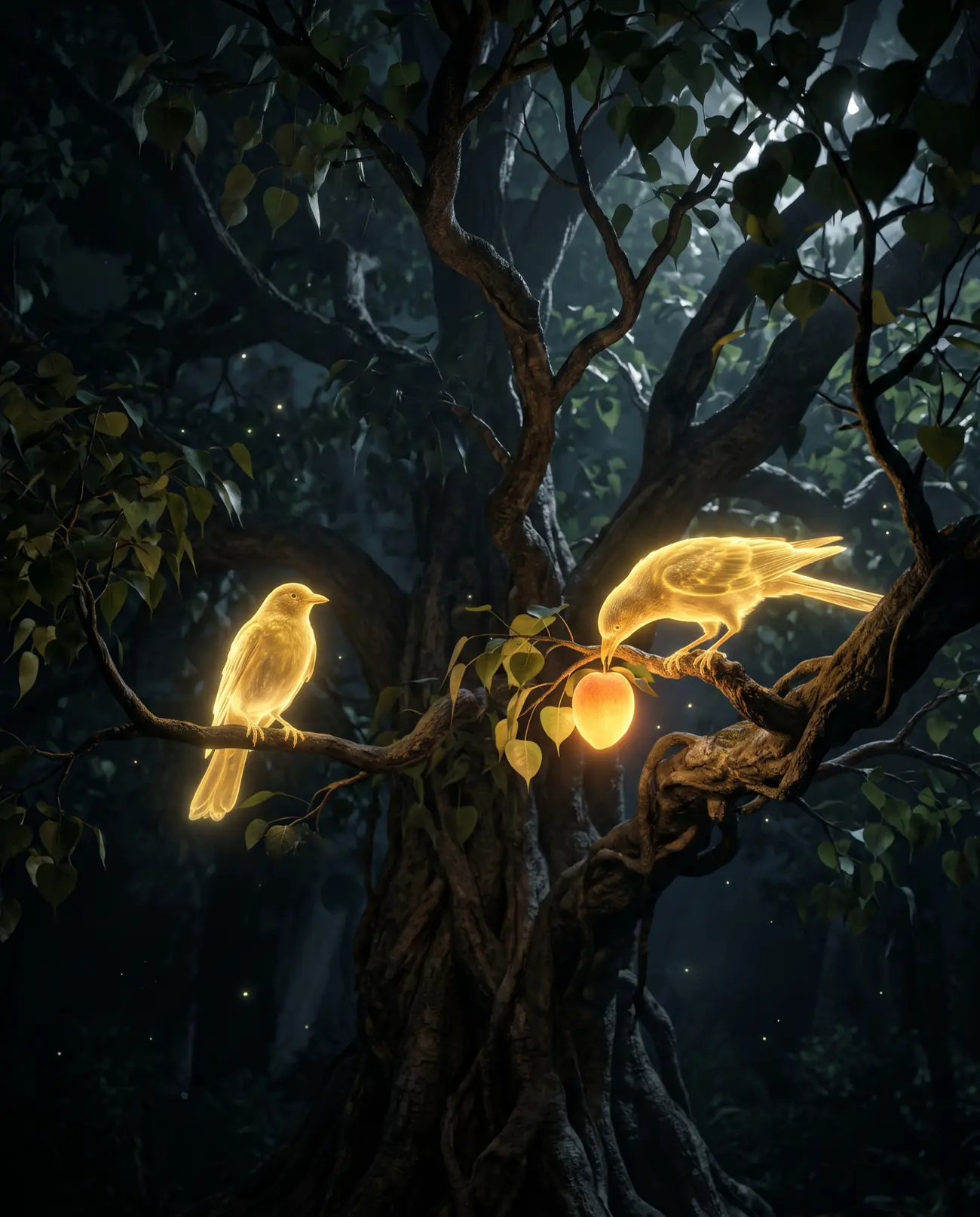
Of two birds on one tree, one eats the sweet fruit and the other only looks on. The verse's word is abhicākaśīti, 'looks on'; the commentators call this witness the Self.

Trace it in the graph →

  • Contrast with bhoktṛ in Muṇḍaka 3.1.1: Two birds, companions on one tree: one eats the sweet fruit, the other looks on.

तुरीय turīya the Fourth

Beyond waking, dream and deep sleep: the Self in itself, 'peaceful, auspicious, non-dual'.

Trace it in the graph →

पञ्चकोश pañca-kośa the five sheaths

The Taittirīya peels the person like layers: food, breath, mind, understanding and bliss, each finer than the last, the Self within them all.

Trace it in the graph →

आनन्द ānanda bliss

The joy that is not pleasure from objects but the nature of the Self; the Taittirīya measures every human and divine joy against it.

Trace it in the graph →

महावाक्य mahāvākya the great sayings

Four short sentences, one from each Veda, that state the identity of the Self and Brahman.

Trace it in the graph →

अक्षर akṣara the imperishable

That which does not decay: Yājñavalkya's answer to Gārgī, under whose command sun and moon stand apart.

Trace it in the graph →

अन्तर्यामिन् antaryāmin the inner controller

The one who dwells in every thing yet whom no thing knows, ruling it from within: Yājñavalkya's answer to Uddālaka.

Trace it in the graph →

मनस् manas the mind

The mind that thinks is itself driven: the Kena asks by whom it is sent forth.

Trace it in the graph →

गुहा guhā the cave of the heart

The Self is set in the secret place of the heart, smaller than the small and greater than the great.

Trace it in the graph →

एकत्व ekatva seeing the one in all

When one sees all beings in the Self and the Self in all beings, there is no delusion and no grief; to see difference is to go from death to death.

Trace it in the graph →

अभय abhaya fearlessness

Fear comes from a second; where there is no other, there is nothing to fear. Janaka is told he has reached fearlessness.

Trace it in the graph →

Practice & conduct 11

आचार्य ācārya the qualified teacher

The one who knows and can show. The Upanishads send the seeker to such a teacher, and warn that the truth taught by an inferior person is not understood.

Trace it in the graph →

तपस् tapas disciplined inquiry

Concentrated effort, here the effort of finding out for oneself. Varuṇa does not hand Bhṛgu the answer; he sends him to inquire.

Trace it in the graph →

स्वाध्याय svādhyāya one's own study

Study and recitation as one's own practice, never to be neglected, paired in the Taittirīya with teaching others.

Trace it in the graph →

दाम्यत दत्त दयध्वम् dāmyata, datta, dayadhvam restrain, give, be compassionate

Prajāpati answers gods, humans and demons with the same syllable, Da, and each hears what they most need: self-restraint, giving, compassion.

Trace it in the graph →

श्रद्धा śraddhā trust, faith

Not belief against evidence but the trust that makes one act and listen; it entered the boy Naciketas before he went to Death.

Trace it in the graph →

ऋत धर्म ṛta, dharma order and right

The cosmic order and the right way of living that answers to it; truth spoken is its first form.

Trace it in the graph →

त्याग tyāga letting go

Enjoy by renouncing: the Īśā's first verse, and Yājñavalkya's knowers of Brahman who rise above the desire for sons, wealth and worlds.

Trace it in the graph →

वैराग्य vairāgya dispassion

Seeing through what is made, one grows weary of it; dispassion is the doorway to the teacher, not a contempt for life.

Trace it in the graph →

यज्ञ yajña sacrifice, turned inward

The Upanishads keep the rite but move it within: a person's life is the sacrifice, and the rites alone are leaky boats.

Trace it in the graph →

परम्परा paramparā the line of teachers

Teaching passes from person to person: the Bṛhadāraṇyaka ends its books with the names of those who handed it down, back to Brahman itself.

Trace it in the graph →

गृहस्थ gṛhastha the householder's life

The Upanishads do not only speak to renunciants: family, children and continuity are part of a good life.

Trace it in the graph →

What binds 8

प्रेयस् preyas the pleasant

What gratifies now: wealth, praise, comfort, agreement. Not evil in itself, but binding when it is chosen for its own sake.

Trace it in the graph →

अभिमान abhimāna conceit

The pride of the one who thinks the victory, or the knowledge, is their own. In later texts this is ahaṃkāra.

Trace it in the graph →

इन्द्रिय indriya the senses (the horses)

The horses of the chariot. Unreined, they run wherever their objects pull them.

Trace it in the graph →

काम kāma desire

Desire as the seed of will and action: 'as one's desire is, so is one's will; as one's will, so one's deed.'

Trace it in the graph →

भोक्तृ bhoktṛ the one who eats the fruit

The bird that eats the sweet fruit: experience consumed for its taste, and the grief that follows.

Trace it in the graph →

कर्म karma action and its fruit

Deeds shape the doer: as one acts, so one becomes. The Upanishads accept the law and look for what is free of it.

Trace it in the graph →

पुनर्जन्म punarjanma rebirth

Living beings ripen like corn and are born again like corn; how one lives decides where one goes next.

Trace it in the graph →

मृत्यु mṛtyu death

The Kaṭha makes Death the teacher; the Bṛhadāraṇyaka says that in the beginning all this was covered by death, which is hunger.

Trace it in the graph →

The cosmos & its source 11

प्राण prāṇa breath, life-force

The breath that keeps the body alive, and in the Upanishads the power behind every faculty: when it leaves, the senses go with it.

Trace it in the graph →

देवयान पितृयाण devayāna, pitṛyāṇa the two paths after death

The path of the gods leads through flame and light and does not return; the path of the ancestors leads through smoke and the moon and comes back.

Trace it in the graph →

पुरुष puruṣa the Person

The cosmic Person of the Ṛgveda's hymn, taken inward: beyond the unmanifest there is nothing higher than the Person.

Trace it in the graph →

गुण guṇa the three qualities of nature

Red, white and black, passion, clarity and inertia: the strands of nature that bind the self until it sees through them.

Trace it in the graph →

माया māyā the power of appearance

The Lord's power that makes the one appear as many; the Śvetāśvatara names nature itself as māyā.

Trace it in the graph →

ईश्वर īśvara the Lord

God as the ruler within all things, hidden in every being; the Īśā and the Śvetāśvatara give the Upanishads' most devotional voice.

Trace it in the graph →

अन्न anna food, the body

Food is the first form of Brahman Bhṛgu learns: all beings are born of food and live by it.

Trace it in the graph →

सत् sat Being

In the beginning there was Being alone, one without a second; it thought, may I be many.

Trace it in the graph →

सृष्टि sṛṣṭi creation from the Self

The worlds are not made from outside material: the Self alone was, and it emitted them from itself, as a spider spins its thread.

Trace it in the graph →

हिरण्यगर्भ hiraṇyagarbha the golden womb

The first-born of creation, the cosmic mind; the Śvetāśvatara asks the Lord who brought him forth to give clear understanding.

Trace it in the graph →

रुद्र rudra Rudra, the Lord as Śiva

The Śvetāśvatara gives the Upanishads' theism its face: one Rudra, who stands against all beings and yet is kind.

Trace it in the graph →

Paths & practices 6

ॐ oṃ the syllable OM

The sacred syllable that stands for Brahman. Chanted, it gathers the mind; understood, it maps waking, dream, deep sleep and the Fourth.

Trace it in the graph →

मोक्ष mokṣa freedom

Release from bondage, not by going anywhere but by the knots of desire being cut while one still lives.

Trace it in the graph →

उपासना upāsanā, vidyā the meditations

Named meditations that teach one to see the whole in a single object: Śāṇḍilya's 'all this is Brahman', the space in the heart, the honey of the sun.

Trace it in the graph →

प्रसाद prasāda grace

The Self is not won by learning or cleverness alone; it reveals itself to the one it chooses, by the grace of the Creator.

Trace it in the graph →

योग yoga yoga, the stilling of the senses

Yoking the senses and mind until they are still; the Kaṭha's definition and the Śvetāśvatara's instruction are among the oldest in Indian thought.

Trace it in the graph →

अमृतत्व amṛtatva immortality

Not endless life in a body but freedom from the fear of death, reached by knowing the Self.

Trace it in the graph →

  • Contrast with mṛtyu in Kaṭha 2.3.14: Death is crossed not by escaping the body but by letting go of desire.

States of consciousness 1

अवस्थात्रय avasthā-traya waking, dream and deep sleep

The three states every person passes through each day; the Māṇḍūkya reads them as quarters of the Self, with the Fourth beyond them.

Trace it in the graph →

Glossary 60

Advaita अद्वैत
'Not two': the reading of the Upanishads in which the Self and Brahman are one reality.
Ahaṃkāra अहंकार
The 'I-maker': the sense of a separate ego, inflated by flattery and by false certainty.
Akṣara अक्षर
'Imperishable': Brahman as that which does not decay; also 'syllable', so OM. More →
Anuvāka अनुवाक
A lesson or section, the unit of recitation in the Taittirīya.
Avidyā अविद्या
Ignorance: not a lack of facts but taking oneself to be what one is not. More →
Bhāṣya भाष्य
A commentary that explains a text word by word; here, almost always Śaṅkara's.
Brahma Sūtra ब्रह्मसूत्र
Bādarāyaṇa's aphorisms that systematize the Upanishads' teaching; with the Upanishads and the Gītā, one of Vedānta's three sources.
Brahman ब्रह्मन्
The one Reality underlying everything that exists; the Upanishads teach that it is not other than the Self. More →
Brāhmaṇa ब्राह्मण
The prose layer of a Veda that explains the rituals; several Upanishads close a Brāhmaṇa.
Buddhi बुद्धि
The intellect that discerns and decides: the charioteer of the Kaṭha. More →
Devanagari देवनागरी
The script in which Sanskrit is usually written today.
Dharma धर्म
Right conduct and the order it upholds; what is fitting to do. More →
Guṇa गुण
One of nature's three strands: clarity (sattva), passion (rajas) and inertia (tamas). More →
IAST
A standard way of writing Sanskrit in Latin letters, with marks for long vowels and special sounds (ā, ṛ, ś, ṣ, ṃ).
Indriya इन्द्रिय
A sense-power: in the Kaṭha's chariot, the horses that run toward their objects. More →
Karma कर्म
Action, and the way actions shape the doer and what comes next. More →
Karuṇā करुणा
Compassion: truth delivered with care.
Khaṇḍa खण्ड
A section of a chapter.
Kośa कोश
A 'sheath' of the person: food, breath, mind, understanding and bliss, from outer to inner. More →
Kāma काम
Desire: as one's desire, so one's will; as one's will, so one's deed. More →
Mahāvākya महावाक्य
One of four 'great sayings' (such as 'that thou art') that state the identity of the Self and Brahman. More →
Manas मनस्
The mind that perceives and wants: the reins of the chariot. More →
Mantra मन्त्र
A verse or formula of the Veda, meant to be heard and chanted as well as read.
Mokṣa मोक्ष
Freedom: release from the cycle of birth and death, reached by knowing the Self. More →
Māyā माया
The power by which the one appears as many. More →
Neti neti नेति नेति
'Not this, not this': no description fits Brahman, so every description is set aside. More →
OM ॐ
The sacred syllable that stands for Brahman; its sounds map waking, dream, deep sleep and the silence beyond. More →
Prapāṭhaka प्रपाठक
A lesson or chapter, used in the Chāndogya and Maitrī.
Prasāda प्रसाद
Grace: the Self reveals itself to the one it chooses, not to effort alone. More →
Preyas प्रेयस्
The pleasant: what gratifies now, such as praise, comfort or agreement; not evil, but binding when chosen for its own sake. More →
Prāṇa प्राण
Breath, and the life-force behind every faculty; when it leaves the body, the senses go with it. More →
Puruṣa पुरुष
'The Person': the conscious principle, and in the Ṛgveda the cosmic being from whom all arose. More →
Satya सत्य
Truth, and the real; 'truth alone triumphs' is from the Muṇḍaka. More →
Saṃhitā संहिता
The collected hymns or formulas of a Veda, the oldest layer of the text.
Saṃsāra संसार
The round of births and deaths that continues as long as one acts from desire and ignorance.
Svādhyāya स्वाध्याय
One's own study: learning and recitation done by oneself, kept up for life. More →
Sākṣī साक्षी
The witness: the one who looks on, like the second bird that watches without eating. More →
Sāra सार
Essence: the Upanishads are called the sāra of the Vedas, the meaning their hymns and rites point to.
Sārathi सारथि
Charioteer: in the Kaṭha, the intellect that holds the reins of the mind; 'Upa-sārathi' is the charioteer who sits near. More →
Tapas तपस्
Disciplined effort, literally 'heat': the sustained inquiry by which Bhṛgu learned Brahman. More →
Tat tvam asi तत्त्वमसि
'That thou art': Uddālaka's teaching to his son that the subtle essence of all things is your own Self. More →
Turīya तुरीय
'The Fourth': pure awareness beyond waking, dream and deep sleep, present in all three. More →
Upaniṣad उपनिषद्
Literally 'sitting down near' a teacher: the philosophical closing teachings of each Veda.
Vallī वल्ली
A 'creeper': the name for a chapter in the Kaṭha and Taittirīya.
Veda वेद
'Knowledge': the four oldest scriptures of India (Ṛg, Yajur, Sāma, Atharva), of which the Upanishads are the closing part.
Vedānta वेदान्त
'The end of the Veda': the Upanishads, and the schools of thought built on them.
Vidyā विद्या
Knowledge; the higher vidyā is knowing the Imperishable, the lower is learning about the world. More →
Viveka विवेक
Discernment: telling the real from the apparent, and what you know from what you only hope. More →
Yoga योग
'Yoking': the steady holding of the senses and mind, defined in the Kaṭha. More →
Ācārya आचार्य
A qualified teacher; the Upanishads insist the Self is learned from one who has realized it. More →
Ānanda आनन्द
Bliss: the joy that is the Self's own nature, not borrowed from objects. More →
Āraṇyaka आरण्यक
'Forest book': the layer of a Veda that turns the ritual into meditation, bridging Brāhmaṇa and Upanishad.
Ātman आत्मन्
The Self: what you most essentially are, the awareness that witnesses every thought and state. More →
Īśvara ईश्वर
The Lord: God as ruler within all things. More →
Śaṅkara शङ्कर
Ādi Śaṅkara (c. 8th century), whose commentaries read the Upanishads as teaching one Self without a second (Advaita).
Śraddhā श्रद्धा
Trust: the confidence that makes one listen, act and keep inquiring. More →
Śreyas श्रेयस्
The good: what actually serves you over time, even when it is not what you want right now. More →
Śākhā शाखा
A 'branch': one school's recension of a Veda, with its own text of the hymns and teachings.
Śānti mantra शान्तिमन्त्र
The peace invocation chanted before and after a text, ending 'oṃ śāntiḥ śāntiḥ śāntiḥ'.
Ṛta ऋत
The cosmic order the Vedas praise; truth spoken is its human form. More →

Concepts, explanations and the links to mantras: UpaSārathi’s editorial notes (MIT).

Texts, translations and chant gathered by UpaSārathi (MIT); Sanskrit, transliteration and recitation from upanishads.org.in. Translations and commentaries belong to their translators and publishers, named on every passage. Sources