A Beautiful Mind
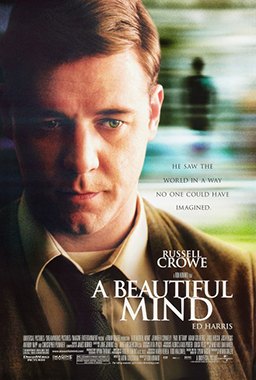
At a Glance
A brilliant mathematician's groundbreaking work is overshadowed by a decades-long battle with schizophrenia, as he slowly learns to tell his own mind's projections from reality.
Plot
John Nash arrives at Princeton as a mathematics prodigy convinced that a single, original idea will secure his legacy. He develops a governing dynamics theory that will later win him the Nobel Prize, while simultaneously believing he is recruited into secret code-breaking work for the government by a mysterious handler, William Parcher.
As Nash's life unravels, it becomes clear that Parcher, along with his college roommate Charles and Charles's young niece Marcee, exist only within Nash's mind — vivid, consistent hallucinations that his schizophrenia has sustained for years, indistinguishable to him from real people. His wife Alicia, alongside psychiatrist Dr. Rosen, helps him confront the diagnosis and begin a painful process of treatment.
Rather than banishing the hallucinations entirely, Nash learns, over years, to recognize them the instant they appear and consciously choose not to engage with them — a discipline that allows him to return to teaching and research, and eventually to be honored for the very insight that first defined his genius.
Characters & Roles
John Nash — The Mathematician
A gifted, socially awkward genius who must learn to distinguish the real world from his own mind's persuasive fabrications.
Alicia Nash — The Anchor
Nash's wife, whose steady presence and refusal to give up on him anchors him to shared reality through his worst years.
Charles Herman — The Hallucination
Nash's seemingly ordinary “roommate,” in fact a projection of his mind, representing companionship Nash's illness manufactures.
Marcee — The Hallucination's Niece
Charles's “niece,” a hallucinated child whose innocence makes Nash's delusions especially difficult for him to relinquish.
William Parcher — The Imagined Agent
A hallucinated government handler embodying Nash's paranoid fear of hidden threat and secret purpose.
Dr. Rosen — The Psychiatrist
The physician who diagnoses Nash and guides his difficult, incomplete recovery.
Philosophical Points
Reflections connecting the film to Vedantic themes of identity, illusion, karma, and the Self.